


Impact of HER-2 overexpression/amplification on the prognosis of gastric cancer patients undergoing resection: a single-center study of 1,036 patients
- PMID: 22143936
- PMCID: PMC3248769
- DOI: 10.1634/theoncologist.2011-0199
Impact of HER-2 overexpression/amplification on the prognosis of gastric cancer patients undergoing resection: a single-center study of 1,036 patients
Abstract
Background: Opinions regarding the impact of human epidermal growth factor receptor (HER)-2 overexpression or HER-2 amplification on the prognosis of gastric cancer patients are mixed. The present study attempted to clarify this issue by investigating a large cohort of surgical patients.
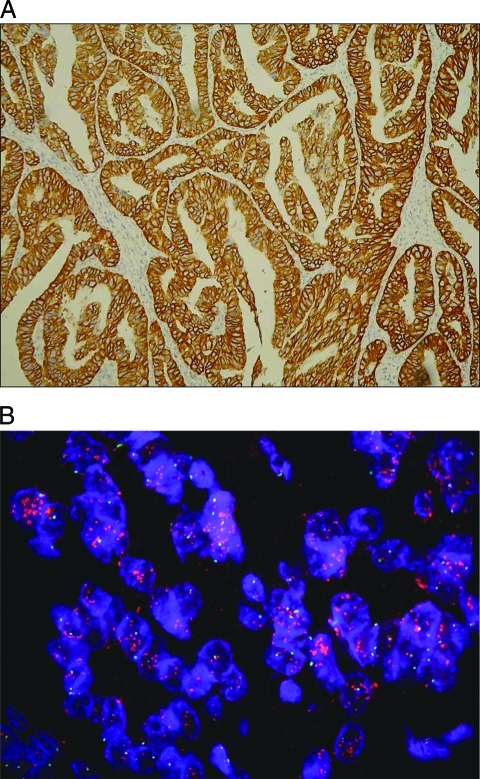
Methods: We investigated 1,036 gastric cancer patients undergoing curative-intent resection. Their surgical specimens were evaluated for HER-2 expression by immunohistochemistry (IHC), and those with HER-2 expression levels of 2+ were additionally subjected to fluorescence in situ hybridization (FISH). Data on demographic and clinicopathological features and relevant prognostic factors in these patients were analyzed.
Results: HER-2 positivity was noted in 64 (6.1%) of 1,036 gastric cancer patients, including 46 patients whose HER-2 expression level was 3+ on IHC and 18 patients whose FISH results were positive. On univariate analysis, HER-2 positivity was more often associated with differentiated histology, intestinal type, and negative resection margins, whereas only differentiated histology was independently associated with HER-2 positivity in a logistic regression model. For stage I-IV gastric cancer, HER-2 was not a prognostic factor. In a subpopulation study, although HER-2 positivity emerged as a favorable prognostic factor for stage III-IV gastric cancer on univariate analysis, it failed to be an independent prognostic factor after multivariate adjustment.
Conclusions: The prevalence of HER-2 positivity, determined using standardized assays and scoring criteria in a large cohort of gastric cancer patients after resection, was 6.1%. HER-2 positivity was phenotypically associated with differentiated histology. HER-2 is not an independent prognostic factor for gastric cancer.
Conflict of interest statement
Figures
References
-
- Jemal A, Siegel R, Xu J, et al. Cancer statistics, 2010. CA Cancer J Clin. 2010;60:277–300. - PubMed
-
- Dikken JL, Jansen EP, Cats A, et al. Impact of the extent of surgery and postoperative chemoradiotherapy on recurrence patterns in gastric cancer. J Clin Oncol. 2010;28:2430–2436. - PubMed
-
- Van Cutsem E, Moiseyenko VM, Tjulandin S, et al. Phase III study of docetaxel and cisplatin plus fluorouracil compared with cisplatin and fluorouracil as first-line therapy for advanced gastric cancer: A report of the V325 Study Group. J Clin Oncol. 2006;24:4991–4997. - PubMed
-
- Cunningham D, Starling N, Rao S, et al. Capecitabine and oxaliplatin for advanced esophagogastric cancer. N Engl J Med. 2008;358:36–46. - PubMed
-
- Gravalos C, Jimeno A. HER2 in gastric cancer: A new prognostic factor and a novel therapeutic target. Ann Oncol. 2008;19:1523–1529. - PubMed
Publication types
MeSH terms
Substances
LinkOut - more resources
Full Text Sources
Medical
Research Materials
Miscellaneous
