


A single-nucleotide polymorphism in the methylene tetrahydrofolate reductase (MTHFR) gene is associated with risk of radiation pneumonitis in lung cancer patients treated with thoracic radiation therapy
- PMID: 22144047
- PMCID: PMC3312983
- DOI: 10.1002/cncr.26667
A single-nucleotide polymorphism in the methylene tetrahydrofolate reductase (MTHFR) gene is associated with risk of radiation pneumonitis in lung cancer patients treated with thoracic radiation therapy
Abstract
Background: This study examined the association between functional single-nucleotide polymorphisms in candidate genes from oxidative stress pathways and risk of radiation pneumonitis (RP) in patients treated with thoracic radiation therapy for locally advanced lung cancer.
Methods: A review was conducted of 136 patients treated with radiation therapy for lung cancer between 2001 and 2007, and who had prior genotyping of functional single-nucleotide polymorphisms in oxidative stress genes including superoxide dismutase 2 (SOD2; rs4880) and methylene tetrahydrofolate reductase (MTHFR; rs1801131, rs1801133). RP events were retrospectively scored using the National Cancer Institute Common Terminology Criteria for Adverse Events, version 4.0. Cox proportional hazard regression was performed to identify clinical variables and genotypes associated with risk of RP of grades ≥2 and ≥3 on univariate and multivariate analysis, respectively. P values were corrected for multiple hypothesis esting.
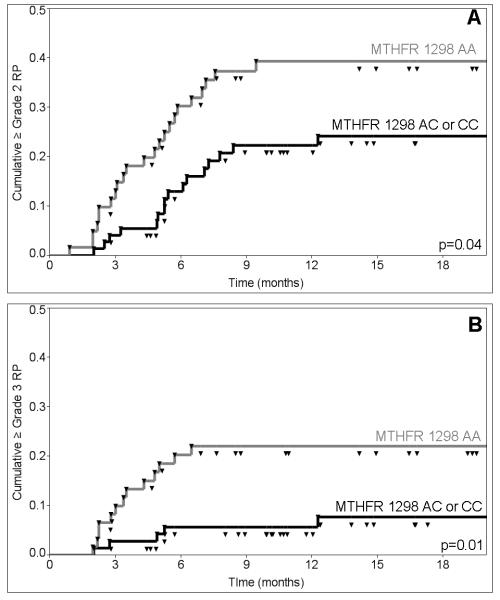
Results: With a median follow-up of 21.4 months, the incidence of grade ≥2 RP was 29% and grade ≥3 RP was 14%. On multivariate analysis, after adjusting for clinical factors such as concurrent chemotherapy and consolidation docetaxel, and lung dosimetric parameters such as volume receiving greater than 20 Gy and mean lung dose, MTHFR genotype (rs1801131; AA versus AC/CC) was significantly associated with risk of grade ≥2 RP (hazard ratio: 0.37; 95% confidence interval: 0.18-0.76; P = .006, corrected P = .018) and grade ≥3 RP (hazard ratio: 0.21; 95% confidence interval: 0.06-0.70; P = .01; corrected P = .03). SOD2 genotype was not associated with RP.
Conclusions: This study showed an association between MTHFR genotype and risk of clinically significant RP. Further study of MTHFR-related pathways may provide insight into the mechanisms behind RP.
Copyright © 2011 American Cancer Society.
Figures
Comment in
-
Predicting toxicity from radiation therapy--it's genetic, right?Cancer. 2012 Jul 15;118(14):3450-4. doi: 10.1002/cncr.26670. Epub 2011 Dec 5. Cancer. 2012. PMID: 22144075 Free PMC article. No abstract available.
References
-
- Yom SS, Liao Z, Liu HH, Tucker SL, Hu CS, Wei X, Wang X, Wang S, Mohan R, Cox JD, Komaki R. Initial evaluation of treatment-related pneumonitis in advanced-stage non-small-cell lung cancer patients treated with concurrent chemotherapy and intensity-modulated radiotherapy. Int J Radiat Oncol Biol Phys. 2007;68(1):94–102. Available from http://www.ncbi.nlm.nih.gov/pubmed/17321067. - PubMed
-
- Curran W, Scott C, Langer C, et al. Long-term benefit is observed in a phase III comparison of sequential vs concurrent chemo-radiation for patients with unresected stage III non small cell lung cancer: RTOG 9410 (abstract) Proc Am Soc Clin Oncol. 2003;22
-
- Furuse K, Fukuoka M, Kawahara M, Nishikawa H, Takada Y, Kudoh S, et al. Phase III study of concurrent versus sequential thoracic radiotherapy in combination with mitomycin, vindesine, and cisplatin in unresectable stage III non-small-cell lung cancer. J Clin Oncol. 1999;17(9):2692–9. Available from http://www.ncbi.nlm.nih.gov/entrez/query.fcgi?cmd=Retrieve&db=PubMed&dop.... - PubMed
-
- Hanna N, Neubauer M, Yiannoutsos C, McGarry R, Arseneau J, Ansari R, et al. Phase III study of cisplatin, etoposide, and concurrent chest radiation with or without consolidation docetaxel in patients with inoperable stage III non-small-cell lung cancer: the Hoosier Oncology Group and U.S. Oncology. J Clin Oncol. 2008;26(35):5755–60. Available from http://www.ncbi.nlm.nih.gov/entrez/query.fcgi?cmd=Retrieve&db=PubMed&dop.... - PubMed
-
- Graham MV, Purdy JA, Emami B, Harms W, Bosch W, Lockett MA, et al. Clinical dose-volume histogram analysis for pneumonitis after 3D treatment for non-small cell lung cancer (NSCLC) Int J Radiat Oncol Biol Phys. 1999;45(2):323–9. Available from http://www.ncbi.nlm.nih.gov/entrez/query.fcgi?cmd=Retrieve&db=PubMed&dop.... - PubMed
Publication types
MeSH terms
Substances
Grants and funding
LinkOut - more resources
Full Text Sources
Medical
