The combination of indoor residual spraying and insecticide-treated nets provides added protection against malaria compared with insecticide-treated nets alone
- PMID: 22144448
- PMCID: PMC3225156
- DOI: 10.4269/ajtmh.2011.10-0684
The combination of indoor residual spraying and insecticide-treated nets provides added protection against malaria compared with insecticide-treated nets alone
Abstract
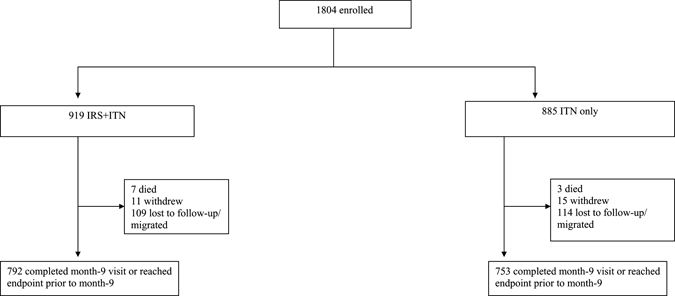
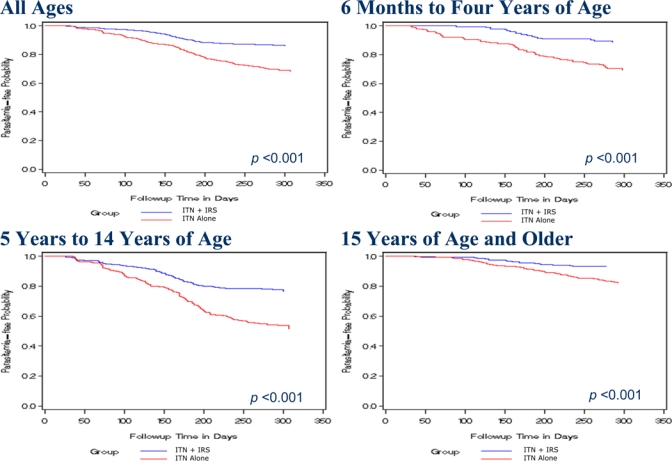
Both insecticide-treated bed nets (ITNs) and indoor residual spraying (IRS) reduce malaria in high malaria transmission areas. The combined effect of these interventions is unknown. We conducted a non-randomized prospective cohort study to determine protective efficacy of IRS with ITNs (ITN + IRS) compared with ITNs alone (ITN only) in preventing Plasmodium falciparum parasitemia. At baseline, participants provided blood samples for malaria smears, were presumptively treated for malaria, and received ITNs. Blood smears were made monthly and at sick visits. In total, 1,804 participants were enrolled. Incidence of P. falciparum parasitemia in the ITN + IRS and ITN only groups was 18 and 44 infections per 100 persons-years at risk, respectively (unadjusted rate ratio = 0.41; 95% confidence interval [CI] = 0.31-0.56). Adjusted protective efficacy of ITN + IRS compared with ITN only was 62% (95% CI = 0.50-0.72). The combination of IRS and ITN might be a feasible strategy to further reduce malaria transmission in areas of persistent perennial malaria transmission.
Figures
References
-
- Lengeler C. Insecticide-treated bed nets and curtains for preventing malaria. Cochrane Database Syst Rev. 2004;2:CD000363. - PubMed
-
- World Health Organization Malaria Key Facts Sheet. 2010. http://www.who.int/mediacentre/factsheets/fs094/en/ Available at. Accessed May 25, 2011.
-
- United Nations. The Millenium Development Goals Report. New York, NY: United Nations; 2009. p. 60.
Publication types
MeSH terms
Substances
LinkOut - more resources
Full Text Sources
Medical