Feeding cells induced by phytoparasitic nematodes require γ-tubulin ring complex for microtubule reorganization
- PMID: 22144887
- PMCID: PMC3228788
- DOI: 10.1371/journal.ppat.1002343
Feeding cells induced by phytoparasitic nematodes require γ-tubulin ring complex for microtubule reorganization
Abstract
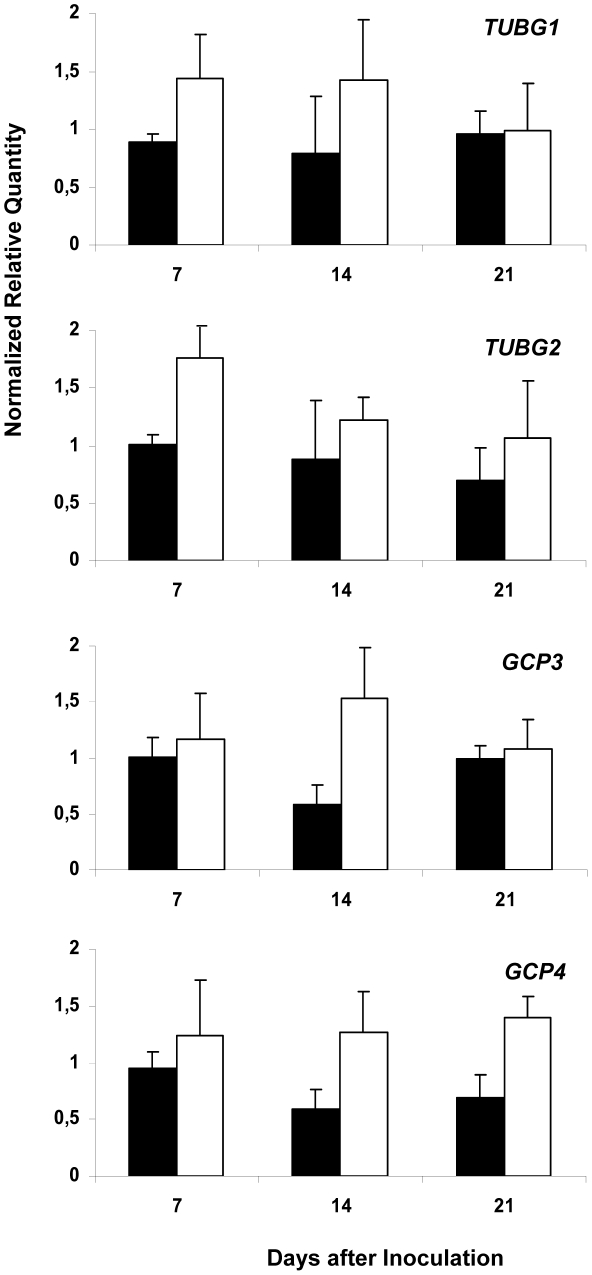
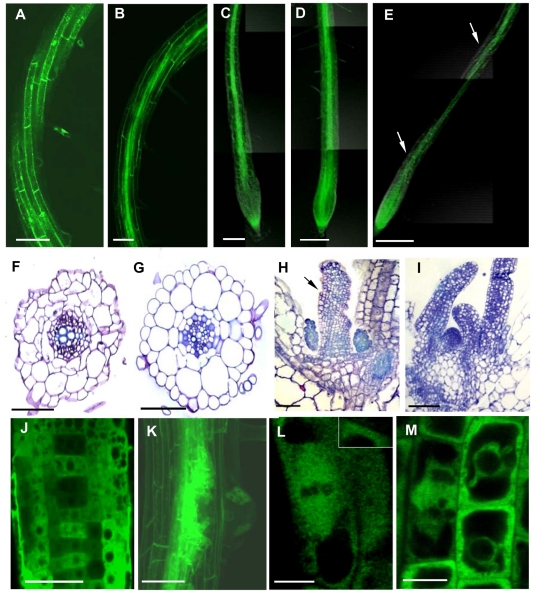
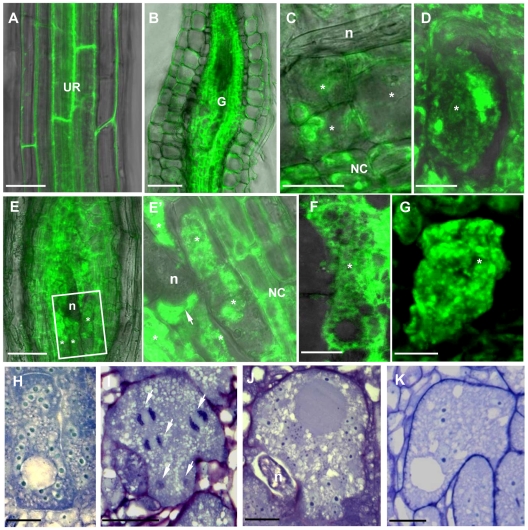
Reorganization of the microtubule network is important for the fast isodiametric expansion of giant-feeding cells induced by root-knot nematodes. The efficiency of microtubule reorganization depends on the nucleation of new microtubules, their elongation rate and activity of microtubule severing factors. New microtubules in plants are nucleated by cytoplasmic or microtubule-bound γ-tubulin ring complexes. Here we investigate the requirement of γ-tubulin complexes for giant feeding cells development using the interaction between Arabidopsis and Meloidogyne spp. as a model system. Immunocytochemical analyses demonstrate that γ-tubulin localizes to both cortical cytoplasm and mitotic microtubule arrays of the giant cells where it can associate with microtubules. The transcripts of two Arabidopsis γ-tubulin (TUBG1 and TUBG2) and two γ-tubulin complex proteins genes (GCP3 and GCP4) are upregulated in galls. Electron microscopy demonstrates association of GCP3 and γ-tubulin as part of a complex in the cytoplasm of giant cells. Knockout of either or both γ-tubulin genes results in the gene dose-dependent alteration of the morphology of feeding site and failure of nematode life cycle completion. We conclude that the γ-tubulin complex is essential for the control of microtubular network remodelling in the course of initiation and development of giant-feeding cells, and for the successful reproduction of nematodes in their plant hosts.
Conflict of interest statement
The authors have declared that no competing interests exist.
Figures




References
-
- Jansky SH, Simon R, Spooner DM. A test of taxonomic predictivity: Resistance to early blight in wild relatives of cultivated potato. Phytopathology. 2008;98:680–687. - PubMed
-
- Wyss U, Grundler FMW, Munch A. The parasitic behavior of second-stage juveniles of Meloidogyne incognita in roots of Arabidopsis thaliana. Nematologica. 1992;38:98–111.
-
- Von Mende N. Invasion and migration behaviour of sedentary nematodes. In: Fenoll C, Grundler FMW, Ohl SA, editors. Cellular and molecular aspects of plant-nematodes interactions. Vol. 21. Dordrecht, The Netherlands: Kluwer Academics Publishers; 1997. pp. 1129–1140.
-
- Jones MGK. The development and function of plant cells modified by endoparasitic nematodes. In: Zuckerman BM, Rhode RA, editors. Plant Parasitic Nematodes. New York: Academic Press; 1981. pp. 225–279.
-
- Wiggers RJ, Starr JL, Price HJ. DNA content and variation in chromosome number in plant cells affected by Meloidogyne incognita and M. arenaria. Phytopathology. 1990;80:1391–1395.
MeSH terms
Substances
LinkOut - more resources
Full Text Sources
Other Literature Sources
Molecular Biology Databases
Miscellaneous