. 2011 Dec;7(12):e1002398.
doi: 10.1371/journal.pgen.1002398. Epub 2011 Dec 1.

Widespread cotranslational formation of protein complexes

Affiliations

Widespread cotranslational formation of protein complexes

Caia D S Duncan et al. PLoS Genet. 2011 Dec.

Abstract

Most cellular processes are conducted by multi-protein complexes. However, little is known about how these complexes are assembled. In particular, it is not known if they are formed while one or more members of the complexes are being translated (cotranslational assembly). We took a genomic approach to address this question, by systematically identifying mRNAs associated with specific proteins. In a sample of 31 proteins from Schizosaccharomyces pombe that did not contain RNA-binding domains, we found that ∼38% copurify with mRNAs that encode interacting proteins. For example, the cyclin-dependent kinase Cdc2p associates with the rum1 and cdc18 mRNAs, which encode, respectively, an inhibitor of Cdc2p kinase activity and an essential regulator of DNA replication. Both proteins interact with Cdc2p and are key cell cycle regulators. We obtained analogous results with proteins with different structures and cellular functions (kinesins, protein kinases, transcription factors, proteasome components, etc.). We showed that copurification of a bait protein and of specific mRNAs was dependent on the presence of the proteins encoded by the interacting mRNAs and on polysomal integrity. These results indicate that these observed associations reflect the cotranslational interaction between the bait and the nascent proteins encoded by the interacting mRNAs. Therefore, we show that the cotranslational formation of protein-protein interactions is a widespread phenomenon.


Conflict of interest statement

The authors have declared that no competing interests exist.

Figures

Figure 1
Figure 1. Cotranslational assembly of the Tea2p-Tip1p complex.
(A) RIp-chip experiments with Tea2p. The y axis shows the log10 enrichment ratios in Tea2p RIp-chip experiments, standardised to make the mean and standard deviation equal to 0 and 1, respectively. The box plots show the distribution of enrichments, with the box showing the lower and upper quartiles, the whiskers representing data within the upper/lower quartile plus/minus 1.5-fold the interquartile range, and other data points displayed as circles. White circles represent mRNAs not considered significant (either because they are common contaminants in multiple RIp-chip experiments, or because they were not reproducibly enriched in independent replicas of the experiment), black circles correspond to mRNAs encoding the bait, and grey circles are used for mRNAs specifically associated with the bait protein. Left: Tea2p copurifies with wild type tip1 (+ATG), but not with tip1 that cannot be translated (−ATG). Right: The interaction between Tea2p and the tip1 and tea2 mRNAs is lost upon treatment of the cells with puromycin. (B) Three models to explain the association between Tea2p and the tip1 mRNA (see text for details). (C) Design of the −ATG experiment coupled to RIp-chip analysis. A single nucleotide mutation to the start codon prevents the translation of tip1. If the association between Tea2p and tip1 is cotranslational, lack of Tip1p should abolish their interaction.
Figure 2
Figure 2. Many proteins that lack RNA–binding domains associate specifically with small numbers of mRNAs.
Box plots of the distribution of enrichments for 12 RIp-chip experiments. The y axis shows normalised log10 enrichment ratios in the corresponding RIp-chip experiments (see Figure 1 for details). For each protein, a representative experiment is presented. Black circles show the mRNA encoded by the bait protein used for the RIp-chip experiment, and grey circles other mRNAs that were consistently enriched in independent biological experiments. White circles represent mRNAs not considered significant, either because they are common contaminants in multiple RIp-chip experiments, or because they were not reproducibly enriched in independent replicas of the experiment. The dashed line at two standard deviations above the mean shows the threshold used to define mRNA enrichment.
Figure 3
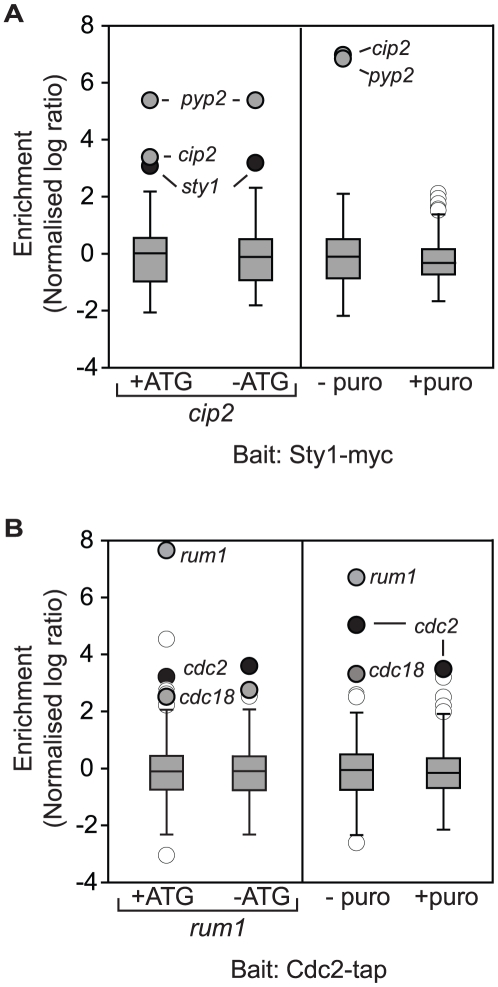
Figure 3. Cotranslational association of Cdc2p-Rum1p and Sty1p-Cip2p.
Box plots of the distribution of normalised log10 enrichments for RIp-chip experiments with (A) Sty1p and (B) Cdc2p (see legend to Figure 1 for details). The left panels show the comparison between −ATG cells and the corresponding wild type controls. The right panels display the comparison between cells incubated with puromycin and a mock-treated control. mRNAs encoding the bait are shown in black, mRNAs not considered significant are displayed in white, and other significant mRNAs are presented in grey.

References

    1. Fulton AB, L'Ecuyer T. Cotranslational assembly of some cytoskeletal proteins: implications and prospects. J Cell Sci. 1993;105:867–871. - PubMed
    1. Lu J, Robinson JM, Edwards D, Deutsch C. T1-T1 interactions occur in ER membranes while nascent Kv peptides are still attached to ribosomes. Biochemistry. 2001;40:10934–10946. - PubMed
    1. Phartiyal P, Jones EM, Robertson GA. Heteromeric assembly of human ether-a-go-go-related gene (hERG) 1a/1b channels occurs cotranslationally via N-terminal interactions. J Biol Chem. 2007;282:9874–9882. - PubMed
    1. Lin L, DeMartino GN, Greene WC. Cotranslational dimerization of the Rel homology domain of NF-kappaB1 generates p50-p105 heterodimers and is required for effective p50 production. Embo J. 2000;19:4712–4722. - PMC - PubMed
    1. Nicholls CD, McLure KG, Shields MA, Lee PW. Biogenesis of p53 involves cotranslational dimerization of monomers and posttranslational dimerization of dimers. Implications on the dominant negative effect. J Biol Chem. 2002;277:12937–12945. - PubMed

Publication types

MeSH terms