


doi: 10.1038/nphoton.2011.100.
Optical tweezers study life under tension
Affiliations
- PMID: 22145010
- PMCID: PMC3229214
- DOI: 10.1038/nphoton.2011.100
Item in Clipboard
Optical tweezers study life under tension
Nat Photonics.
.
Abstract
Optical tweezers have become one of the primary weapons in the arsenal of biophysicists, and have revolutionized the new field of single-molecule biophysics. Today's techniques allow high-resolution experiments on biological macromolecules that were mere pipe dreams only a decade ago.
Figures
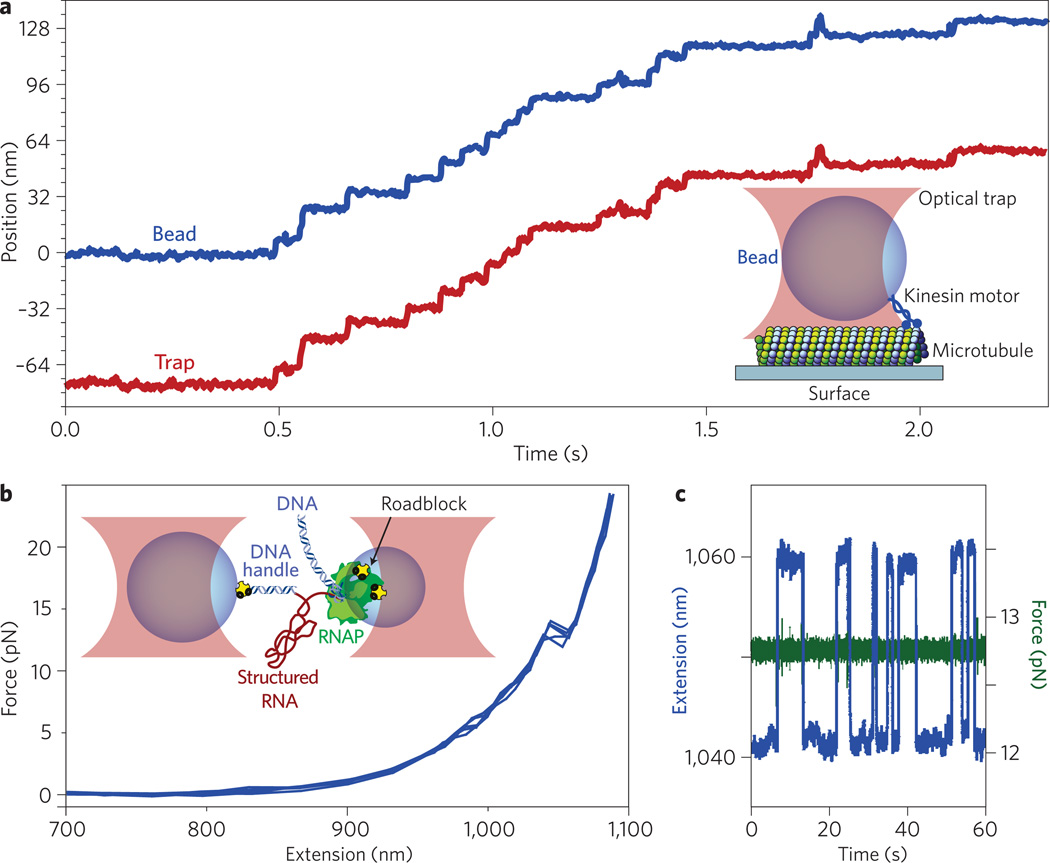
Biological applications of optical tweezers to kinesin motor stepping and RNA folding. a, Record of motion for a single kinesin motor under force-clamped conditions, displaying discrete, 8 nm steps (blue trace) as it walks along a microtubule (inset, not to scale). The trap position is servoed under computer control to maintain a fixed distance behind the bead, thereby imposing a load of a few piconewtons in a direction that hinders movement (red trace). b,c, Unfolding of a structured RNA molecule (red, inset, not to scale) using a dual-beam optical trap arrangement (pink), producing out-of-equilibrium transitions (‘rips’) as the structure unfolds under a force ramp (b) or reversible, thermally driven fluctuations in extension when clamped near equilibrium (c). To exert forces on the ends of the RNA molecule, it is hybridized at one end to a DNA ‘handle’ (blue), which is chemically (yellow) linked to the left bead (blue). The RNA emerges at its other end as a transcript from RNAP (green), which is chemically attached to the right bead (blue). The RNAP molecule is transcriptionally stalled at a roadblock (yellow) placed on the DNA template (blue).
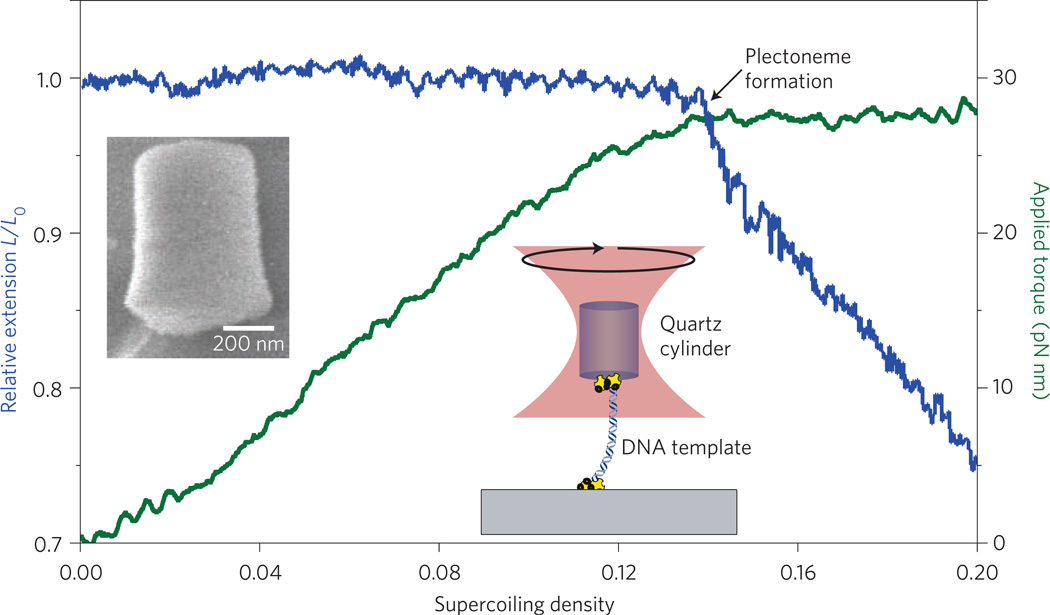
Twisting DNA with an optical torque wrench. Inset, left: scanning electron micrograph of a nanofabricated quartz cylinder. Inset, right: schematic of the experimental set-up (not to scale), in which a DNA molecule is tethered to the cylinder at one end and to a glass surface at the other. Here, the DNA is stretched by a force of 3 pN and twisted at a constant rate of 0.5 turns per second. The relative extension of the DNA (blue trace) and the applied torque (green trace) are plotted as a function of the supercoiling density, which indicates the degree of twist introduced. When the supercoiling density is around 0.14, the coiled DNA undergoes a phase transition from a twisted to a plectonemic form, which is indicated by the plateau in the applied torque and the monotonic decrease in relative extension.
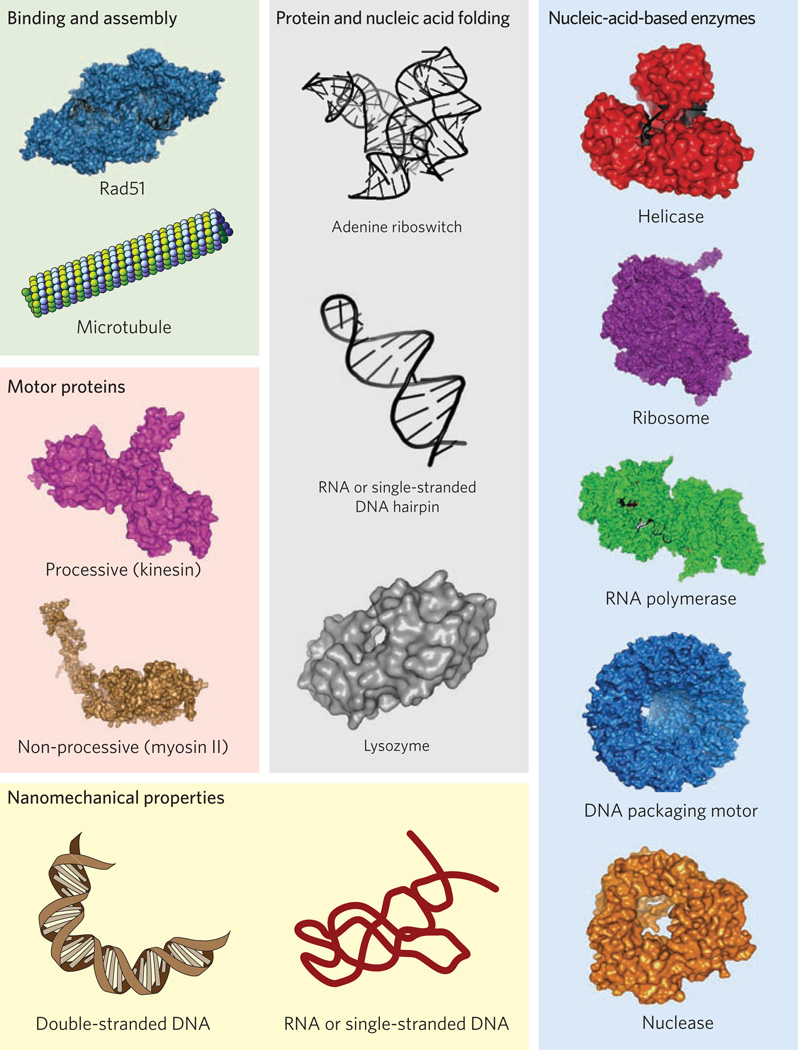
Examples of the diverse protein and nucleic acid systems that have been studied using optical tweezers, ranging in complexity from simple hairpins, formed in RNA or double-stranded DNA, to the bacterial ribosome, a macromolecular machine comprised of over 50 protein subunits and three structured RNA molecules (not to scale). The systems have been grouped into categories (boxes).
References
-
- Ashkin A, Dziedzic JM, Bjorkholm JE, Chu S. Opt. Lett. 1986;11:288–290. - PubMed
-
- Svoboda K, Block SM. Ann. Rev. Biophys. Biomol. Struct. 1994;23:247–285. - PubMed
-
- Svoboda K, Schmidt CF, Schnapp BJ, Block SM. Nature. 1993;365:721–727. - PubMed
-
- Finer JT, Simmons RM, Spudich JA. Nature. 1994;368:113–119. - PubMed
Grants and funding
LinkOut - more resources
Full Text Sources
Other Literature Sources