


doi: 10.4061/2011/308730.
Epub 2011 Nov 17.
Cellulases from thermophilic fungi: recent insights and biotechnological potential
Affiliations
- PMID: 22145076
- PMCID: PMC3226318
- DOI: 10.4061/2011/308730
Item in Clipboard
Cellulases from thermophilic fungi: recent insights and biotechnological potential
Enzyme Res.
2011.
Abstract
Thermophilic fungal cellulases are promising enzymes in protein engineering efforts aimed at optimizing industrial processes, such as biomass degradation and biofuel production. The cloning and expression in recent years of new cellulase genes from thermophilic fungi have led to a better understanding of cellulose degradation in these species. Moreover, crystal structures of thermophilic fungal cellulases are now available, providing insights into their function and stability. The present paper is focused on recent progress in cloning, expression, regulation, and structure of thermophilic fungal cellulases and the current research efforts to improve their properties for better use in biotechnological applications.
Figures
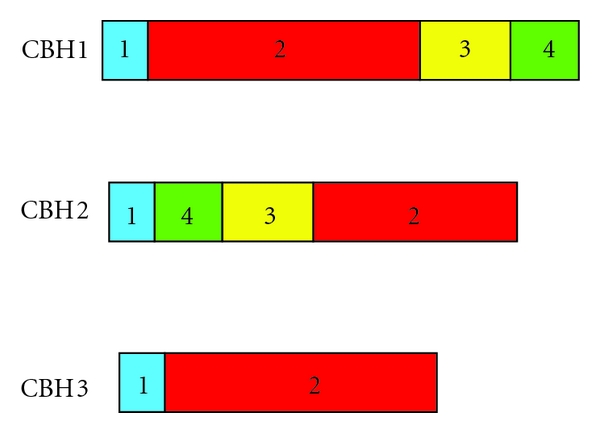
Domain organization of cellobiohydrolases CBH1 (AY861347), CBH2 (AY861348), and CBH3 of C. thermophilum (DQ085790) [16]. 1: signal peptide region, 2: catalytic domain, 3: hinge region, 4: cellulose-binding domain.

Ribbon diagrams of known thermophilic fungal cellulase structures. The catalytic residues are shown in stick representation. (a) T. aurantiacus family 5 endoglucanase (PDB id 1GZJ), F5 (b) H. insolens family 6 endoglucanase Cel6B (PDB id 1DYS), (c) H. insolens family 7 endoglucanase EGI (PDB id 2A39), (d) M. albomyces family 7 cellobiohydrolase in complex with cellotetraose (PDB id 2RG0), (e) catalytic domain of H. grisea family 12 Cel12A in complex with cellobiose (PDB id 1UU4), (f) M. albomyces family 45 endoglucanase in complex with cellobiose (PDB id 1OA7). α-Helices are shown in coral and β-strands in cyan. Bound ligands are depicted in stick representation and colored according to atom type. The figures of the structures were created with the CCP4 molecular graphics program [50].
References
-
- Wilson DB. Cellulases and biofuels. Current Opinion in Biotechnology. 2009;20(3):295–299. - PubMed
-
- Sukumaran RK, Surender VJ, Sindhu R, et al. Lignocellulosic ethanol in India: prospects, challenges and feedstock availability. Bioresource Technology. 2010;101(13):4826–4833. - PubMed
-
- Vlasenko E, Schülein M, Cherry J, Xu F. Substrate specificity of family 5, 6, 7, 9, 12, and 45 endoglucanases. Bioresource Technology. 2010;101(7):2405–2411. - PubMed
-
- Suto M, Tomita F. Induction and catabolite repression mechanisms of cellulase in fungi. Journal of Bioscience and Bioengineering. 2001;92(4):305–311. - PubMed
LinkOut - more resources
Full Text Sources
Other Literature Sources
