


Erythropoietin attenuates the sequels of ischaemic spinal cord injury with enhanced recruitment of CD34+ cells in mice
- PMID: 22145921
- PMCID: PMC3822692
- DOI: 10.1111/j.1582-4934.2011.01489.x
Erythropoietin attenuates the sequels of ischaemic spinal cord injury with enhanced recruitment of CD34+ cells in mice
Abstract
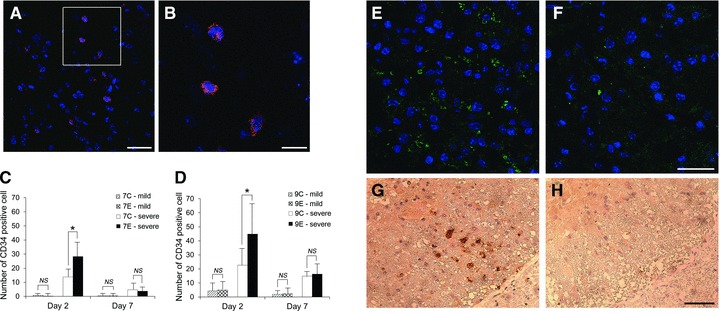
Erythropoietin has been shown to promote tissue regeneration after ischaemic injury in various organs. Here, we investigated whether Erythropoietin could ameliorate ischaemic spinal cord injury in the mouse and sought an underlying mechanism. Spinal cord ischaemia was developed by cross-clamping the descending thoracic aorta for 7 or 9 min. in mice. Erythropoietin (5000 IU/kg) or saline was administrated 30 min. before aortic cross-clamping. Neurological function was assessed using the paralysis score for 7 days after the operation. Spinal cords were histologically evaluated 2 and 7 days after the operation. Immunohistochemistry was used to detect CD34(+) cells and the expression of brain-derived neurotrophic factor and vascular endothelial growth factor. Each mouse exhibited either mildly impaired function or complete paralysis at day 2. Erythropoietin-treated mice with complete paralysis demonstrated significant improvement of neurological function between day 2 and 7, compared to saline-treated mice with complete paralysis. Motor neurons in erythropoietin-treated mice were more preserved at day 7 than those in saline-treated mice with complete paralysis. CD34(+) cells in the lumbar spinal cord of erythropoietin-treated mice were more abundant at day 2 than those of saline-treated mice. Brain-derived neurotrophic factor and vascular endothelial growth factor were markedly expressed in lumbar spinal cords in erythropoietin-treated mice at day 7. Erythropoietin demonstrated neuroprotective effects in the ischaemic spinal cord, improving neurological function and attenuating motor neuron loss. These effects may have been mediated by recruited CD34(+) cells, and enhanced expression of brain-derived neurotrophic factor and vascular endothelial growth factor.
© 2012 The Authors Journal of Cellular and Molecular Medicine © 2012 Foundation for Cellular and Molecular Medicine/Blackwell Publishing Ltd.
Figures
References
-
- Wong DR, Parenti JL, Green SY, et al. Open repair of thoracoabdominal aortic aneurysm in the modern surgical era: contemporary outcomes in 509 patients. J Am Coll Surg. 2011;212:569–79. - PubMed
-
- Conrad MF, Crawford RS, Davison JK, et al. Thoracoabdominal aneurysm repair: a 20-year perspective. Ann Thorac Surg. 2007;83:856–61. - PubMed
-
- Wong DR, Coselli JS, Amerman K, et al. Delayed spinal cord deficits after thoracoabdominal aortic aneurysm repair. Ann Thorac Surg. 2007;83:1345–55. - PubMed
-
- Bavaria JE, Appoo JJ, Makaroun MS, et al. Endovascular stent grafting versus open surgical repair of descending thoracic aortic aneurysms in low-risk patients: a multicenter comparative trial. J Thorac Cardiovasc Surg. 2007;133:369–77. - PubMed
Publication types
MeSH terms
Substances
LinkOut - more resources
Full Text Sources
Medical
