. 2012 Mar;103(3):535-41.
doi: 10.1111/j.1349-7006.2011.02178.x. Epub 2012 Jan 16.

Carbon monoxide, generated by heme oxygenase-1, mediates the enhanced permeability and retention effect in solid tumors

Affiliations

Carbon monoxide, generated by heme oxygenase-1, mediates the enhanced permeability and retention effect in solid tumors

Jun Fang et al. Cancer Sci. 2012 Mar.

Abstract

The enhanced permeability and retention (EPR) effect is a unique pathophysiological phenomenon of solid tumors that sees biocompatible macromolecules (>40 kDa) accumulate selectively in the tumor. Various factors have been implicated in this effect. Herein, we report that heme oxygenase-1 (HO-1; also known as heat shock protein 32) significantly increases vascular permeability and thus macromolecular drug accumulation in tumors. Intradermal injection of recombinant HO-1 in mice, followed by i.v. administration of a macromolecular Evans blue-albumin complex, resulted in dose-dependent extravasation of Evans blue-albumin at the HO-1 injection site. Almost no extravasation was detected when inactivated HO-1 or a carbon monoxide (CO) scavenger was injected instead. Because HO-1 generates CO, these data imply that CO plays a key role in vascular leakage. This is supported by results obtained after intratumoral administration of a CO-releasing agent (tricarbonyldichlororuthenium(II) dimer) in the same experimental setting, specifically dose-dependent increases in vascular permeability plus augmented tumor blood flow. In addition, induction of HO-1 in tumors by the water-soluble macromolecular HO-1 inducer pegylated hemin significantly increased tumor blood flow and Evans blue-albumin accumulation in tumors. These findings suggest that HO-1 and/or CO are important mediators of the EPR effect. Thus, anticancer chemotherapy using macromolecular drugs may be improved by combination with an HO-1 inducer, such as pegylated hemin, via an enhanced EPR effect.


Figures

Figure 1
Figure 1
Effect of heme oxygenase‐1 (HO‐1) on vascular permeability of the dorsal skin in normal mice. Recombinant HO‐1 protein and other agents were administered i.d., followed by i.v. injection of Evans blue (10 mg/kg). The dye was allowed to extravasate for 2 h. (a) Representative image showing the extravasation of blue dye caused by each agent. (b) Quantification of the extravasation of Evans blue from the skin tissues. Alb, albumin. Data are the mean ± SEM (n =3–4). *P <0.05, **P <0.01.
Figure 2
Figure 2
Vascular permeability induced by heme oxygenase‐1 (HO‐1) and its inhibition in normal mice, as evaluated using an in vivo imaging system. The HO‐1 protein, with or without its inhibitor zinc protoporphyrin‐IX (ZnPP) or the carbon monoxide scavenger hemoglobin (Hb), was administered i.d., followed by i.v. injection of the macromolecular fluorescent dye rhodamine‐conjugated bovine albumin (5 mg/kg rhodamine equivalent). The dye was allowed to extravasate for 1 h. (a) Representative image showing authentic HO‐1‐induced vascular permeability. (b) Quantification of data. Data are the mean ± SEM (n =3–4). *P <0.05, **P <0.01.
Figure 3
Figure 3
Effect of CORM‐2 on the vascular permeability of the dorsal skin of normal mice. Different concentrations of CORM‐2 were administered i.d., followed by i.v. injection of Evans blue (10 mg/kg). The dye was allowed to extravasate for 2 h. (a) Representative images showing CORM‐2‐induced extravasation of blue dye. (b) Quantification of Evans blue extravasation in the skin. Data are the mean ± SEM (n =3–4). *P <0.05, **P <0.01.
Figure 4
Figure 4
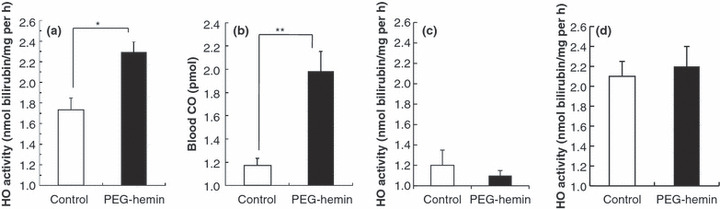
In vivo induction of heme oxygenase‐1 (HO‐1) in tumors and normal tissues (liver, muscle) after pegylated hemin (PEG‐hemin) treatment of tumor‐bearing mice. (a) Twenty‐four hours after i.v. injection of PEG‐hemin (10 mg/kg hemin equivalent), HO‐1 activity, as evidenced by bilirubin formation, was determined in the tumors. (b) The induction of HO‐1 was verified by measuring blood concentrations of carbon monoxide (CO). (c,d) The HO‐1 activity in the liver (c) and muscle (d) was also determined. Data are the mean ± SEM (n =4). *P <0.05, **P <0.01.
Figure 5
Figure 5
Accumulation of Evans blue–albumin complex in tumors and normal tissues (liver, kidney, and spleen) after pegylated hemin (PEG‐hemin) treatment of tumor‐bearing mice. Twenty‐four hours after i.v. injection of PEG‐hemin (10 mg/kg hemin equivalent), 10 mg/kg, i.v., Evans blue was injected. After a further 24 h, mice were killed and tissues collected. Control mice were not treated with PEG‐hemin. The blue dye in each tissue was extracted and the amount was quantified. Data are the mean ± SEM (n =4). *P <0.05.
Figure 6
Figure 6
Changes in tumor blood flow after (a) pegylated hemin (PEG‐hemin) and (b) CORM‐2 treatment of tumor‐bearing mice (control mice were untreated). Mice were injected with either PEG‐hemin (10 mg/kg, i.v.) or the indicated concentrations of CORM‐2 (intratumoral) and tumor blood flow was measured using a laser Doppler flowmeter. Data are the mean ± SEM (n =4). *P <0.05.

References

    1. Hassett MJ, O’Malley AJ, Pakes JR, Newhouse JP, Earle CC. Frequency and cost of chemotherapy‐related serious adverse effects in a population sample of women with breast cancer. J Natl Cancer Inst 2006; 98: 1108–17. - PubMed
    1. Matsumura Y, Maeda H. A new concept for macromolecular therapeutics in cancer chemotherapy: mechanism of tumoritropic accumulation of proteins and the antitumor agent SMANCS. Cancer Res 1986; 46: 6387–92. - PubMed
    1. Folkman J. Tumor angiogenesis: therapeutic implications. N Engl J Med 1971; 285: 1182–6. - PubMed
    1. Folkman J, Shing Y. Angiogenesis. J Biol Chem 1992; 267: 10931–4. - PubMed
    1. Maeda H, Matsumura Y, Kato H. Purification and identification of [hydroxyprolyl3]bradykinin in ascitic fluid from a patient with gastric cancer. J Biol Chem 1988; 263: 16051–4. - PubMed

Publication types