


Triple-negative subtype predicts poor overall survival and high locoregional relapse in inflammatory breast cancer
- PMID: 22147002
- PMCID: PMC3248766
- DOI: 10.1634/theoncologist.2011-0196
Triple-negative subtype predicts poor overall survival and high locoregional relapse in inflammatory breast cancer
Abstract
Background: Numerous studies have demonstrated that expression of estrogen/progesterone receptor (ER/PR) and human epidermal growth factor receptor (HER)-2 is important for predicting overall survival (OS), distant relapse (DR), and locoregional relapse (LRR) in early and advanced breast cancer patients. However, these findings have not been confirmed for inflammatory breast cancer (IBC), which has different biological features than non-IBC.
Methods: We retrospectively analyzed the records of 316 women who presented to MD Anderson Cancer Center in 1989-2008 with newly diagnosed IBC without distant metastases. Most patients received neoadjuvant chemotherapy, mastectomy, and postmastectomy radiation. Patients were grouped according to receptor status: ER(+) (ER(+)/PR(+) and HER-2-; n = 105), ER(+)HER-2(+) (ER(+)/PR(+) and HER-2(+); n = 37), HER-2(+) (ER(-)/PR(-) and HER-2(+); n = 83), or triple-negative (TN) (ER(-)PR(-)HER-2(-); n = 91). Kaplan-Meier and Cox proportional hazards methods were used to assess LRR, DR, and OS rates and their associations with prognostic factors.
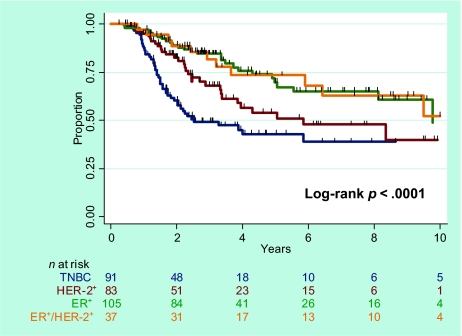
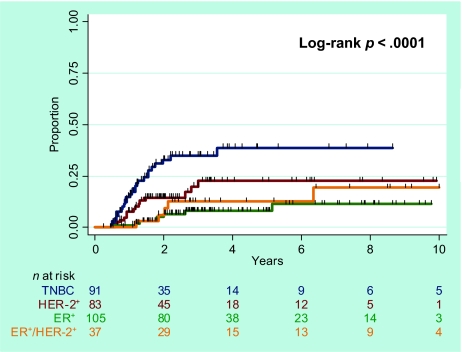
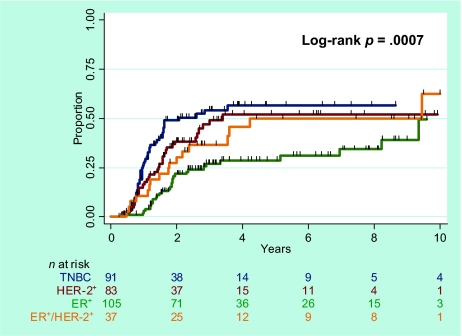
Results: The median age was 50 years (range, 24-83 years). The median follow-up time and median OS time for all patients were both 33 months. The 5-year actuarial OS rates were 58.7% for the entire cohort, 69.7% for ER(+) patients, 73.5% for ER(+)HER-2(+) patients, 54.0% for HER=2(+) patients, and 42.7% for TN patients (p < .0001); 5-year LRR rates were 20.3%, 8.0%, 12.6%, 22.6%, and 38.6%, respectively, for the four subgroups (p < .0001); and 5-year DR rates were 45.5%, 28.8%, 50.1%, 52.1%, and 56.7%, respectively (p < .001). OS and LRR rates were worse for TN patients than for any other subgroup (p < .0001-.03).
Conclusions: TN disease is associated with worse OS, DR, and LRR outcomes in IBC patients, indicating the need for developing new locoregional and systemic treatment strategies for patients with this aggressive subtype.
Conflict of interest statement
Figures
References
-
- Huber KE, Carey LA, Wazer DE. Breast cancer molecular subtypes in patients with locally advanced disease: Impact on prognosis, patterns of recurrence, and response to therapy. Semin Radiat Oncol. 2009;19:204–210. - PubMed
-
- Perou CM, Sørlie T, Eisen MB, et al. Molecular portraits of human breast tumours. Nature. 2000;406:747–752. - PubMed
Publication types
MeSH terms
Substances
LinkOut - more resources
Full Text Sources
Medical
Research Materials
Miscellaneous
