


Involvement of metabotropic glutamate receptor 5 in brain reward deficits associated with cocaine and nicotine withdrawal and somatic signs of nicotine withdrawal
- PMID: 22147259
- PMCID: PMC4010095
- DOI: 10.1007/s00213-011-2578-8
Involvement of metabotropic glutamate receptor 5 in brain reward deficits associated with cocaine and nicotine withdrawal and somatic signs of nicotine withdrawal
Abstract
Rationale: The involvement of metabotropic glutamate 5 (mGlu5) receptors has been suggested in the reinforcing effects of psychostimulants. However, little is known about the role of these receptors in psychostimulant withdrawal.
Objectives: The role of mGlu5 receptors was assessed in the anhedonic and somatic aspects of psychostimulant withdrawal.
Methods: Anhedonia was assessed with the discrete-trial current-intensity intracranial self-stimulation (ICSS) procedure after the termination of cocaine (180 mg kg(-1) day(-1), salt, 3 days, i.p.) or nicotine (40 mg kg(-1) day(-1), base, 28 days, s.c.) administration via osmotic minipumps in mGlu5 receptor knockout (mGluR5(-/-)) and wild-type (mGluR5(+/+)) mice. Somatic signs were assessed during nicotine withdrawal. The effects of the nicotinic acetylcholine receptor antagonist mecamylamine on ICSS thresholds were assessed during chronic nicotine administration.
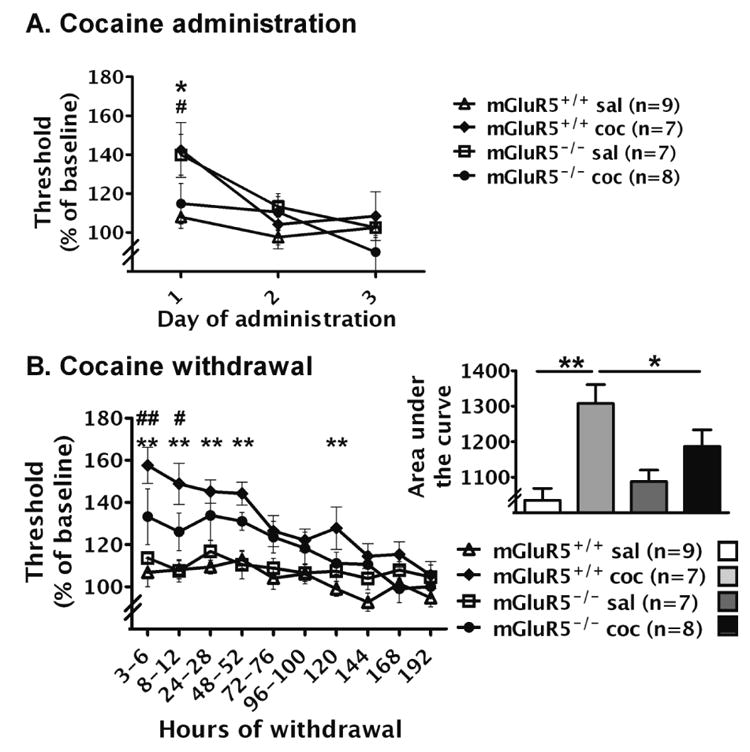
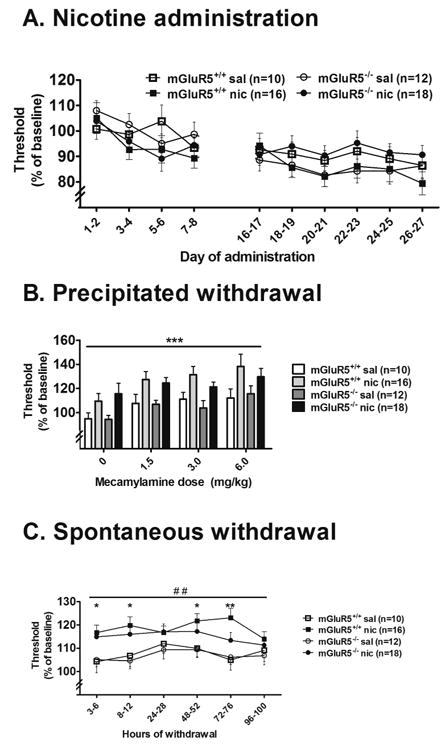
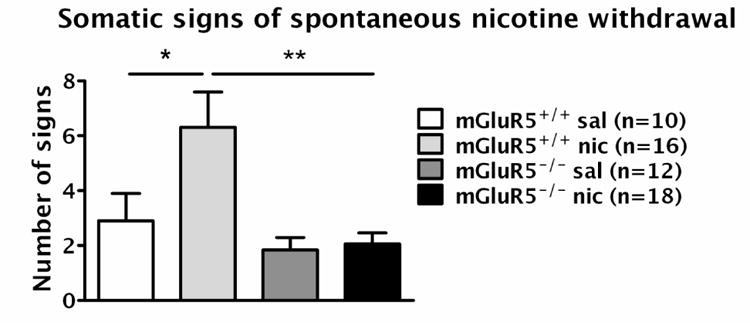
Results: Nicotine-treated mGluR5(+/+) and mGluR5(-/-) mice demonstrated similar threshold elevations during mecamylamine-precipitated withdrawal compared with their saline-treated counterparts. During spontaneous nicotine and cocaine withdrawal, thresholds in drug-withdrawing mGluR5(+/+), but not mGluR5(-/-), mice were elevated up to 72 h of nicotine/cocaine withdrawal and then returned to baseline, indicating attenuation of withdrawal-induced anhedonia in mGluR5(-/-) mice. Nicotine-withdrawing mGluR5(+/+), but not mGluR5(-/-), mice showed increases in somatic signs compared with saline-treated counterparts.
Conclusions: mGlu5 receptor null mutation attenuates the anhedonic and somatic effects of psychostimulant withdrawal. This attenuated withdrawal in mGluR5(-/-) mice may result from the lack of drug-induced adaptations in mGlu5 receptor function that may occur in mGluR5(+/+) mice with chronic drug administration. Thus, these results suggest the involvement of mGlu5 receptors in psychostimulant dependence and the mediation of the anhedonic and somatic signs of psychostimulant withdrawal.
Conflict of interest statement
Figures
References
-
- American Psychiatric Association. Diagnostic and statistical manual of mental disorders. 4th, text rev. American Psychiatric Press; Washington, DC: 2000.
-
- Backstrom P, Bachteler D, Koch S, Hyytia P, Spanagel R. mGluR5 antagonist MPEP reduces ethanol-seeking and relapse behavior. Neuropsychopharmacology. 2004;29:921–8. - PubMed
-
- Backstrom P, Hyytia P. Ionotropic and metabotropic glutamate receptor antagonism attenuates cue-induced cocaine seeking. Neuropsychopharmacology. 2006;31:778–86. - PubMed
Publication types
MeSH terms
Substances
Grants and funding
LinkOut - more resources
Full Text Sources
Other Literature Sources
