


Comprehensive 2-dimensional gas chromatography fast quadrupole mass spectrometry (GC × GC-qMS) for urinary steroid profiling: mass spectral characteristics with chemical ionization
- PMID: 22147458
- PMCID: PMC3697747
- DOI: 10.1002/dta.380
Comprehensive 2-dimensional gas chromatography fast quadrupole mass spectrometry (GC × GC-qMS) for urinary steroid profiling: mass spectral characteristics with chemical ionization
Abstract
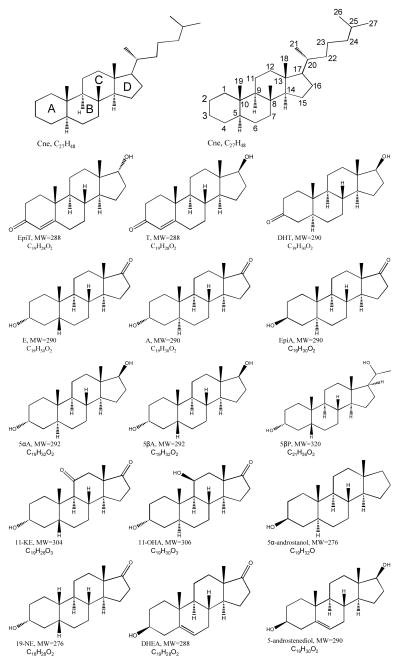
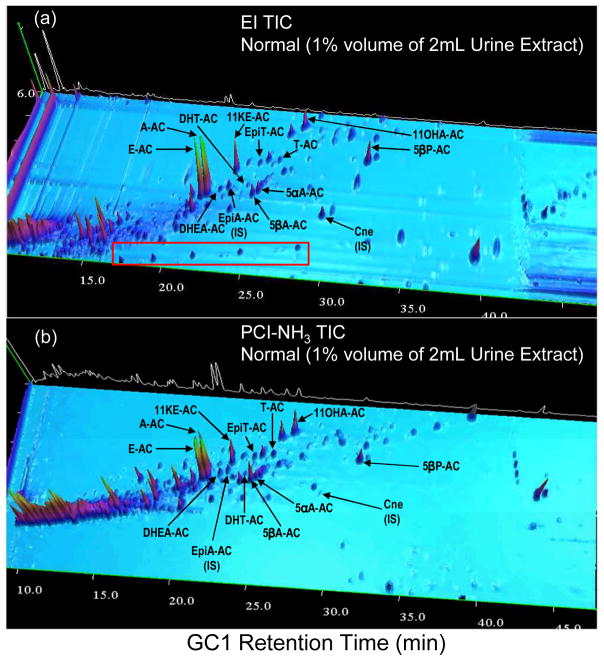
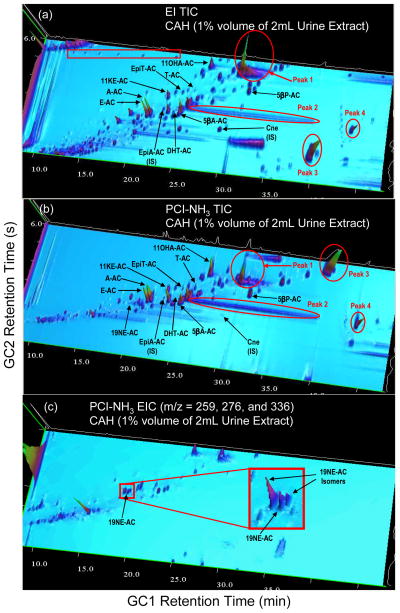
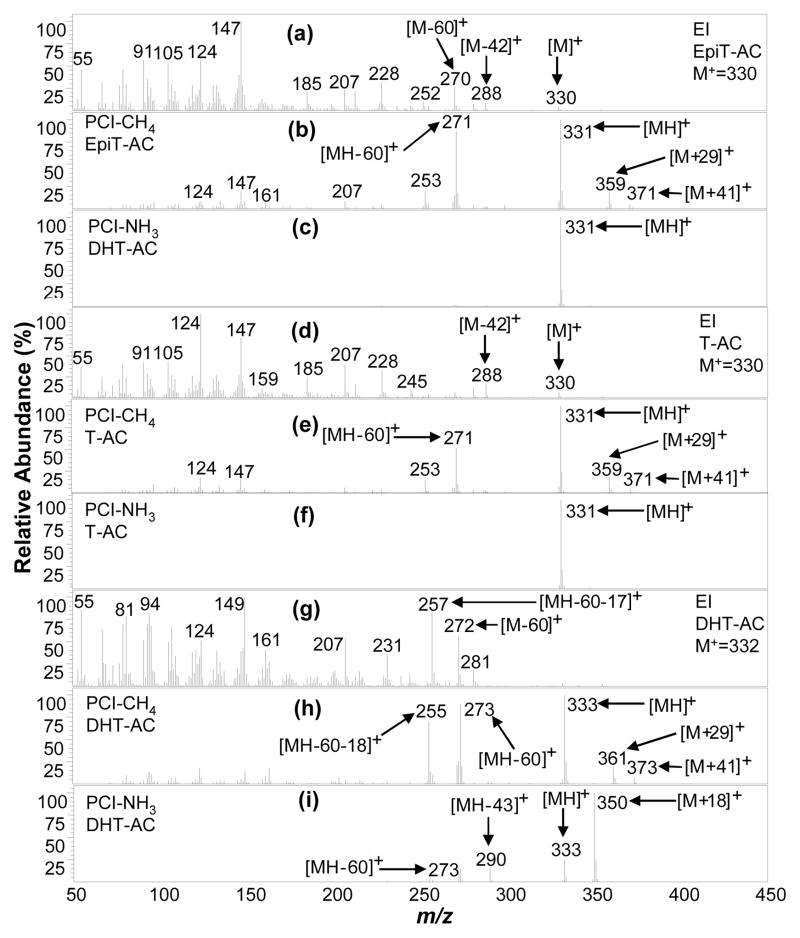
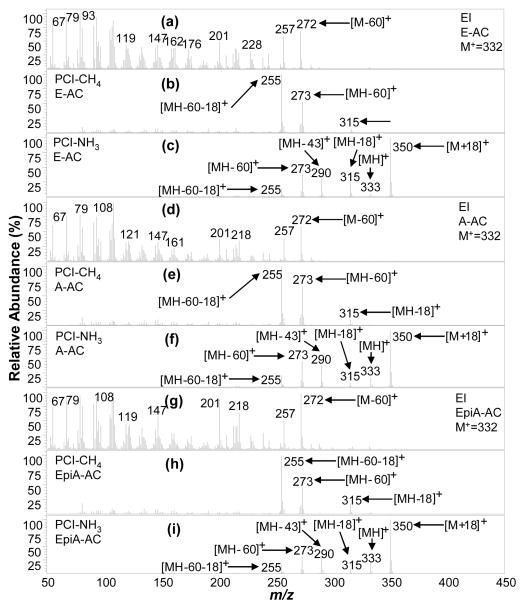
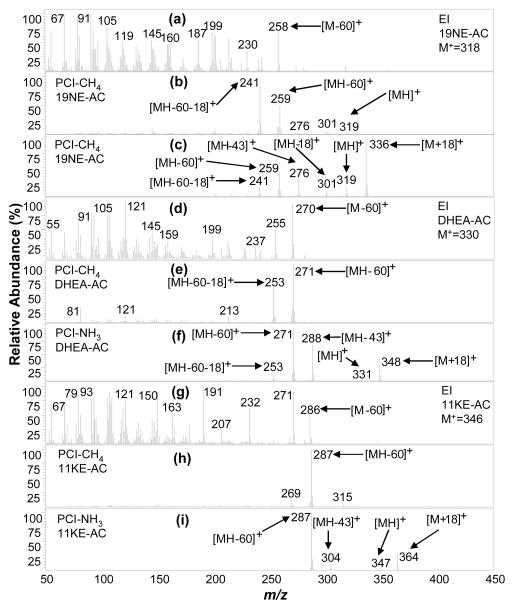
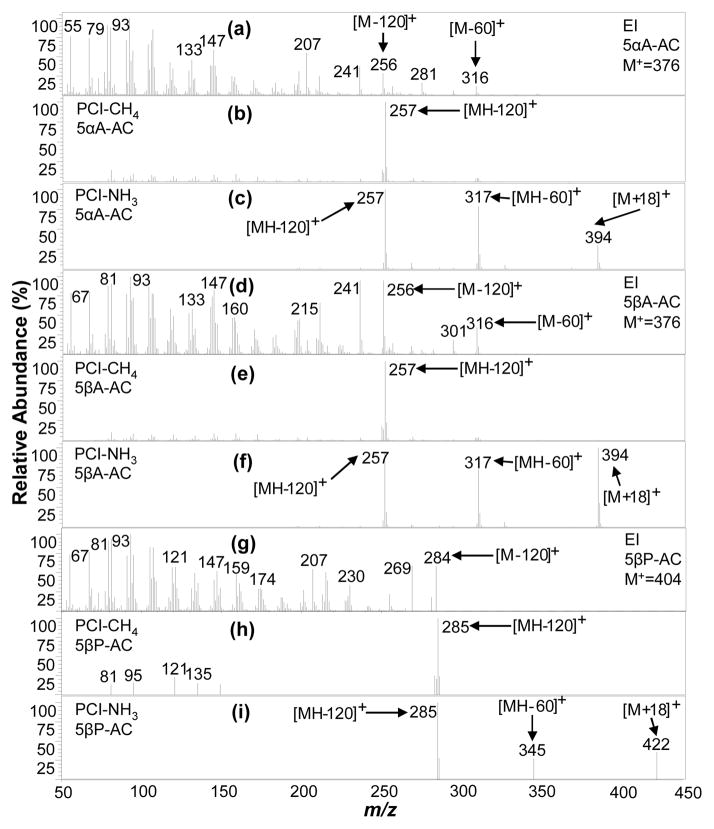
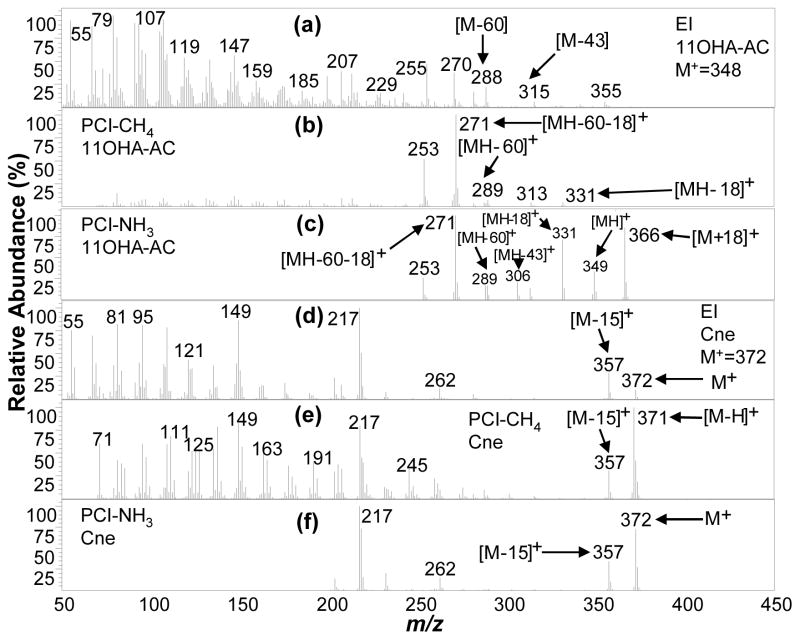
Comprehensive 2-dimensional gas chromatography (GC × GC), coupled to either a time of flight mass spectrometry (TOF-MS) or a fast scanning quadrupole MS (qMS) has greatly increased the peak capacity and separation space compared to conventional GC-MS. However, commercial GC × GC-TOFMS systems are not equipped with chemical ionization (CI) and do not provide dominant molecular ions or enable single ion monitoring for maximal sensitivity. A GC × GC-qMS in mass scanning mode was investigated with electron ionization (EI) and positive CI (PCI), using CH(4) and NH(3) as reagent gases. Compared to EI, PCI-NH(3) produced more abundant molecular ions and high mass, structure-specific ions for steroid acetates. Chromatography in two dimensions was optimized with a mixture of 12 endogenous and 3 standard acetylated steroids (SM15-AC) relevant to doping control. Eleven endogenous target steroid acetates were identified in normal urine based on their two retention times, and EI and PCI-NH(3) mass spectra; nine of these endogenous target steroid acetates were identified in congenital adrenal hyperplasia (CAH) patients. The difference between the urinary steroids profiles of normal individuals and those from CAH patients can easily be visually distinguished by their GC × GC-qMS chromatograms. We focus here on the comparison and interpretation of the various mass spectra of the targeted endogenous steroids. PCI-NH(3) mass spectra were most useful for unambiguous molecular weight determination and for establishing the number of -OH by the losses of one or more acetate groups. We conclude that PCI-NH(3) with GC × GC-qMS provides improved peak capacity and pseudomolecular ions with structural specificity.
Copyright © 2011 John Wiley & Sons, Ltd.
Figures
References
-
- Vollmin JA. High Resolution Gas Chromatography of Urinary Steroids on Glass Capillary Columns. Clinica Chimica Acta. 1971;34(2):207–214. - PubMed
-
- Lusby WR, Thompson MJ, Kochansky J. Analysis of Sterol Esters by Capillary Gas Chromatography-Electron Impact and Chemical Ionization-Mass Spectrometry. Lipids. 1984;19(11):888–901.
-
- Ahmadkhaniha R, Shafiee A, Rastkari N, Khoshayand MR, Kobarfard F. Quantification of endogenous steroids in human urine by gas chromatography mass spectrometry using a surrogate analyte approach. Journal of Chromatography B-Analytical Technologies in the Biomedical and Life Sciences. 2010;878(11–12):845–852. - PubMed
-
- Dehennin L, Ferry M, Lafarge P, Peres G, Lafarge JP. Oral administration of dehydroepiandrosterone to healthy men: Alteration of the urinary androgen profile and consequences for the detection of abuse in sport by gas chromatography mass spectrometry. Steroids. 1998;63(2):80–87. - PubMed
-
- Donike M. The detection of doping by means of chromatographic methods. Drug Testing and Analysis. 2011;3(1):15–17. - PubMed
Publication types
MeSH terms
Substances
Grants and funding
LinkOut - more resources
Full Text Sources
Miscellaneous
