The Wnt secretion protein Evi/Gpr177 promotes glioma tumourigenesis
- PMID: 22147553
- PMCID: PMC3306557
- DOI: 10.1002/emmm.201100186
The Wnt secretion protein Evi/Gpr177 promotes glioma tumourigenesis
Abstract
Malignant astrocytomas are highly aggressive brain tumours with poor prognosis. While a number of structural genomic changes and dysregulation of signalling pathways in gliomas have been described, the identification of biomarkers and druggable targets remains an important task for novel diagnostic and therapeutic approaches. Here, we show that the Wnt-specific secretory protein Evi (also known as GPR177/Wntless/Sprinter) is overexpressed in astrocytic gliomas. Evi/Wls is a core Wnt signalling component and a specific regulator of pan-Wnt protein secretion, affecting both canonical and non-canonical signalling. We demonstrate that its depletion in glioma and glioma-derived stem-like cells led to decreased cell proliferation and apoptosis. Furthermore, Evi/Wls silencing in glioma cells reduced cell migration and the capacity to form tumours in vivo. We further show that Evi/Wls overexpression is sufficient to promote downstream Wnt signalling. Taken together, our study identifies Evi/Wls as an essential regulator of glioma tumourigenesis, identifying a pathway-specific protein trafficking factor as an oncogene and offering novel therapeutic options to interfere with the aberrant regulation of growth factors at the site of production.
Copyright © 2012 EMBO Molecular Medicine.
Figures
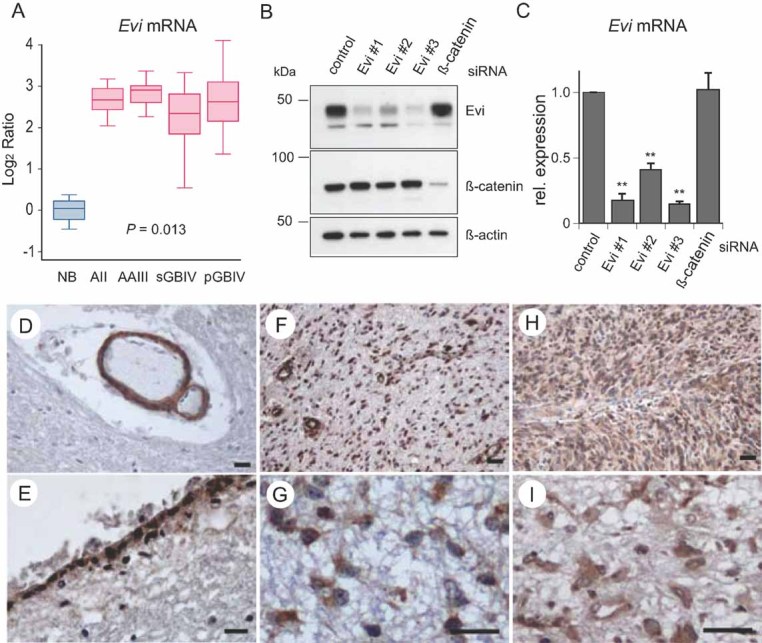
A. Log2-gene expression ratios normalized to the mean expression in NB samples are shown for diffuse astrocytoma WHO grade II (AII), anaplastic astrocytoma WHO grade III (AAIII), secondary glioblastoma WHO grade IV (sGBIV) and primary glioblastoma WHO grade IV (pGBIV). Median RNA expression is indicated by horizontal bars; boxes show the 25th and 75th percentile range, whiskers mark the 5th and 95th percentiles; maximum and minimum values are depicted as horizontal bars.
B, C. The specificity of the antibody against Evi was confirmed by siRNA silencing of the target protein. U87MG cells were transfected with three-independent siRNAs to silence Evi. Silencing of gene expression was validated by Western blot and quantified real-time RT-PCR confirming robust downregulation of Evi expression. β-Actin was detected as loading control. PCR-data are expressed as mean ± SD of three-independent experiments (**p < 0.01).
D, E. Representative immunohistochemical stainings for Evi on tissue sections of NB and astrocytic gliomas of different WHO grades. (D) NB, Evi-positive vascular smooth muscle cells; (E) NB, Evi-positive ependymal cells.
F, G. Evi-positive tumour cells in a diffuse astrocytoma WHO grade II.
H, I. Evi-positive tumour cells in a primary glioblastoma WHO grade IV. Scale bar: 100 µm.
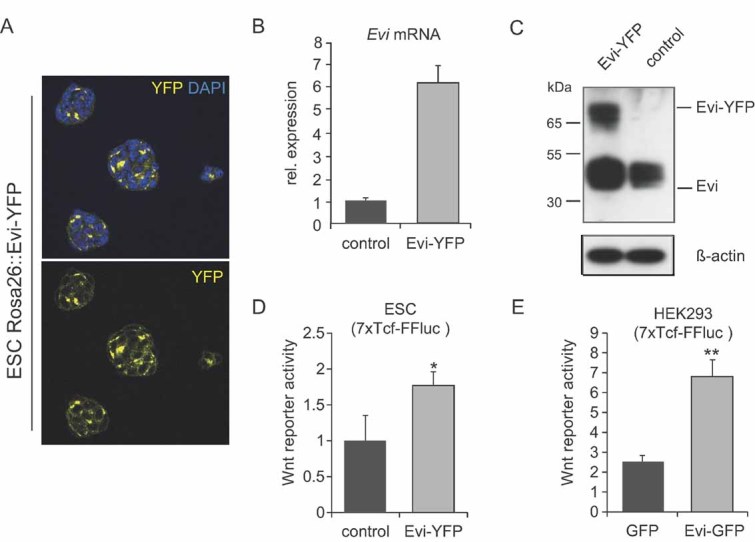
Immunofluorescence of endogeneous expression of Evi-YFP in ESC colonies.
Relative mRNA expression levels of Evi were analysed by quantitative RT-PCR. Evi-ESCs expressed increased Evi levels.
Western blot of Evi overexpressing ESCs. Evi-ESCs expressed Evi-YFP fusion protein.
Evi-ESCs stably transfected with 7TCF Firefly luciferase reporter showed increased Wnt reporter activity (*p < 0.05).
Transfection of 7TCF Firefly luciferase reporter containing HEK293 cells with Evi-GFP plasmid led to increased Wnt reporter activity compared to transfection with GFP control vector (**p < 0.01).
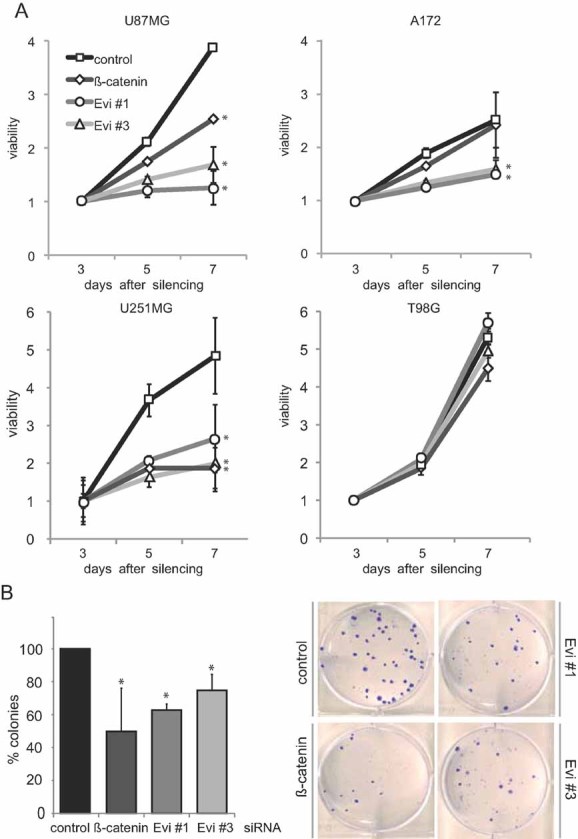
Viability of RNAi transduced U87MG cells, A172, U251MG cells and T98G was determined by CellTiter-Glow assay and revealed reduced viability of Evi-RNAi transduced cells compared to control cells. β-catenin silencing had significant effect on viability of U787MG and U251MG cells. Evi and β-catenin silencing had no significant effect on proliferation of T98G cells (*p < 0.05).
Evi and β-catenin silencing caused reduced colony formation in U251MG cells. Representative example of three-independent experiments is shown (right). Data are expressed as mean ± SD of three-independent experiments (*p < 0.05).
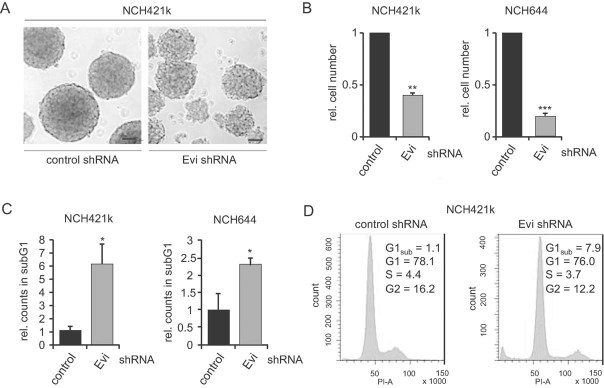
Neurosphere shape and size was disturbed after Evi silencing. Scale bar: 100 µm.
Reduction in cell number compared to control transfected spheres 7 days after infection (**p < 0.01; ***p < 0.001).
Lentiviral shRNA silencing of Evi expression in NCH421k and NCH644 cells led to an increase in the sub-G1 fraction (*p < 0.05; **p < 0.01).
Representative graphs of cell cycle distribution. Data are expressed as mean ± SD of three-independent experiments.
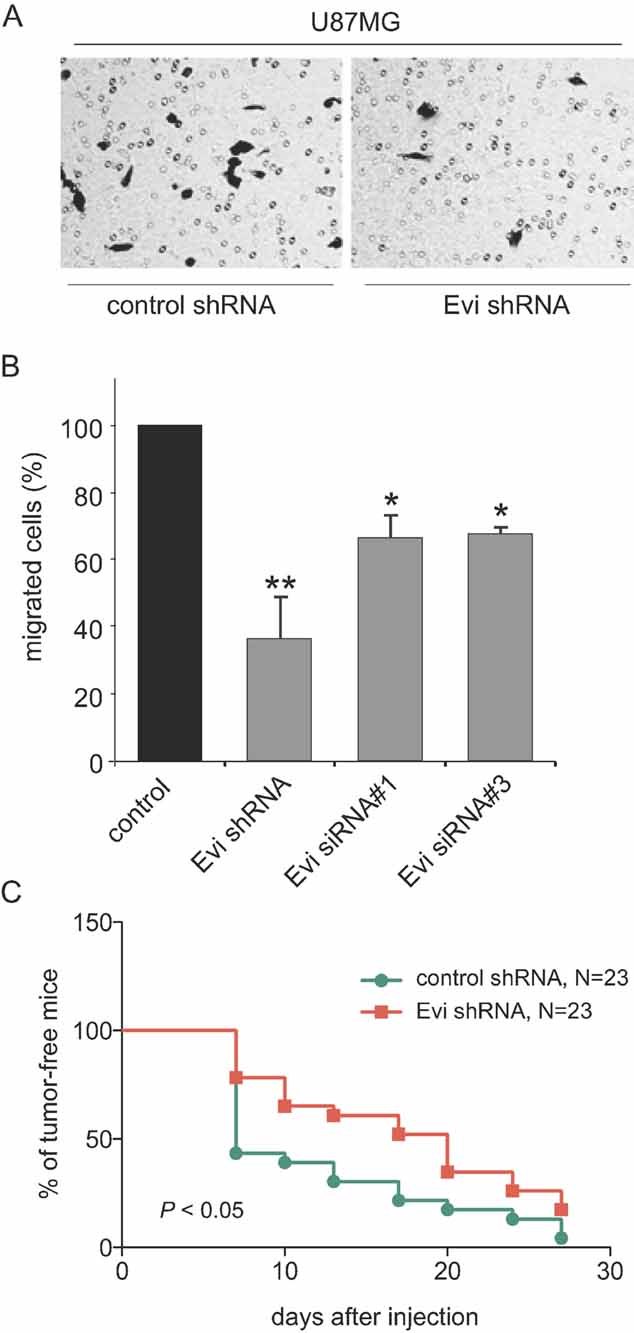
Evi shRNA U87MG cells showed less transwell migration compared to control. Similar effect was achieved by siRNA transfection.
Migration experiments were done as short-term assays to exclude anti-proliferative effects. Values represent mean ± SD from three-independent experiments (*p < 0.05; **p < 0.01).
Reduced in vivo growth of glioma cells transfected with shRNA targeting Evi. The appearance of U87MG glioma xenografts formed by Evi shRNA or control transfected cells was reduced in the Evi downregulated glioma cells.
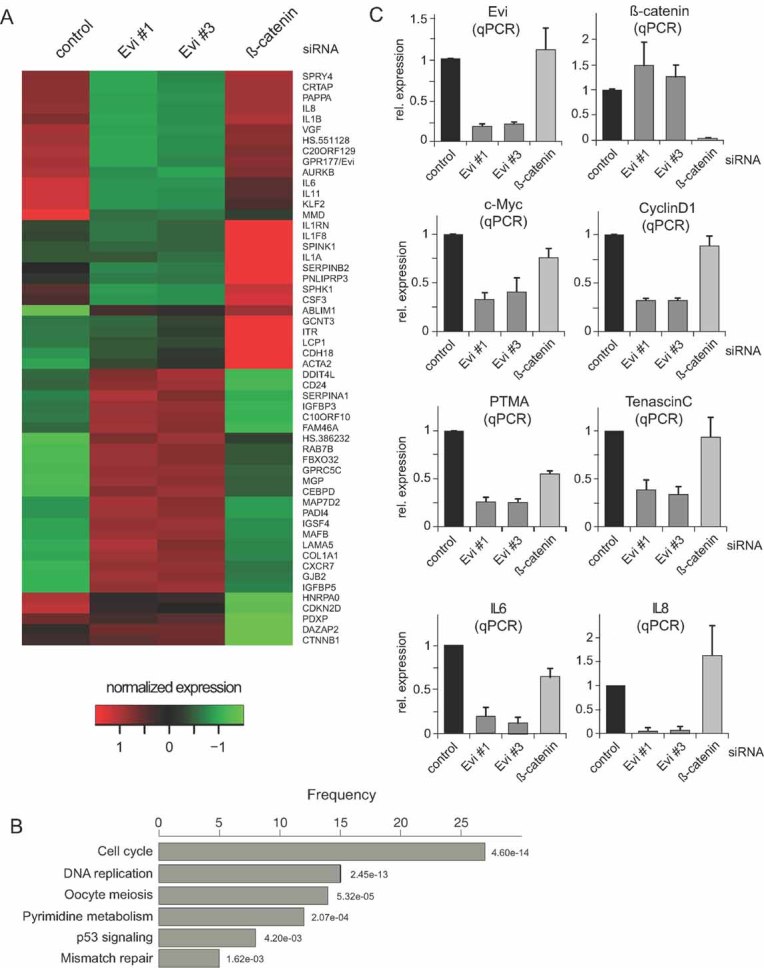
Heatmap based on normalized U87MG gene expression values of RNAi Evi#1, Evi#3, β-catenin and control samples. Rows represent genes, which are differentially expressed (p < 0.01) and have an absolute log2-fold change >1.5 compared to control, in Evi#1, Evi#3 or β-catenin silencing experiments.
Over-represented KEGG categories in set of differentially expressed genes (Fisher's exact test, p < 0.01). The length of the bars represents the number of genes within the set of differentially expressed genes that are annotated as part of the corresponding KEGG category. The numbers is red indicate the significance of the over-representation. The KEGG categories are not mutually exclusive. ‘Cell cycle’ is the most significant over-represented category.
Cells were transduced with indicated siRNAs. The relative mRNA expression levels of Evi, β-catenin, cyclin D1, c-Myc, PTMA, tenascin-C, and IL8 after Evi silencing analysed by quantified RT-PCR. Data are expressed as mean ± SD of three-independent experiments.
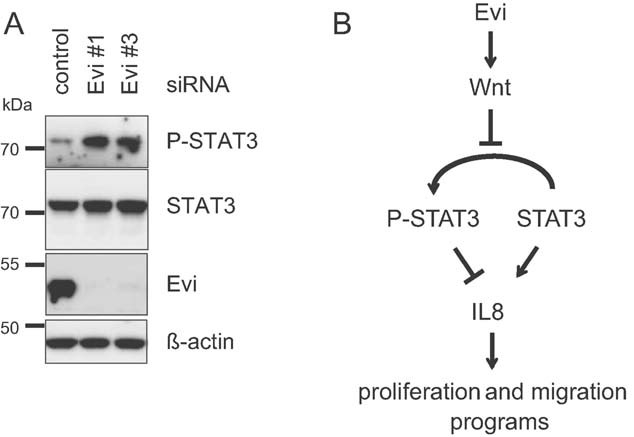
Western blot of U87MG cell lysates after RNAi transfection against Evi (Evi #1 and Evi #3) showed increased levels of phosphorylated STAT3 compared to control transfection. β-Actin was detected as loading control. Representative example of three-independent experiments is shown.
Model of the Evi-Wnt-STAT3-IL8 signalling link in human glioblastoma cells. Evi mediated Wnt secretion controls phosphorylation of STAT3. Downregulation of Evi leads to activation of STAT3 by phosphorylation. Phosphorylated STAT3 binds to IL8 promotor and represses IL8 transcription. Downregulation of IL8 reduces glioblastoma cell proliferation and invasiveness.
References
-
- Bafico A, Liu G, Goldin L, Harris V, Aaronson SA. An autocrine mechanism for constitutive Wnt pathway activation in human cancer cells. Cancer Cell. 2004;6:497–506. - PubMed
-
- Banziger C, Soldini D, Schutt C, Zipperlen P, Hausmann G, Basler K. Wntless, a conserved membrane protein dedicated to the secretion of Wnt proteins from signaling cells. Cell. 2006;125:509–522. - PubMed
-
- Barker N, Clevers H. Mining the Wnt pathway for cancer therapeutics. Nat Rev Drug Discov. 2006;5:997–1014. - PubMed
Publication types
MeSH terms
Substances
LinkOut - more resources
Full Text Sources
Other Literature Sources
Medical