


Comparison of presentation and impact on quality of life of gastroesophageal reflux disease between young and old adults in a Chinese population
- PMID: 22147968
- PMCID: PMC3225098
- DOI: 10.3748/wjg.v17.i41.4614
Comparison of presentation and impact on quality of life of gastroesophageal reflux disease between young and old adults in a Chinese population
Abstract
Aim: To compare the presentation and impact on quality of life of gastroesophageal reflux disease (GERD) in old and young age groups.
Methods: Data from adult patients with GERD diagnosed by endoscopic and symptomic characteristics were collected between January and November 2009. Exclusion criteria included combined peptic ulcers, malignancy, prior surgery, antacid medication for more than 2 mo, and pregnancy. Enrolled patients were assigned to the elderly group if they were 65 years or older, or the younger group if they were under 65 years. They had completed the GERD impact scale, the Chinese GERD questionnaire, and the SF-36 questionnaire. Data from other cases without endoscopic findings or symptoms were collected and these subjects comprised the control group in our study.
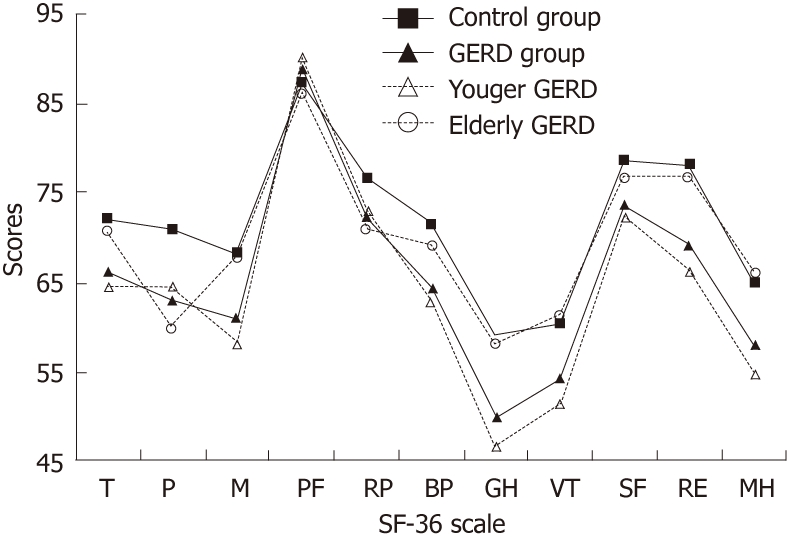
Results: There were 111 patients with GERD and 44 normal cases: 78 (70.3%) and 33 patients (29.7%) were in the younger and elderly groups, respectively. There were more female patients (60.3%) in the younger group, and more males (72.7%) in the elderly group. The younger cases had more severe and frequent typical symptoms than the elderly patients. Significantly more impairment of daily activities was noted in the younger patients compared with the elderly group, except for physical functioning.
Conclusion: Elderly patients with GERD were predominantly male with rare presentation of typical symptoms, and had less impaired quality of life compared with younger patients in a Chinese population.
Keywords: Age factors; Gastroesophageal reflux disease; Quality of life.
Figures
References
-
- Wiklund I. Review of the quality of life and burden of illness in gastroesophageal reflux disease. Dig Dis. 2004;22:108–114. - PubMed
-
- Mold JW, Reed LE, Davis AB, Allen ML, Decktor DL, Robinson M. Prevalence of gastroesophageal reflux in elderly patients in a primary care setting. Am J Gastroenterol. 1991;86:965–970. - PubMed
-
- Furukawa N, Iwakiri R, Koyama T, Okamoto K, Yoshida T, Kashiwagi Y, Ohyama T, Noda T, Sakata H, Fujimoto K. Proportion of reflux esophagitis in 6010 Japanese adults: prospective evaluation by endoscopy. J Gastroenterol. 1999;34:441–444. - PubMed
-
- McDougall NI, Johnston BT, Collins JS, McFarland RJ, Love AH. Three to 4.5-year prospective study of prognostic indicators in gastro-oesophageal reflux disease. Scand J Gastroenterol. 1998;33:1016–1022. - PubMed
-
- Zeitoun P, Salmon L, Bouché O, Jolly D, Thiéfin G. Outcome of erosive/ulcerative reflux oesophagitis in 181 consecutive patients 5 years after diagnosis. Ital J Gastroenterol Hepatol. 1998;30:470–474. - PubMed
Publication types
MeSH terms
LinkOut - more resources
Full Text Sources
Medical
