


Total and high-molecular-weight adiponectin and risk of incident diabetes in older people
- PMID: 22148099
- PMCID: PMC3263897
- DOI: 10.2337/dc11-1519
Total and high-molecular-weight adiponectin and risk of incident diabetes in older people
Abstract
Objective: To delineate the associations of total adiponectin, high-molecular-weight (HMW) adiponectin, and the HMW-to-total adiponectin ratio with diabetes in older adults.
Research design and methods: Total and HMW adiponectin were measured in a population-based study of older adults. The relations of total adiponectin, HMW adiponectin, and their ratio with incident diabetes (n = 309) were assessed in 3,802 individuals.
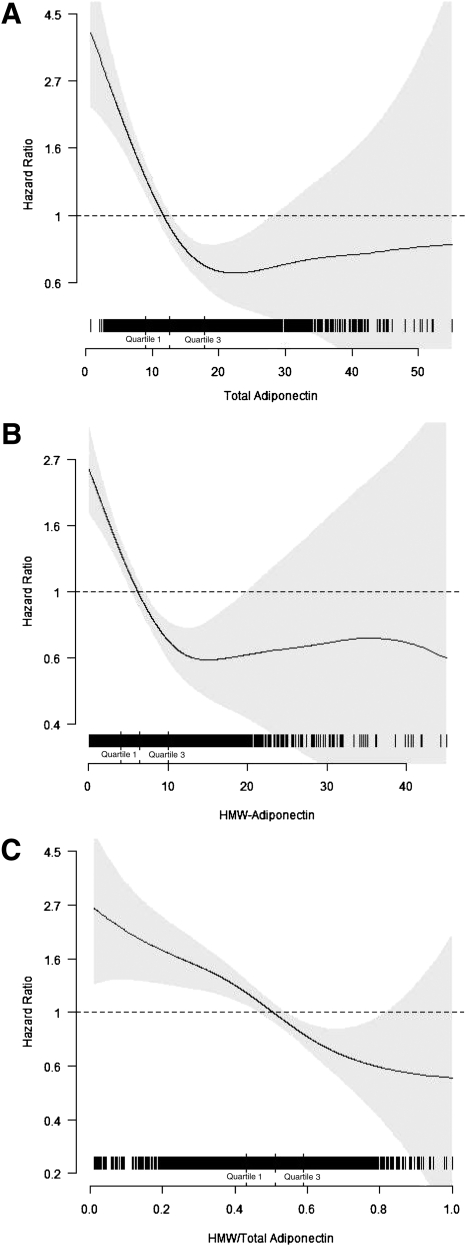
Results: Total and HMW adiponectin were highly correlated (r = 0.94). Analysis using cubic splines revealed that the associations between total and HMW adiponectin and new-onset diabetes were not linear. Specifically, after adjustment for confounders, there were similar inverse relationships for total (hazard ratio per SD 0.49 [95% CI 0.39-0.63]) and HMW adiponectin (0.42 [0.32-0.56]) with diabetes up to values of 20 and 10 mg/L, respectively, above which the associations plateaued. These associations persisted after adjustment for potential mediators (blood pressure, lipids, C-reactive protein, and homeostasis model assessment of insulin resistance [HOMA-IR]). There was, however, evidence of interaction by HOMA-IR in the lower range of adiponectin, with stronger inverse associations among insulin-sensitive than insulin-resistant participants. HMW-to-total adiponectin ratio showed a linear adjusted association with outcome, but this was abolished by inclusion of mediating variables.
Conclusions: In this older cohort, increasing concentrations of total and HMW adiponectin were associated with comparably lower risks of diabetes, but these associations leveled off with further increases above concentrations of 20 and 10 mg/L, respectively. The more pronounced risk decreases at the lower range among participants without insulin resistance support a role for adiponectin that is independent of baseline hyperinsulinemia, but this will require further investigation.
Figures
References
Publication types
MeSH terms
Substances
Grants and funding
- N01-HC-85085/HC/NHLBI NIH HHS/United States
- N01-HC-85081/HC/NHLBI NIH HHS/United States
- AG-20098/AG/NIA NIH HHS/United States
- AG-027058/AG/NIA NIH HHS/United States
- N01-HC-85082/HC/NHLBI NIH HHS/United States
- N01 HC055222/HL/NHLBI NIH HHS/United States
- N01-HC-55222/HC/NHLBI NIH HHS/United States
- R01 HL080295/HL/NHLBI NIH HHS/United States
- R01 AG020098/AG/NIA NIH HHS/United States
- HL-080295/HL/NHLBI NIH HHS/United States
- N01-HC-85079/HC/NHLBI NIH HHS/United States
- N01-HC-85084/HC/NHLBI NIH HHS/United States
- R01 AG015928/AG/NIA NIH HHS/United States
- U01 HL080295/HL/NHLBI NIH HHS/United States
- N01 HC015103/HC/NHLBI NIH HHS/United States
- N01 HC085086/HL/NHLBI NIH HHS/United States
- R56 AG020098/AG/NIA NIH HHS/United States
- R01-HL-094555/HL/NHLBI NIH HHS/United States
- R01 HL094555/HL/NHLBI NIH HHS/United States
- N01-HC-85086/HC/NHLBI NIH HHS/United States
- N01 HC085079/HL/NHLBI NIH HHS/United States
- N01-HC-85083/HC/NHLBI NIH HHS/United States
- N01-HC-75150/HC/NHLBI NIH HHS/United States
- N01-HC-85080/HC/NHLBI NIH HHS/United States
- N01-HC-85239/HC/NHLBI NIH HHS/United States
- AG-023629/AG/NIA NIH HHS/United States
- N01 HC075150/HL/NHLBI NIH HHS/United States
- R01 AG023629/AG/NIA NIH HHS/United States
- R01 AG027058/AG/NIA NIH HHS/United States
- N01 HC045133/HC/NHLBI NIH HHS/United States
- N01 HC035129/HC/NHLBI NIH HHS/United States
- R56 AG023629/AG/NIA NIH HHS/United States
LinkOut - more resources
Full Text Sources
Other Literature Sources
Medical
Research Materials
