


Exposure assessment for estimation of the global burden of disease attributable to outdoor air pollution
- PMID: 22148428
- PMCID: PMC4043337
- DOI: 10.1021/es2025752
Exposure assessment for estimation of the global burden of disease attributable to outdoor air pollution
Abstract
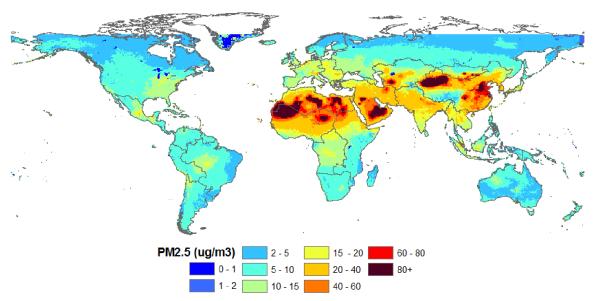
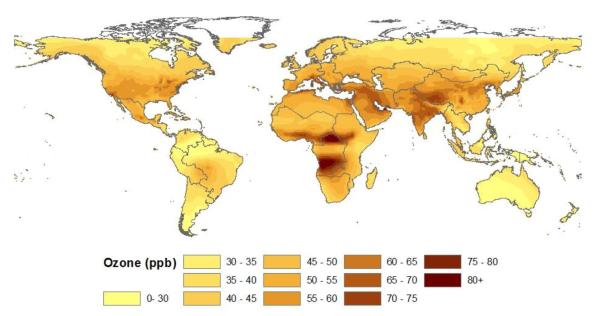
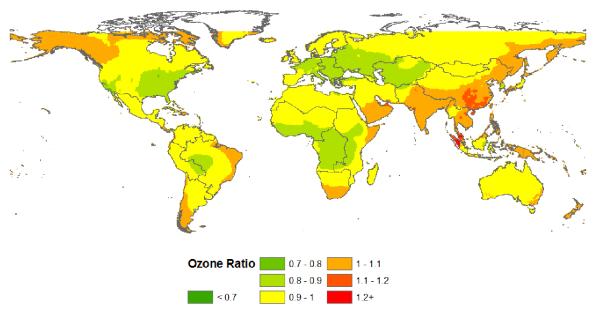
Ambient air pollution is associated with numerous adverse health impacts. Previous assessments of global attributable disease burden have been limited to urban areas or by coarse spatial resolution of concentration estimates. Recent developments in remote sensing, global chemical-transport models, and improvements in coverage of surface measurements facilitate virtually complete spatially resolved global air pollutant concentration estimates. We combined these data to generate global estimates of long-term average ambient concentrations of fine particles (PM(2.5)) and ozone at 0.1° × 0.1° spatial resolution for 1990 and 2005. In 2005, 89% of the world's population lived in areas where the World Health Organization Air Quality Guideline of 10 μg/m(3) PM(2.5) (annual average) was exceeded. Globally, 32% of the population lived in areas exceeding the WHO Level 1 Interim Target of 35 μg/m(3), driven by high proportions in East (76%) and South (26%) Asia. The highest seasonal ozone levels were found in North and Latin America, Europe, South and East Asia, and parts of Africa. Between 1990 and 2005 a 6% increase in global population-weighted PM(2.5) and a 1% decrease in global population-weighted ozone concentrations was apparent, highlighted by increased concentrations in East, South, and Southeast Asia and decreases in North America and Europe. Combined with spatially resolved population distributions, these estimates expand the evaluation of the global health burden associated with outdoor air pollution.
Figures
Comment in
-
Improving global estimates of particulate air pollution: ES&T's top science article 2012.Environ Sci Technol. 2013 Apr 2;47(7):3024-5. doi: 10.1021/es400924t. Epub 2013 Mar 15. Environ Sci Technol. 2013. PMID: 23488552 No abstract available.
References
-
- Cohen AJ, Anderson HR, Ostro B, Pandey KD, Krzyzanowski M, Kuenzli N, Gutschmidt K, Pope CI, Romieu I, Samet JM, Smith KR. Urban Air Pollution. In: Ezzati M, Rodgers AD, Lopez AD, Murray CJL, editors. Comparative Quantification of Health Risks: Global and Regional Burden of Disease Attributable to Selected Major Risk Factors. 1st ed Vol.2. World Health Organization; Geneva: 2004. pp. 1353–1453.
-
- Hoff RM, Christopher SA. Remote Sensing of Particulate Pollution from Space: Have We Reached the Promised Land? J. Air Waste Manage. Assoc. 2009;59:645–675. - PubMed
-
- Martin RV. Satellite remote sensing of surface air quality. Atmos. Environ. 2008;42:7823–7843.
-
- Dentener FJ, Keating T, Akimoto H. Hemispheric Transport of Air Pollution 2010. 2010. ECE/EB.AIR/100, 1-1-278.
MeSH terms
Substances
Grants and funding
LinkOut - more resources
Full Text Sources
Medical
