


Review
doi: 10.1021/cb200422t.
Epub 2011 Dec 23.
Novel modifications in RNA
Affiliations
- PMID: 22148740
- PMCID: PMC3270579
- DOI: 10.1021/cb200422t
Item in Clipboard
Review
Novel modifications in RNA
ACS Chem Biol.
.
Abstract
The past several years have seen numerous reports of new chemical modifications for use in RNA. In addition, in that time period, we have seen the discovery of several previously unknown naturally occurring modifications that impart novel properties on the parent RNAs. In this review, we describe recent discoveries in these areas with a focus on RNA modifications that introduce spectroscopic tags, reactive handles, or new recognition properties.
Figures
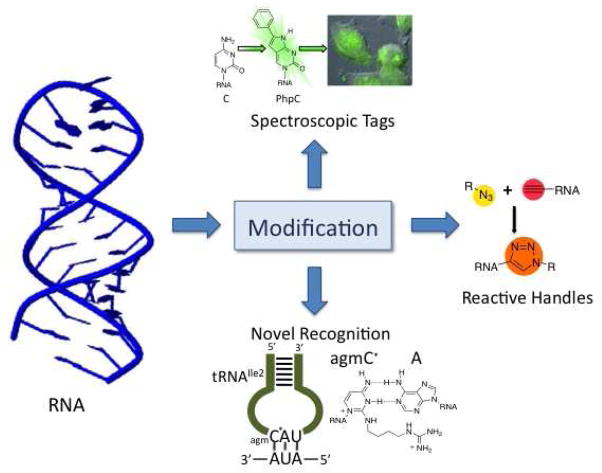
RNA modification provides access to a wide range of powerful chemical and biochemical tools that enable the study of RNA structure and function.
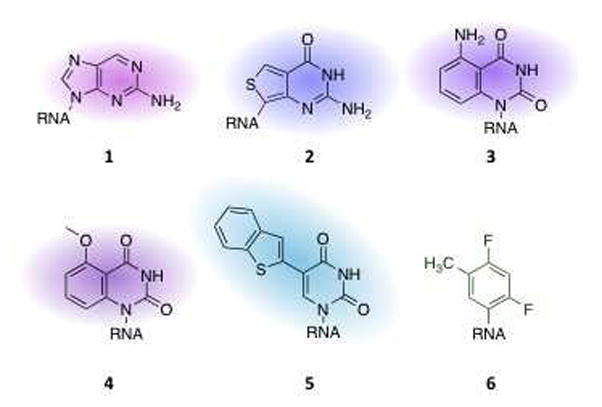
Nucleobase analogs as spectroscopic tags for RNA. 2(6), 3(11), 4(10), 5(5), 6(18)
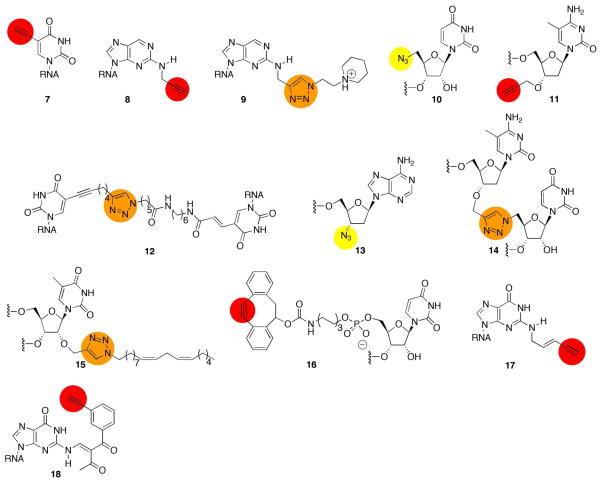
Structures of alkyne and azide reactive handles recently introduced into RNA. 7(29), 8(30), 9(26), 10(24), 11(24), 12(24), 13(25), 14(24–25), 15(23), 16(34), 17(32), 18(33)
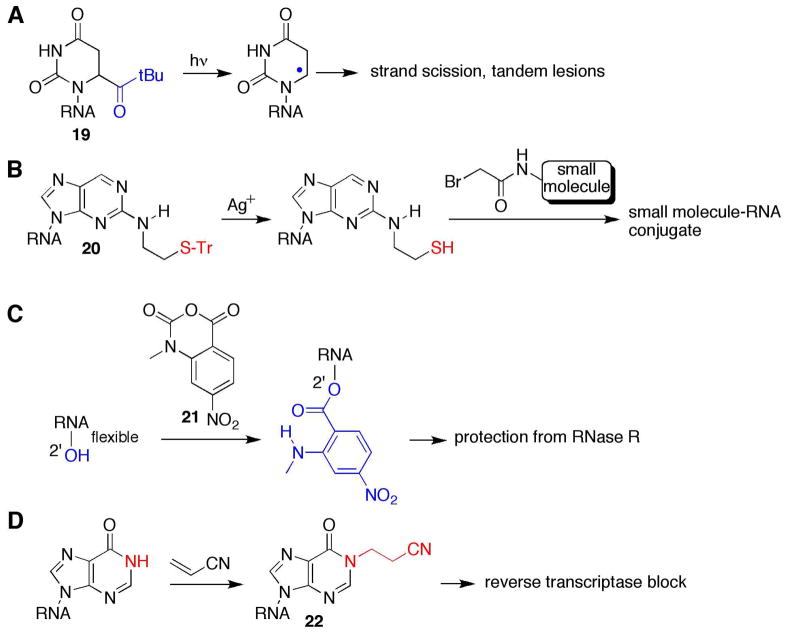
Recent examples of RNA modifications that impart novel reactivity. A. A precursor to a C6 pyrimidine radical (44); B. A new way to install an RNA thiol (48); C. RNase-detected SHAPE (55); D. Method to detect inosine in RNA (56).
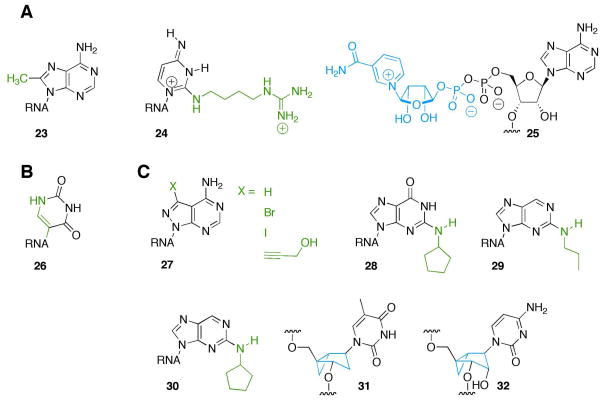
A. Studies of recently reported, naturally occurring modified nucleosides in RNA (–60). B. Known nucleoside analog pseudouridine causes nonsense suppression (73). C. Structures of new synthetic nucleoside analogs that alter RNA recognition (, , –96).
References
-
- Das SR, Fong R, Piccirilli JA. Nucleotide analogues to investigate RNA structure and function. Curr Opin Chem Biol. 2005;9:585–593. - PubMed
-
- Shukla S, Sumaria CS, Pradeepkumar PI. Exploring Chemical Modifications for siRNA Therapeutics: A Structural and Functional Outlook. ChemMedChem. 2010;5:328–349. - PubMed
-
- Mitsui T, Kimoto M, Kawai R, Yokoyama S, Hirao I. Characterization of fluorescent, unnatural base pairs. Tetrahedron. 2007;63:3528–3537.
-
- Pawar MG, Srivatsan SG. Synthesis, Photophysical Characterization, and Enzymatic Incorporation of a Microenvironment-Sensitive Fluorescent Uridine Analog. Org Lett. 2011;13:1114–1117. - PubMed
Publication types
MeSH terms
Substances
Grants and funding
LinkOut - more resources
Full Text Sources
Other Literature Sources
Miscellaneous
