


doi: 10.1021/jm201139r.
Epub 2012 Jan 6.
Allosteric modulation of seven transmembrane spanning receptors: theory, practice, and opportunities for central nervous system drug discovery
Affiliations
- PMID: 22148748
- PMCID: PMC3349997
- DOI: 10.1021/jm201139r
Item in Clipboard
Allosteric modulation of seven transmembrane spanning receptors: theory, practice, and opportunities for central nervous system drug discovery
J Med Chem.
.
No abstract available
Figures
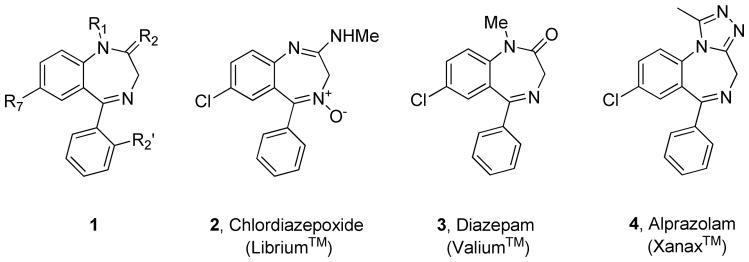
Benzodiazepines, the first allosteric modulators with clinical success, and marketed as GABAA allosteric modualtors. A generic benzodiazepine scaffold 1 highlighting the classical substitution patterns. 2 (Librium™) was the first benzodiazepine launched by Hoffmann-La Roche in 1960, and many other congeners followed such as 3 (Valium™) and the tricylic analog 4 (Xanax™).
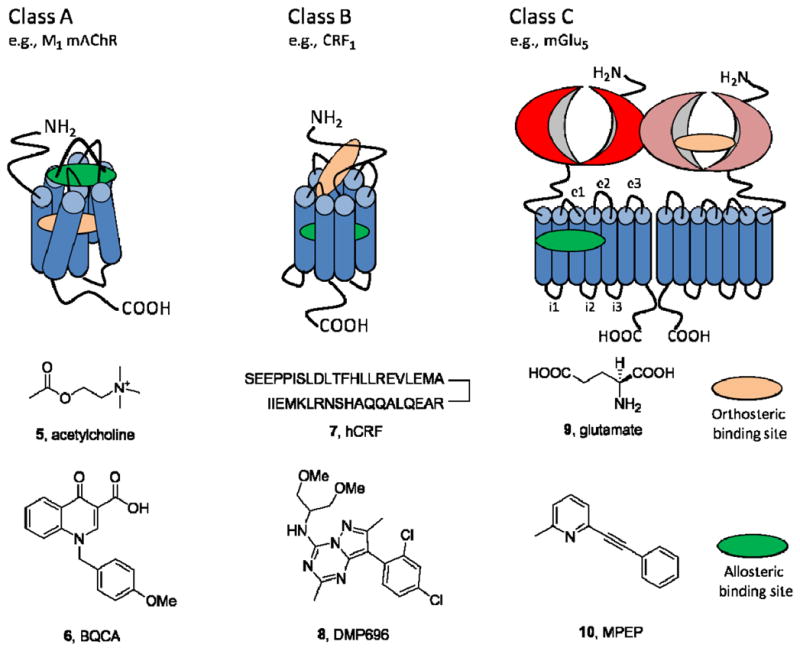
Structural topology of typical orthosteric and allosteric sites of Family A, B and C 7TMRs, highlighting representative orthosteric and allosteric ligands for each Family.
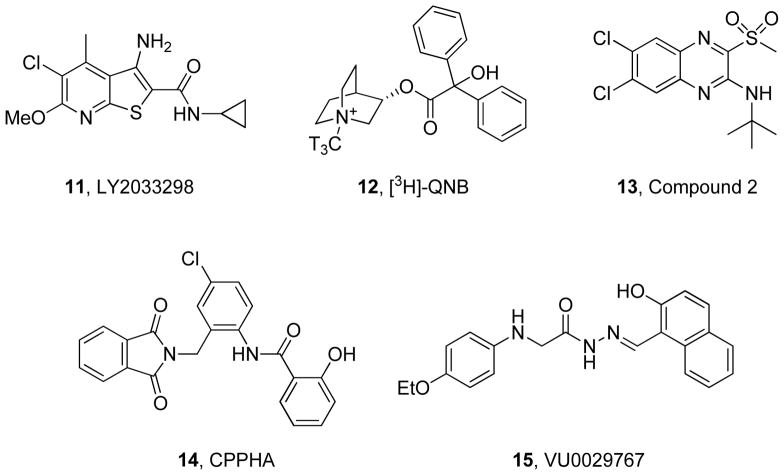
Structures of GPCR allosteric ligands 11, 13, 14 and 15 that demonstrate the concept of ‘probe dependence’, with 12, an mAChR orthosteric radioligand discussed in the text.
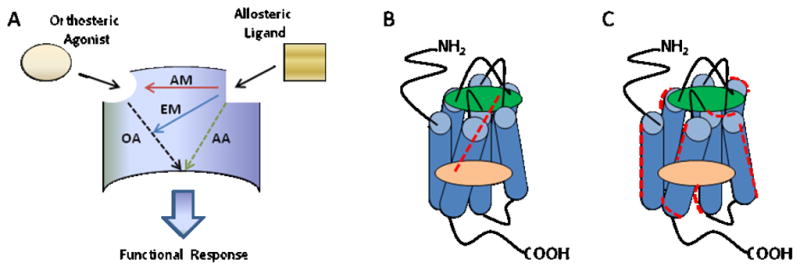
Mode of action of 7TMR allosteric modulators. A) Allosteric ligands bind to a site topographically distinct from the orthosteric site on the 7TMR to modulate either the affinity (AM, affinity modulation) or efficacy (EM, efficacy modulation). This is in contrast to direct orthosteric agonism (OA) by the native ligand or allosteric agonism (AA) by the allosteric ligand alone. B) The ‘hot wire’ mode of allostery, suggesting a direct energy link between the allosteric binding site (green) and the orthosteric binding site (peach). C) The ‘global allosteric modulation’ mode, suggesting changes at the orthosteric site are derived from global conformational variants within an ensemble of conformations.
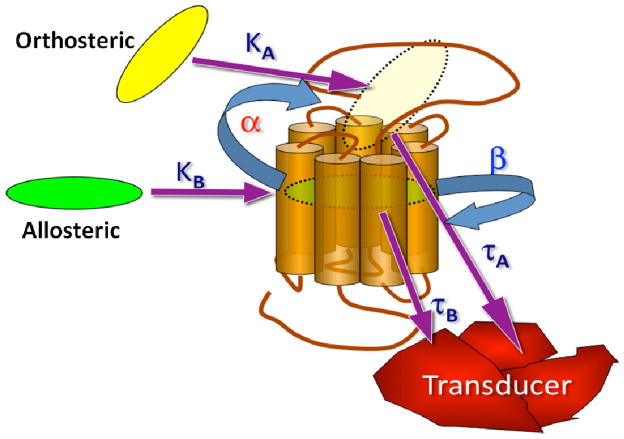
Schematic representation of the parameters underlying the operational model of allosterism and agonism. Parameters are defined in the main text.
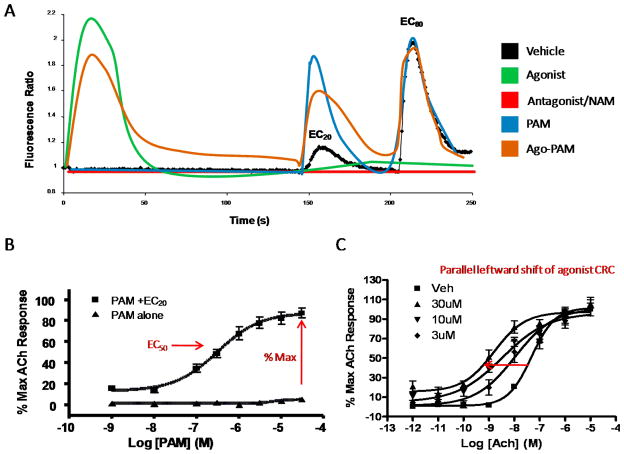
Functional assays, measuring calcium fluorescence as a surrogate for 7TMR receptor activation, employed to identify and profile 7TMR allosteric modulators. A). The ‘triple add’ paradigm for both HTS campaigns and primary assay for lead optimization. Vehicle (black) trace where an EC20 of orthosteric agonist is added 120 seconds into kinetic run, followed by an EC80 of orthosteric agonist. Compounds are added at T=0, and an agonist (green), elicits calcium fluorescence immediately upon addition. Secondary assays with orthosteric radioligands and/or mutant receptors will determine if the compound is an orthosteric or allosteric agonist. An antagonist (red) will block both the EC20 and the EC80; once again, secondary assays will distinguish competitive from noncompetitive (NAM) antagonists. A pure PAM (blue) will not elicit receptor activation alone, but will potentiate the EC20 to varying degrees of efficacy, while an ago-PAM (orange) will activate the receptor alone, plus potentiate the EC20. Hence, a single assay protocol will identify agonists, allosteric agonists, PAMs, ago-PAMs, antagonists and NAMs. B) In vitro pharmacology of an mAChR PAM, once again with a calcium fluorescence readout. The PAM has no effect alone on receptor activation, but in the presence of an EC20 (or sub-threshold concentration of orthosteric agonist, ACh in this case), a classical concentration-response-curve (CRC) results, from which an EC50 for potentiation can be calculated. Also, the %Max, the degree of potentiation above the EC20, can be measured, and both the EC50 and %Max must be optimized. C) “Fold-Shift” assay. Here, the concentration of the orthosteric agonist (ACh) is held constant, and increasing concentrations of the PAM cause a parallel leftward shift of the ACh CRC, in effect making ACh a more potent agonist.
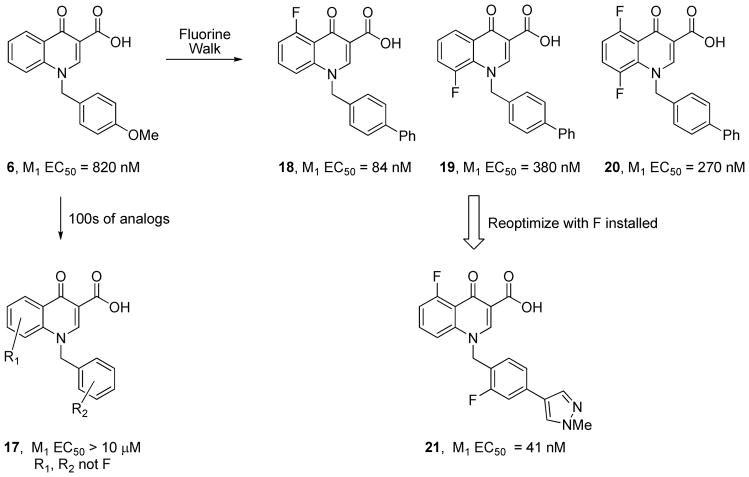
SAR within the M1 PAM 6 Chemotype. Groups R1 and R2 other than F, as in 17, were not tolerated and afforded inactive compounds. Walking fluorine atoms around the core identified three positions, leading to cores 18–20, that engendered M1 PAM activity. Re-optimization with the fluorinated cores led to potent M1 PAMs such as 21.
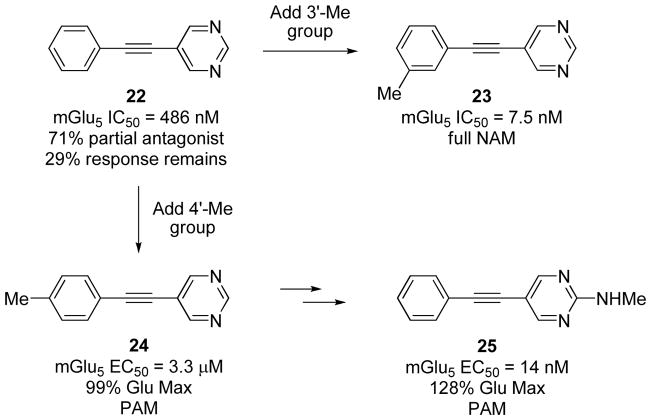
Subtle ‘molecular switches’ within a series of mGlu5 allosteric ligands giving rise to partial antagonists 22, full NAMs 23, and PAMs 24 and 25.
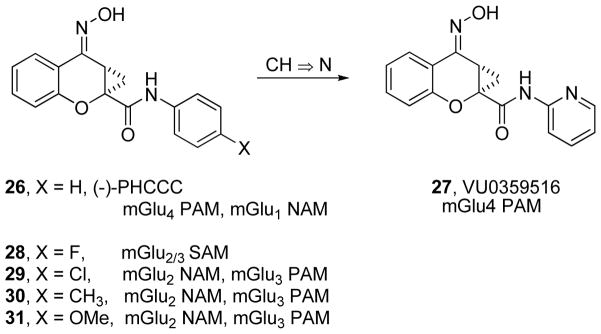
Subtle ‘molecular switches’ within a series of mGlu4 allosteric ligands providing a selective mGlu4 PAM 27, or allosteric ligands that cross over into the Group II family of mGlus and displaying mGlu2 and mGlu3 PAM, NAM and SAM activities.
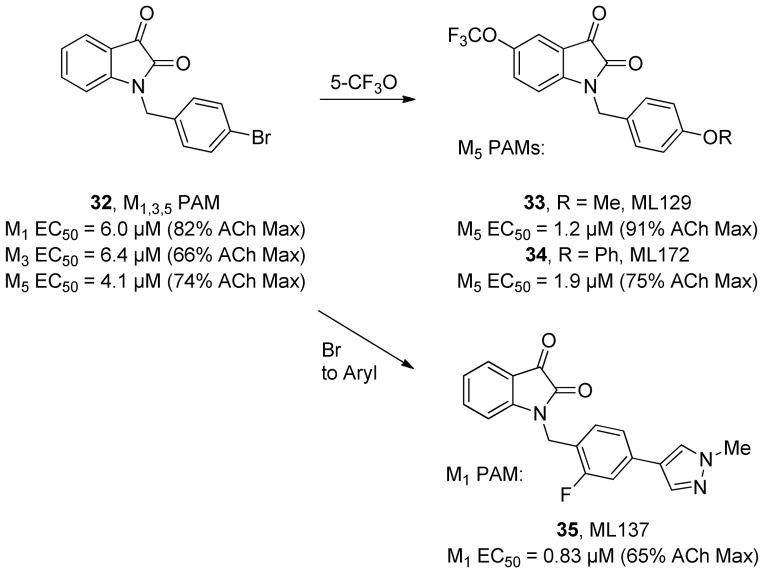
Subtle ‘molecular switches’ within a series of mAChR allosteric ligands that afford highly selective M5 PAMs 33 and 34 or a selective M1 PAM 35.
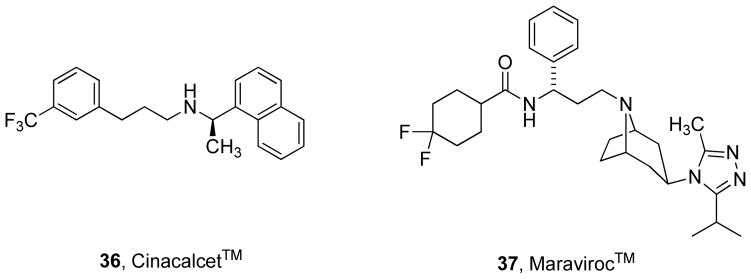
Structures of the two marketed GPCR allosteric modulators. 36, a PAM of the calcium sensing receptor and 37, a NAM of CCR5.
References
Publication types
MeSH terms
Substances
Grants and funding
LinkOut - more resources
Full Text Sources
Other Literature Sources
Chemical Information
