


Oligoclonal antibody targeting ghrelin increases energy expenditure and reduces food intake in fasted mice
- PMID: 22149064
- PMCID: PMC3273630
- DOI: 10.1021/mp200376c
Oligoclonal antibody targeting ghrelin increases energy expenditure and reduces food intake in fasted mice
Abstract
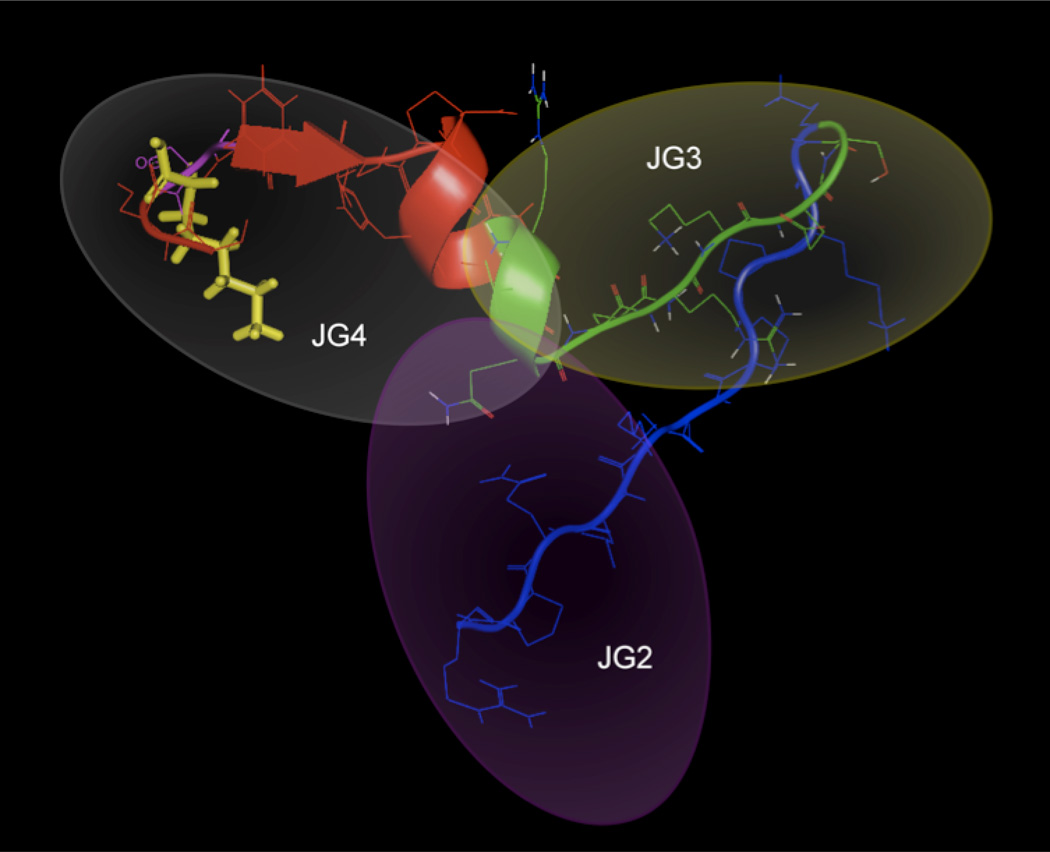
Ghrelin, an enteric peptide hormone linked to the pathophysiology of obesity has been a therapeutic target of great interest over the past decade. Many research efforts have focused on the antagonism of ghrelin's endogenous receptor GHSR1a, which is found along ascending vagal afferent fibers, as well as in the arcuate nucleus of the hypothalamus. Additionally, peptidic inhibitors of ghrelin O-acyltransferase, the enzyme responsible for the paracrine activation of ghrelin, have recently been studied. Our research has taken an alternative immunological approach, studying both active and passive vaccination as a means to sequester ghrelin in the periphery, with the original discovery in rat of decreased feed efficiency and adiposity, as well as increased metabolic activity. Using our previous hapten designs as a stepping-stone, three monoclonal antibodies (JG2, JG3, and JG4) were procured against ghrelin and tested in vivo. While mAb JG4 had the highest affinity for ghrelin, it failed to attenuate the orexigenic effects of food deprivation on energy metabolism or food intake in mice. However, animals that were administered a combination of JG3:JG4 (termed a doublet) or JG2:JG3:JG4 (termed a triplet) demonstrated higher heat dispersion and rate of respiration (higher CO(2) emission and O(2) consumption) during a 24 h fast refeed. Mice administered the triplet cocktail of JG2:JG3:JG4 also demonstrated decreased food intake upon refeeding as compared to control animals. Recently, Lu and colleagues reported that a passive approach using a single, high affinity N-terminally directed monoclonal antibody did not abrogate the effects of endogenous ghrelin. Our current report corroborates this finding, yet, refutes that a monoclonal antibody approach cannot be efficacious. Rather, we find that a multiple monoclonal antibody (oligoclonal) approach can reproduce the underlying logic to previously reported efficacies using active vaccinations.
Figures

 JG3:JG4, and
  JG2:JG3 (n=6) or a
  nicotine control Ab (n=6, NIC-1 9D9) 4 days prior to data collection; *, p < 0.05 vs. control Ab-treated mice. Dark onset begins at hrs 13–14 of the fasting stage.
 JG3:JG4, and
JG2:JG3 (n=6) or a nicotine control Ab (n=6, NIC-1 9D9) 5 days prior to data collection; *, p < 0.05, **, p < 0.01 vs. control Ab-treated mice.
JG3:JG4, and
JG2:JG3 (n=6) or a nicotine control Ab (n=6, NIC-1 9D9) 5 days prior to data collection; *, p < 0.05, **, p < 0.01 vs. control Ab-treated mice. JG3:JG4, and
JG2:JG3 (n=6) or a nicotine control Ab (n=6, NIC-1 9D9) 5 days prior to data collection.
JG3:JG4, and
JG2:JG3 (n=6) or a nicotine control Ab (n=6, NIC-1 9D9) 5 days prior to data collection.

References
-
- Allison DB, Fontaine KR, Manson JE, Stevens J, VanItallie TB. Annual deaths attributable to obesity in the United States. JAMA. 1999;282:1530–1538. - PubMed
-
- Flegal KM, Graubard BI, Williamson DF, Gail MH. Cause-specific excess deaths associated with underweight, overweight, and obesity. JAMA. 2007;298:2028–2037. - PubMed
-
- Schloegl H, Percik R, Horstmann A, Villringer A, Stumvoll M. Peptide hormones regulating appetite-focus on neuroimaging studies in humans. Diabetes Metab. Res. Rev. 2011;27:104–112. - PubMed
-
- Kojima M, Kangawa K. Ghrelin: structure and function. Physiol. Rev. 2005;85:495–522. - PubMed
-
- Cummings DE, Weigle DS, Frayo RS, Breen PA, Ma MK, Dellinger EP, Purnell JQ. Plasma ghrelin levels after diet-induced weight loss or gastric bypass surgery. N. Engl. J. Med. 2002;346:1623–1630. - PubMed
Publication types
MeSH terms
Substances
Grants and funding
LinkOut - more resources
Full Text Sources
Other Literature Sources
Medical
Miscellaneous
