


Mediators of adverse birth outcomes among socially disadvantaged women
- PMID: 22150295
- PMCID: PMC3366100
- DOI: 10.1089/jwh.2011.2766
Mediators of adverse birth outcomes among socially disadvantaged women
Abstract
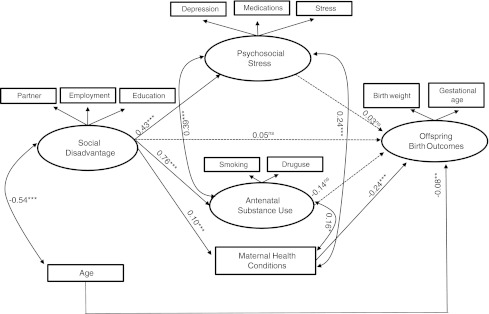
Background: Numerous studies find that socially disadvantaged women are more likely than socially advantaged women to deliver infants that weigh less than normal and/or are born weeks prior to their due date. However, little is known about the pathways that link maternal social disadvantage to birth outcomes. Using data from a prospective cohort study, we examined whether antenatal psychosocial stress, substance use, and maternal health conditions in pregnancy mediated the pathway between maternal social disadvantage and birth outcomes.
Methods: Analyses used structural equation modeling to examine data from a community clinic-based sample (n=2168) of pregnant women who completed questionnaires assessing psychosocial functioning and health behaviors as well as sociodemographic characteristics, which were matched with subsequent birth outcome data.
Results: Analyses revealed maternal social disadvantage predicted poorer birth outcomes through a mediated pathway including maternal health conditions in pregnancy.
Conclusions: The findings demonstrate that maternal social disadvantage is associated with poor health status in pregnancy, which in turn adversely affects birth outcomes. Results argue for more systematic attention to the roles of social disadvantage, including life course perspectives that trace social disadvantage prior to and through pregnancy.
Figures
References
-
- Hamilton B. Martin J. Ventura S. Births: preliminary data for 2007. National Vital Statistics Reports. http://www.cdc.gov/nchs/data/nvsr/nvsr57/nvsr57_12.pdf. [Jul 17;2011 ]. http://www.cdc.gov/nchs/data/nvsr/nvsr57/nvsr57_12.pdf - PubMed
-
- Goldenberg R. Culhane J. Low birth weight in the United States. Am J Clin Nutr. 2007;85(Suppl):584S–590S. - PubMed
-
- Martin J. Hamilton B. Sutton P. Ventura S. Mathews M. Osterman M. Births: final data for 2008. National Vital Statistics Reports. http://www.cdc.gov/nchs/data/nvsr/nvsr59/nvsr59_01.pdf. [Jul 17;2011 ]. http://www.cdc.gov/nchs/data/nvsr/nvsr59/nvsr59_01.pdf - PubMed
-
- Barker D. Eriksson J. Forsen T. Osmond C. Fetal origins of adult disease: strength of effects and biological basis. Int J Epidemiol. 2002;31:1235–1239. - PubMed
Publication types
MeSH terms
Grants and funding
LinkOut - more resources
Full Text Sources
Medical
