


Caregivers' oral health literacy and their young children's oral health-related quality-of-life
- PMID: 22150574
- PMCID: PMC3305855
- DOI: 10.3109/00016357.2011.629627
Caregivers' oral health literacy and their young children's oral health-related quality-of-life
Abstract
Objectives: To investigate the association of caregivers' oral health literacy (OHL) with their children's oral health related-quality of life (C-OHRQoL) and explore literacy as a modifier in the association between children's oral health status (COHS) and C-OHRQoL.
Methods: This study relied upon data from structured interviews with 203 caregivers of children aged 3-5 from the Carolina Oral Health Literacy (COHL) Project. Data were collected for OHL using REALD-30, caregiver-reported COHS using the NHANES-item and C-OHRQoL using the Early Childhood Oral Health Impact Scale (ECOHIS). This study also measured oral health behaviors (OHBs) and socio-demographic characteristics and calculated overall/stratified summary estimates for OHL and C-OHRQoL. Spearman's rho and 95% confidence intervals (CI) were computed as measures of correlation of OHL and COHS with C-OHRQoL. To determine whether OHL modified the association between COHS and C-OHRQoL, this study compared literacy-specific summary and regression estimates.
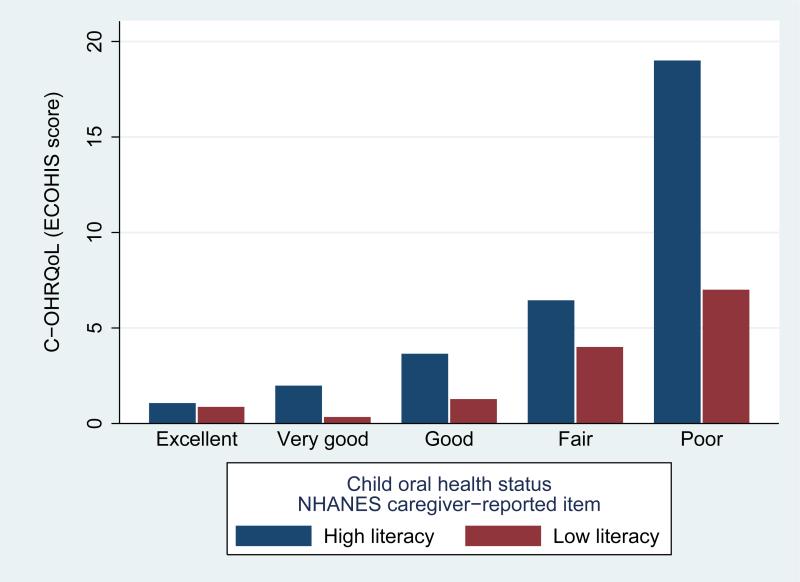
Results: Reported COHS was: excellent-50%, very good-28%, good-14%, fair-6%, poor-2%. The aggregate C-OHRQoL mean score was 2.0 (95% CI: 1.4, 2.6), and the mean OHL score 15.9 (95% CI: 15.2, 16.7). There was an inverse relationship between COHS and C-OHRQoL: ρ = -0.32 (95% CI: -0.45, -0.18). There was no important association between OHL and C-OHRQoL; however, deleterious OHBs were associated with worse C-OHRQoL. Literacy-specific linear and Poisson regression estimates of the association between COHS and C-OHRQoL departed from homogeneity (Wald χ(2) p < 0.2).
Conclusion: In this community-based sample of caregiver/child dyads, a strong correlation was found between OHS and C-OHRQoL. The association's magnitude and gradient were less pronounced among caregivers with low literacy.
Figures
References
-
- American Academy of Pediatric Dentistry (AAPD) [April 12 2011];Definition of dental disability. 2008 Available at: http://www.aapd.org/media/Policies_Guidelines/D_DentalDisability.pdf.
-
- American Academy of Pediatric Dentistry (AAPD) [April 12 2011];Policy on early childhood caries (ECC): Classification, consequences, and preventive strategies. 2008 Available at: http://www.aapd.org/media/Policies_Guidelines/P_ECCClassifications.pdf. - PubMed
-
- Hale KJ, American Academy of Pediatrics Section on Pediatric Dentistry Oral health risk assessment timing and establishment of the dental home. Pediatrics. 2003;111(5 Pt 1):1113–6. - PubMed
-
- Mouradian WE. The face of a child: children's oral health and dental education. J Dent Educ. 2001;65:821–31. - PubMed
-
- US Department of Health and Human Services . In: Oral Health in America: A Report of the Surgeon General. Rockville Md., editor. Vol. 7. National Institute of Dental and Craniofacial Research, National Institutes of Health, US Dept of Health and Human Services; 2000. pp. 158–68.
Publication types
MeSH terms
Substances
Grants and funding
LinkOut - more resources
Full Text Sources
Medical
