Review
. 2012 Jan;22(1):89-98.
doi: 10.1111/j.1750-3639.2011.00544.x.

Autophagy in brain tumors: a new target for therapeutic intervention

Affiliations
Review

Autophagy in brain tumors: a new target for therapeutic intervention

Niroop Kaza et al. Brain Pathol. 2012 Jan.

Abstract

The role of autophagy, traditionally considered a cellular homeostatic and recycling mechanism, has expanded dramatically to include an involvement in discrete stages of tumor initiation and development. Gliomas are the most aggressive and also the most common brain malignancies. Current treatment modalities have only a modest effect on patient outcomes. Resistance to apoptosis, a hallmark of most cancers, has driven the search for novel targets in cancer therapy. The autophagy lysosomal pathway is one such target that is being explored in multiple cancers including gliomas and is a promising avenue for further therapeutic development. This review summarizes our current understanding of the autophagic process and its potential utility as a target for glioma therapy.


Figures

Figure 1
Figure 1
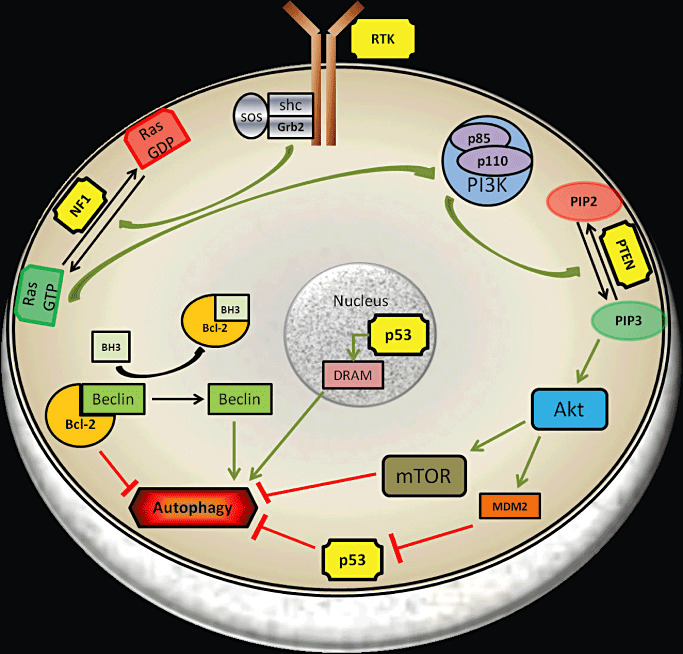
Schematic illustration of common mutations seen in gliomas and their role in autophagy regulation. Mutations in receptor tyrosine kinases (EGFR, PDGFR), phosphatase and tensin homolog (PTEN), NF1 and p53 are frequently observed in gliomas (yellow boxes). Aberrant signals from the RTK and/or Ras pathways feed into the PI3K–AKT–mTOR axis altering the autophagic machinery of the tumor cell. Nuclear p53 induces autophagy whereas cytoplasmic localization of p53 negatively regulates autophagy. BCL‐2 is bound to BECLIN, which is required for induction of autophagy and BH3‐only molecules like BNIP3 release BECLIN from BCL‐2 resulting in autophagy induction. Abbreviations: DRAM, damage‐regulated autophagy modulator; GDP, guanosine diphosphate; GTP, guanosine triphosphate; mTOR, mammalian target of rapamycin; PIP3, phosphatidylinositol (3,4,5)‐triphosphate; PIP2, phosphatidylinositol (4,5)‐bisphosphate; RTK, receptor tyrosine kinase; SOS, son of sevenless.
Figure 2
Figure 2
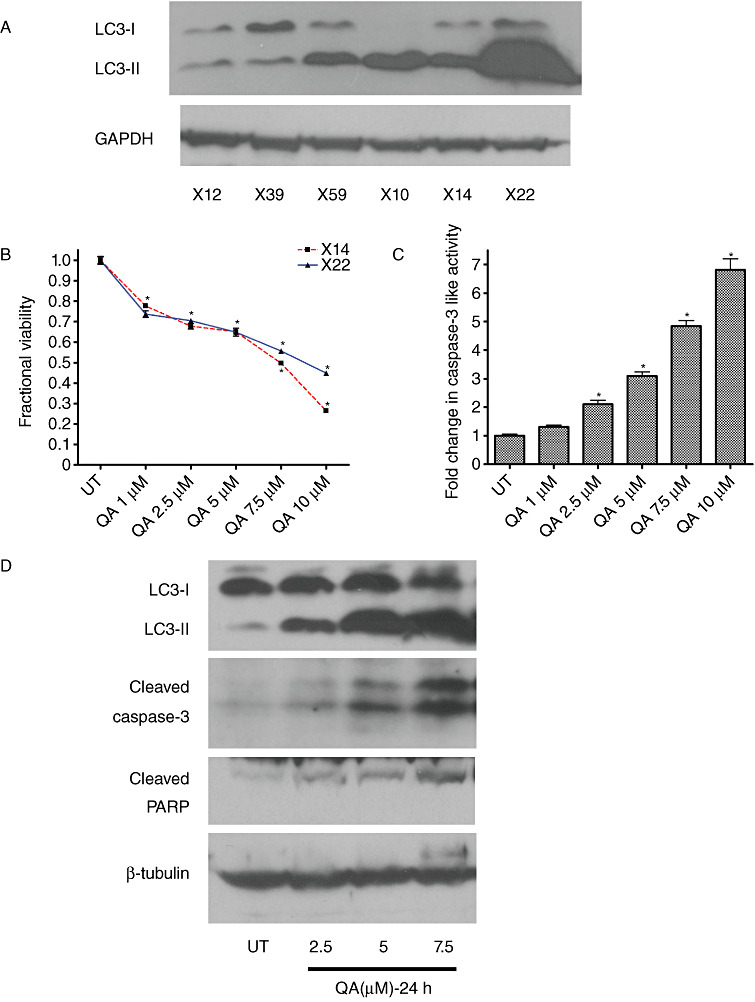
Assessment of baseline level and quinacrine (QA)‐induced autophagy and tumoricidal activity in xenograft derived glioma cells in vitro. Baseline levels of LC3 I and II vary in xenografts derived from different molecular subtypes of gliomas (A). X12 is a xenograft classified as proneural, X39 and X59 are classified as classical and X10, X14 and X22 are classified as mesenchymal subtype. QA induces a concentration‐dependent (B) decrease in viability and an increase in levels of (C) caspase‐3 like activity (D) LC3‐II, cleaved caspase 3 and cleaved poly (ADP‐ribose) polymerase (PARP). Data shown in (C) and (D) are from xenografts X14 and X12, respectively. Error bars represent standard deviation (SD) measurements that are less than 5% of the mean value (*P < 0.05).
Figure 3
Figure 3
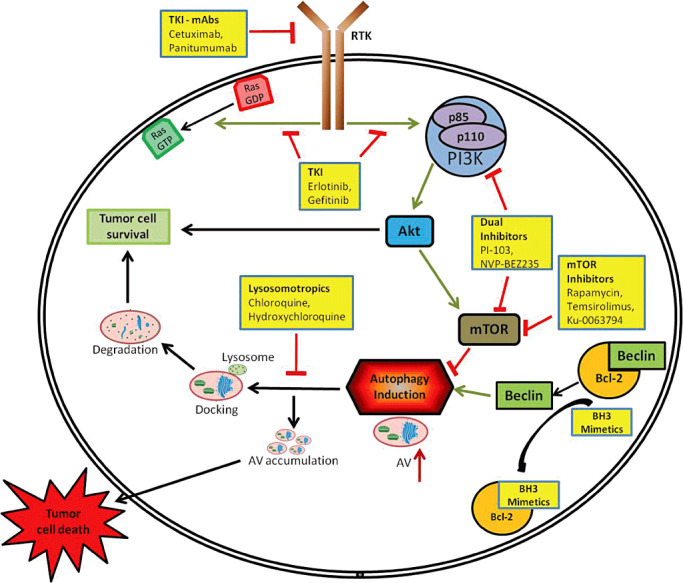
Therapies modulating the autophagy lysosomal pathway. Tyrosine kinase inhibitors (monoclonal antibodies and small molecules) block RTK/Ras signaling upstream of the PI3‐K–AKT–mTOR axis. Inhibitors for PI3‐K and/or mTOR act on their specific targets resulting in the inhibition of mTOR, which induces autophagy. BH3 mimetics induce autophagy by disrupting the BECLIN–BCL‐2 interaction. These agents when combined with lysosomotropic drugs result in the disruption of the autophagy‐lysosomal pathway, leading to accumulation of autophagic vacuoles ultimately resulting in tumor cell death. Abbreviations: DRAM; damage‐regulated autophagy modulator; GDP, guanosine diphosphate; GTP, guanosine triphosphate; mTOR, mammalian target of rapamycin; PI3‐K, phosphoinositide 3‐kinase; RTK, receptor tyrosine kinase.

References

    1. Alonso MM, Jiang H, Yokoyama T, Xu J, Bekele NB, Lang FF et al (2008) Delta‐24‐RGD in combination with RAD001 induces enhanced anti‐glioma effect via autophagic cell death. Mol Ther 16:487–493. - PubMed
    1. Aoki H, Kondo Y, Aldape K, Yamamoto A, Iwado E, Yokoyama T et al (2008) Monitoring autophagy in glioblastoma with antibody against isoform B of human microtubule‐associated protein 1 light chain 3. Autophagy 4:467–475. - PubMed
    1. Arico S, Petiot A, Bauvy C, Dubbelhuis PF, Meijer AJ, Codogno P, Ogier‐Denis E (2001) The tumor suppressor PTEN positively regulates macroautophagy by inhibiting the phosphatidylinositol 3‐kinase/protein kinase B pathway. J Biol Chem 276:35243–35246. - PubMed
    1. Bellot G, Garcia‐Medina R, Gounon P, Chiche J, Roux D, Pouyssegur J, Mazure NM (2009) Hypoxia‐induced autophagy is mediated through hypoxia‐inducible factor induction of BNIP3 and BNIP3L via their BH3 domains. Mol Cell Biol 29:2570–2581. - PMC - PubMed
    1. Carrasco‐Garcia E, Saceda M, Grasso S, Rocamora‐Reverte L, Conde M, Gomez‐Martinez A et al (2011) Small tyrosine kinase inhibitors interrupt EGFR signaling by interacting with erbB3 and erbB4 in glioblastoma cell lines. Exp Cell Res 317:1476–1489. - PubMed

Publication types

Substances