. 2012 Feb;14(2):503-16.
doi: 10.1111/j.1462-2920.2011.02662.x. Epub 2011 Dec 12.

TPV1, the first virus isolated from the hyperthermophilic genus Thermococcus

Affiliations

TPV1, the first virus isolated from the hyperthermophilic genus Thermococcus

Aurore Gorlas et al. Environ Microbiol. 2012 Feb.

Abstract

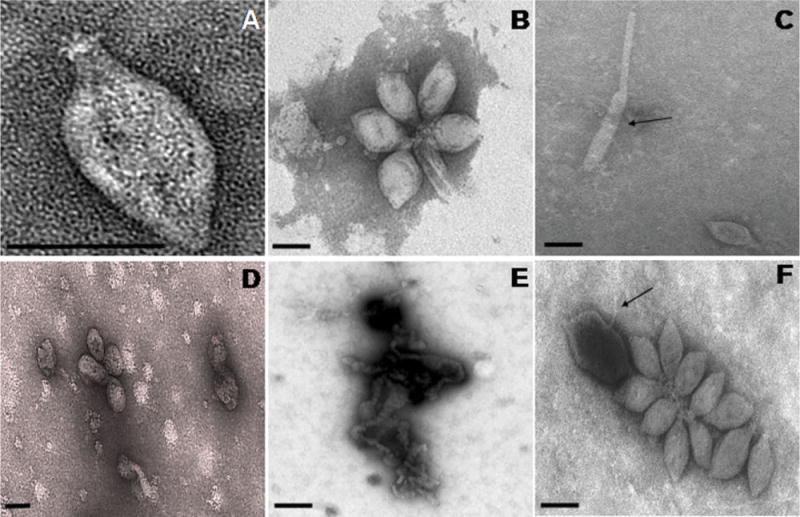
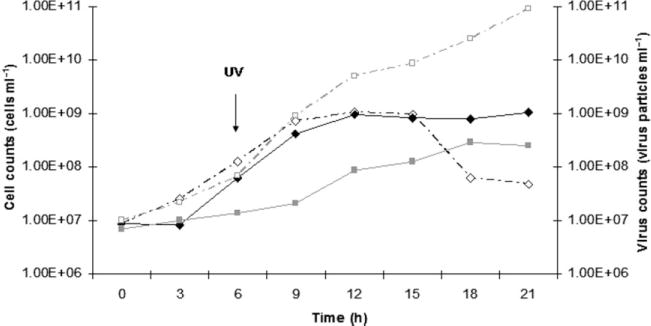
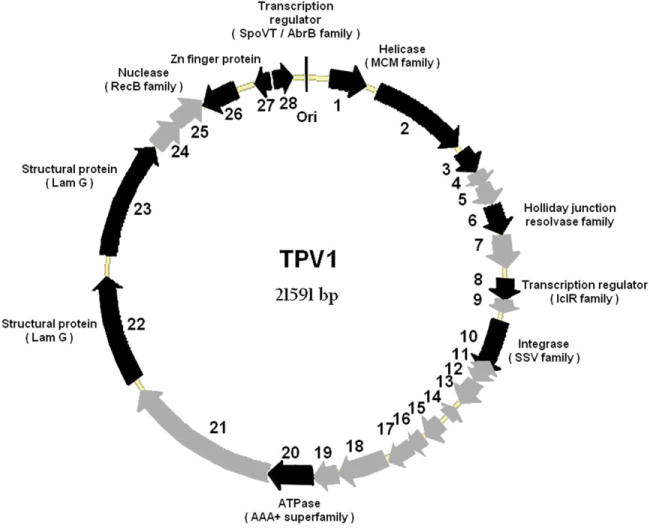
We describe a novel virus, TPV1 (Thermococcus prieurii virus 1), which was discovered in a hyperthermophilic euryarchaeote isolated from a deep-sea hydrothermal chimney sample collected at a depth of 2700 m at the East Pacific Rise. TPV1 is the first virus isolated and characterized from the hyperthermophilic euryarchaeal genus Thermococcus. TPV1 particles have a lemon-shaped morphology (140 nm × 80 nm) similar to the structures previously reported for Fuselloviruses and for the unclassified virus-like particle PAV1 (Pyrococcus abyssi virus 1). The infection with TPV1 does not cause host lysis and viral replication can be induced by UV irradiation. TPV1 contains a double-stranded circular DNA of 21.5 kb, which is also present in high copy number in a free form in the host cell. The TPV1 genome encompasses 28 predicted genes; the protein sequences encoded in 16 of these genes show no significant similarity to proteins in public databases. Proteins predicted to be involved in genome replication were identified as well as transcriptional regulators. TPV1 encodes also a predicted integrase of the tyrosine recombinase family. The only two genes that are homologous between TPV1 and PAV1 are TPV1-22 and TPV1-23, which encode proteins containing a concanavalin A-like lectin/glucanase domain that might be involved in virus-host recognition.


Figures

Fig. 1
Fig. 1
A. Electron micrographs of TPV1 negatively stained with 2% uranyl acetate. Lemon shaped particle with a tail terminated by fibres. B. Clusters of virus particles forming rosette-like aggregates. C. Elongated virus particles (arrow). D. Effect of exposure to chloroform on virus particle structure. E. Disrupted virions caused by exposure to proteinase K. F. Effect of acidic pH on virions structure (arrow). Scale bars represent 120 nm.
Fig. 2
Fig. 2
Typical growth curve (black diamonds) of the host and production of TPV1 (grey squares). UV induction. Cultures were grown and irradiated for 1 h (white diamonds) and the virus counts were estimated by epifluorescence microscopy (white squares).
Fig. 3
Fig. 3
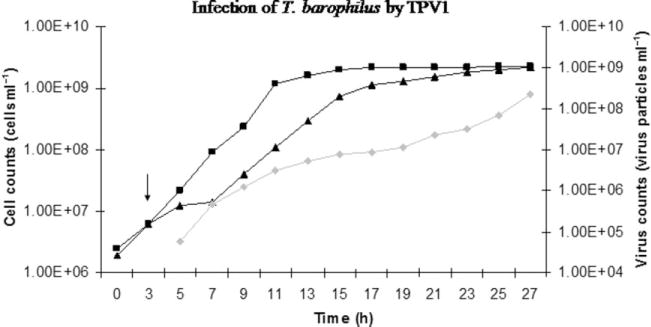
Infection of T. barophilus by TPV1. Squares: cells of T. barophilus non-infected. Triangles: cells of T. barophilus infected with TPV1. Diamonds: free TPV1 virions. The arrow indicates the addition of TPV1 virions in the culture.
Fig. 4
Fig. 4
TPV1 genome map. Predicted genes are presented by thick arrows; grey arrows indicate ORFs with no similarity or unassigned function and black arrows indicate either conserved hypothetical ORFs or ORFs with an attributed function. The approximate location of the origin (Ori) of replication is also indicated.
Fig. 5
Fig. 5
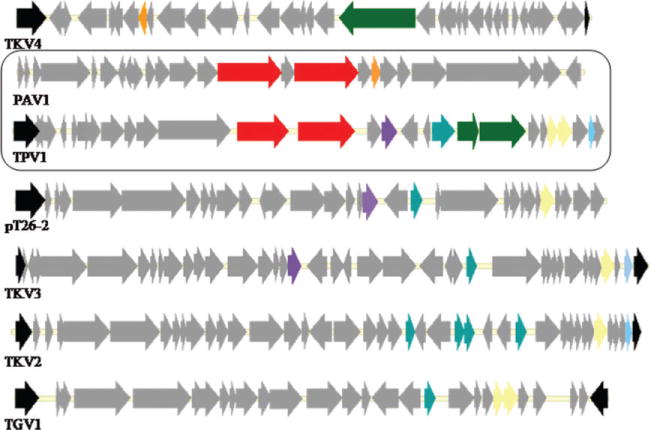
Alignment of the genomes of TKV2-4, pT26-2, TGV1, PAV1 and TPV1, with a focus on genes present in the TPV1 and/or PAV1 genomes, and shared with other euryarchaeal genes are a colour coded as follows: integrase in black, the LamG domain protein in red, the MCM protein in green, transcription regulator SpoVT/AbrB in dark blue and the resolvase in yellow. Orange, light blue and mauve ORFs represent genes encoding uncharacterized conserved proteins.

References

    1. Achenbach-Richter CR. Rooting the archaebacterial tree: the pivotal role of Thermococcus celer in archaebacterial evolution. Syst Appl Microbiol. 1988;10:231–240. - PubMed
    1. Altschul SF, Madden TL, Schäffer AA, Zhang J, Zhang Z, Miller W, Lipman DJ. Gapped BLAST and PSI-BLAST: a new generation of protein database search programs. Nucleic Acids Res. 1997;17:3389–3402. - PMC - PubMed
    1. Aravind L, Walker DR, Koonin EV. Conserved domains in DNA repair proteins and evolution of repair systems. Nucleic Acids Res. 1999;5:1223–1242. - PMC - PubMed
    1. Aravind L, Makarova KS, Koonin EV. SURVEY AND SUMMARY: holliday junction resolvases and related nucleases: identification of new families, phyletic distribution and evolutionary trajectories. Nucleic Acids Res. 2000;18:3417–3432. - PMC - PubMed
    1. Bath C, Cukalac T, Porter K, Dyall-Smith ML. His1 and His2 are distantly related, spindle-shaped haloviruses belonging to the novel virus group, Salterprovirus. Virology. 2006;350:228–239. - PubMed

Publication types

Associated data

LinkOut - more resources