


Contingency management in substance abuse treatment: a structured review of the evidence for its transportability
- PMID: 22153943
- PMCID: PMC3307900
- DOI: 10.1016/j.drugalcdep.2011.11.011
Contingency management in substance abuse treatment: a structured review of the evidence for its transportability
Abstract
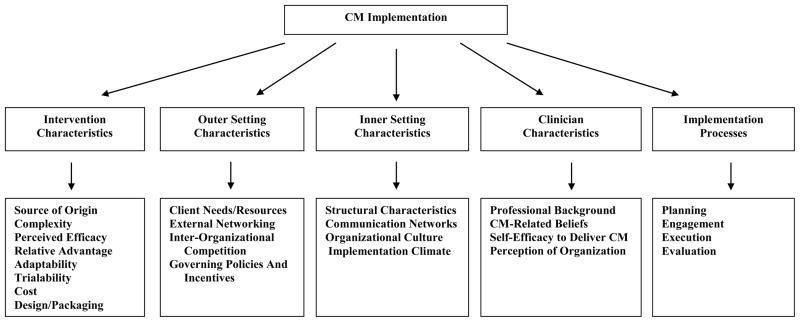
Aims: Extant literature on contingency management (CM) transportability, or its transition from academia to community practice, is reviewed. The Consolidated Framework for Implementation Research (CFIR; Damschroder et al., 2009) guides the examination of this material.
Methods: PsychInfo and Medline database searches identified 27 publications, with reviewed reference lists garnering 22 others. These 49 sources were examined according to CFIR domains of the intervention, outer setting, inner setting, clinicians, and implementation processes.
Results: Intervention characteristics were focal in 59% of the identified literature, with less frequent focus on clinicians (34%), inner setting (32%), implementation processes (18%), and outer setting (8%). As intervention characteristics, adaptability and trialability most facilitate transportability whereas non-clinical origin, perceived inefficacy or disadvantages, and costs are impediments. Clinicians with a managerial focus and greater clinic tenure and CM experience are candidates to curry organizational readiness for implementation, and combat staff disinterest or philosophical objection. A clinic's technology comfort, staff continuity, and leadership advocacy are inner setting characteristics that prompt effective implementation. Implementation processes in successful demonstration projects include careful fiscal/logistical planning, role-specific staff engagement, practical adaptation in execution, and evaluation via fidelity-monitoring and cost-effectiveness analyses. Outer setting characteristics-like economic policies and inter-agency networking or competition-are salient, often unrecognized influences.
Conclusions: As most implementation constructs are still moving targets, CM transportability is in its infancy and warrants further scientific attention. More effective dissemination may necessitate that future research weight emphasis on external validity, and utilize models of implementation science.
Published by Elsevier Ireland Ltd.
Conflict of interest statement
All authors declare that they have no conflict of interest related to this work.
Figures
References
-
- Alessi SM, Hanson T, Wieners M, Petry NM. Low-cost contingency management in community clinics: delivering incentives partially in group therapy. Exp Clin Psychopharm. 2007;15:293–300. - PubMed
-
- Amass L, Kamien JB. Funding contingency management in community clinics: use of community donations and clinic rebates. In: Higgins ST, Silverman K, Heil SH, editors. Contingency Management in Substance Abuse Treatment. Guilford Press; New York: 2008. pp. 280–297.
-
- Andrzejewski ME, Kirby KC, Morral AR, Iguchi MY. Technology transfer through performance management: the effects of graphical feedback and positive reinforcement on drug treatment counselors’ behavior. Drug Alcohol Depend. 2001;63:179–186. - PubMed
-
- ATTC. The Change Book: A Blueprint for Technology Transfer. Addiction Technology Transfer Center; Kansas City, MO: 2004.
Publication types
MeSH terms
Grants and funding
LinkOut - more resources
Full Text Sources
Medical
Research Materials
