


Innovation adoption as facilitated by a change-oriented workplace
- PMID: 22154030
- PMCID: PMC3268854
- DOI: 10.1016/j.jsat.2011.10.014
Innovation adoption as facilitated by a change-oriented workplace
Abstract
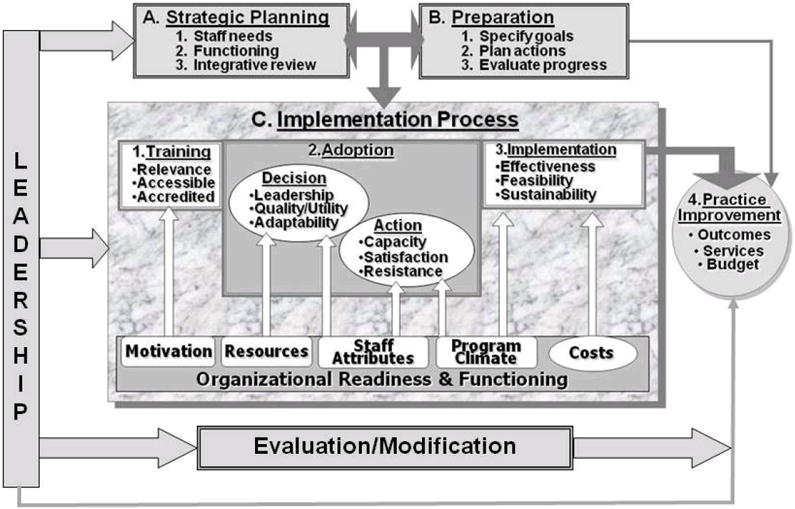
One of the unique contributions of this study is a glimpse into the process by which counselors decide to try new innovations in their clinical work. Data were collected from 421 counseling staff from 71 outpatient treatment programs in 4 U.S. regions. Using hierarchical linear modeling, results reveal that the propensity to adopt workshop-based interventions is facilitated by two important mechanisms: (a) an innovative organization with creative leadership and (b) change-oriented staff attributes (i.e., seeking professional growth, efficacy, adaptability, and influence on others). Innovative leaders and a climate receptive to change also bolster the development of these change-oriented attributes. One implication of these findings is the cascading effect of leaders' support of innovative thinking and action resulting in employees strengthening their own adaptive skills and carrying this innovative thinking into individual adoption.
Copyright © 2012 Elsevier Inc. All rights reserved.
Figures
References
-
- Avolio BJ, Bass BM. Multifactor Leadership Questionnaire: Manual and sampler set. 3. Menlo Park, CA: Mind Garden, Inc; 2004.
-
- Avolio BJ, Bass BM, Jung DI. Re-examining the components of transformational and transactional leadership using the Multifactor Leadership Questionnaire. Journal of Occupational and Organizational Psychology. 1999;72:441–462.
-
- Bandura A. The explanatory and predictive scope of self-efficacy theory. Journal of Social & Clinical Psychology. 1986;4:359–373.
-
- Baron R, Kenny D. The moderator–mediator variable distinction in social psychological research: Conceptual, strategic, and statistical considerations. Journal of Personality and Social Psychology. 1986;51:1173–1182. - PubMed
Publication types
MeSH terms
Grants and funding
LinkOut - more resources
Full Text Sources
