Review
. 2012 Jan;35(1):57-67.
doi: 10.1016/j.tins.2011.10.004. Epub 2011 Dec 6.

Cortical parvalbumin interneurons and cognitive dysfunction in schizophrenia

Affiliations
Review

Cortical parvalbumin interneurons and cognitive dysfunction in schizophrenia

David A Lewis et al. Trends Neurosci. 2012 Jan.

Abstract

Deficits in cognitive control, a core disturbance of schizophrenia, appear to emerge from impaired prefrontal gamma oscillations. Cortical gamma oscillations require strong inhibitory inputs to pyramidal neurons from the parvalbumin basket cell (PVBC) class of GABAergic neurons. Recent findings indicate that schizophrenia is associated with multiple pre- and postsynaptic abnormalities in PVBCs, each of which weakens their inhibitory control of pyramidal cells. These findings suggest a new model of cortical dysfunction in schizophrenia in which PVBC inhibition is decreased to compensate for an upstream deficit in pyramidal cell excitation. This compensation is thought to rebalance cortical excitation and inhibition, but at a level insufficient to generate the gamma oscillation power required for high levels of cognitive control.


Figures

Figure 1
Figure 1
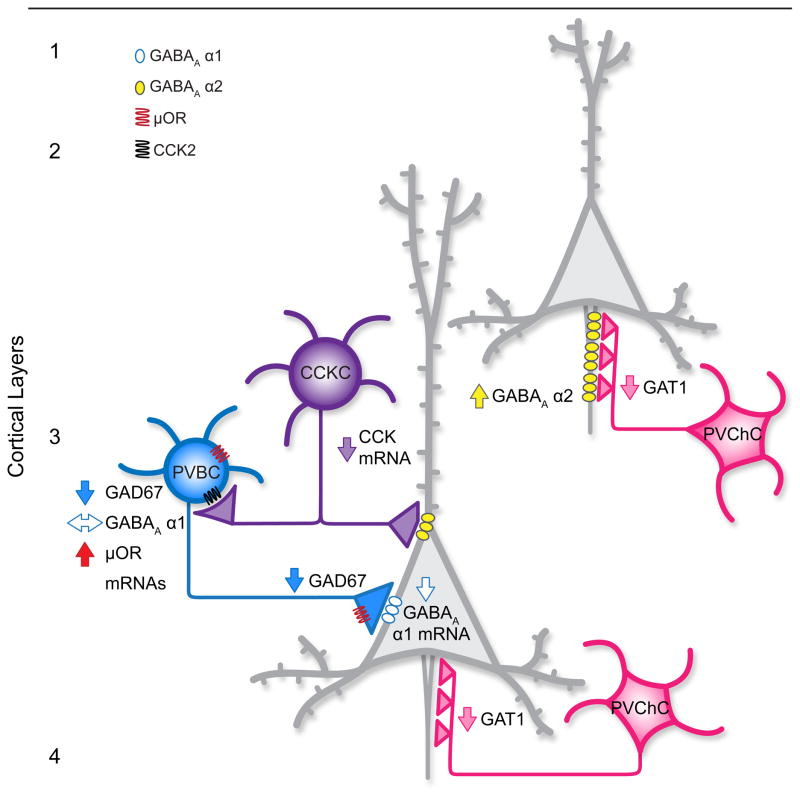
Schematic summary of alterations in neuronal circuitry in layer 3 of the DLPFC in subjects with schizophrenia. The perisomatic inhibition of pyramidal neurons (gray neurons) by parvalbumin-positive basket cells (PVBCs) is reduced due to 1) lower GAD67 mRNA expression [39] and lower GAD67 protein [23], and hence less GABA synthesis; 2) higher levels of μ opioid receptor expression in PVBCs which reduces their activity and suppresses GABA release [77]; 3) reduced expression of cholecystokinin (CCK) mRNA [28,41] which stimulates the activity of, and GABA release from, PVBCs [–81]; and 4) less mRNA for, and presumably fewer, postsynaptic GABAA α1 receptors in pyramidal neurons [63]. These alterations are shown only for the pyramidal neuron in deep layer 3, but are likely present throughout layer 3. Chandelier neurons (PVChCs) have decreased GABA membrane transporter 1 (GAT1) protein in their axon terminals [47,48] and increased postsynaptic GABAA α2 receptors in pyramidal neuron axon initial segments [49], suggesting enhanced GABA signaling and increased excitation of pyramidal neurons if these inputs are depolarizing [51,53]. Because relatively few GABAA α2-labeled axon initial segments are detectable in layers deep 3–4 of the adult primate DLPFC [100], perhaps reflecting the postnatal developmental decline in mRNA expression of this subunit in the primate DLFPC [101], it is unclear whether postsynaptic GABAA α2 receptors are increased in deep layer 3 pyramidal neurons in schizophrenia. Levels of GAD67 protein in PVChC axon terminals in schizophrenia are not known.
Figure 2
Figure 2
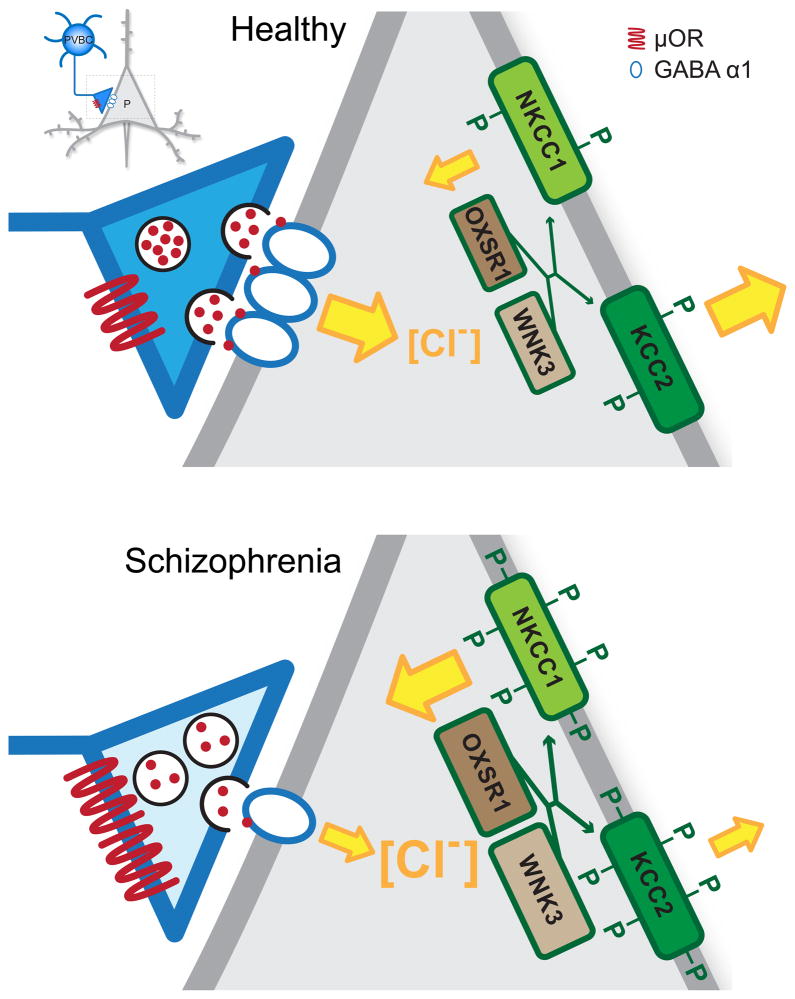
Summary of regulators of GABA neurotransmission from a parvalbumin-positive basket cell (PVBC) terminal to a layer 3 pyramidal cell (gray neuron, insert) in the DLPFC from a healthy subject (top) and a subject with schizophrenia (bottom). In both panels, the size and orientation of the yellow arrows indicates the magnitude and direction of chloride (Cl) ion flow mediated by the Cl transporters N+-K+-Cl-cotransporter 1 (NKCC1) and K+-Cl-cotransporter 2 (KCC2) and Cl channels in α1-containing GABAA receptors. In healthy adult neurons, intracellular Cl concentration is low due to low levels of NKCC1 and high levels of KCC2. The binding of GABA (red dots) to α1-containing GABAA receptors triggers Cl entry and membrane hyperpolarization. In schizophrenia, lower levels of GAD67 (light blue shading) in PVBC axon terminals [23] lead to less GABA synthesis. The release of GABA is further suppressed by greater signaling through up-regulated μ opioid receptors (μOR) [77], and the effects of GABA are reduced due to fewer postsynaptic α1-containing GABAA receptors [63]. Higher levels of two kinases (OXSR1 and WNK3) [69] are thought to lead to increased phosphorylation (green P) of both Cl transporters and consequently increased NKCC1 activity and decreased KCC2 activity, producing a greater intracellular Cl concentration. Thus, upon activation of the α1-containing GABAA receptors, Cl influx is reduced and GABA neurotransmission is less hyperpolarizing.
Figure 3
Figure 3
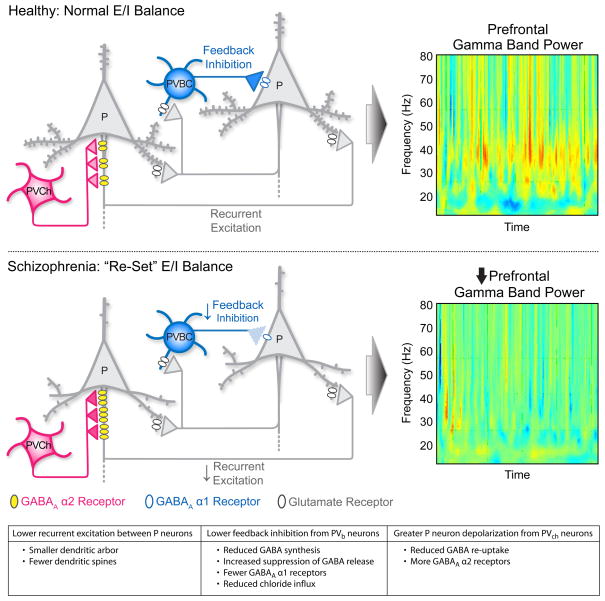
Connectivity between pyramidal (P) neurons and parvalbumin-positive basket (PVBC) and chandelier (PVChC) cells in DLPFC layer 3. Reciprocal connections formed by the local axon collaterals of pyramidal neurons provide recurrent excitation, whereas the excitatory inputs from pyramidal neurons to PV basket cells furnish feedback inhibition. These connections are critical for generating gamma band oscillations, and the strengths of these connections are adjusted to maintain normal E/I balance in the healthy brain (top panel). In schizophrenia (bottom panel), lower spine density in layer 3 pyramidal neurons is hypothesized to result in lower network excitation, evoking a compensatory reduction in feedback inhibition of pyramidal neurons from PVBCs (less presynaptic GAD67; fewer postsynaptic GABAA α1 receptors) and increased depolarization of pyramidal neurons by PVChs (less presynaptic GABA membrane transporter 1; more postsynaptic GABAA α2 receptors). The resulting “re-set” of E/I balance at a lower level of both excitation and inhibition renders the circuit less able to generate normal levels of gamma band power, resulting in impaired cognition. Heat maps are reproduced, with permission, from [8] © (2006) Proceedings of the National Academy of Sciences.

References

    1. Keefe RS, Fenton WS. How should DSM-V criteria for schizophrenia include cognitive impairment? Schizophr Bull. 2007;33:912–920. - PMC - PubMed
    1. Reichenberg A, et al. Static and dynamic cognitive deficits in childhood preceding adult schizophrenia: a 30-year study. Am J Psychiatry. 2010;167:160–169. - PMC - PubMed
    1. Green MF. Cognitive impairment and functional outcome in schizophrenia and bipolar disorder. J Clin Psychiatry. 2006;67(Suppl 9):3–8. - PubMed
    1. Lesh TA, et al. Cognitive control deficits in schizophrenia: mechanisms and meaning. Neuropsychopharm. 2011;36:316–338. - PMC - PubMed
    1. Miller EK, Cohen JD. An integrative theory of prefrontal cortex function. Annu Rev Neurosci. 2001;24:167–202. - PubMed

Publication types

MeSH terms