


Multiple degradation pathways regulate versatile CIP/KIP CDK inhibitors
- PMID: 22154077
- PMCID: PMC3298816
- DOI: 10.1016/j.tcb.2011.10.004
Multiple degradation pathways regulate versatile CIP/KIP CDK inhibitors
Abstract
The mammalian CIP/KIP family of cyclin-dependent kinase (CDK) inhibitors (CKIs) comprises three proteins--p21(Cip1/WAF1), p27(Kip1), and p57(Kip2)--that bind and inhibit cyclin-CDK complexes, which are key regulators of the cell cycle. CIP/KIP CKIs have additional independent functions in regulating transcription, apoptosis and actin cytoskeletal dynamics. These divergent functions are performed in distinct cellular compartments and contribute to the seemingly contradictory observation that the CKIs can both suppress and promote cancer. Multiple ubiquitin ligases (E3s) direct the proteasome-mediated degradation of p21, p27 and p57. This review analyzes recent data highlighting our current understanding of how distinct E3 pathways regulate subpopulations of the CKIs to control their diverse functions.
Copyright © 2011 Elsevier Ltd. All rights reserved.
Figures

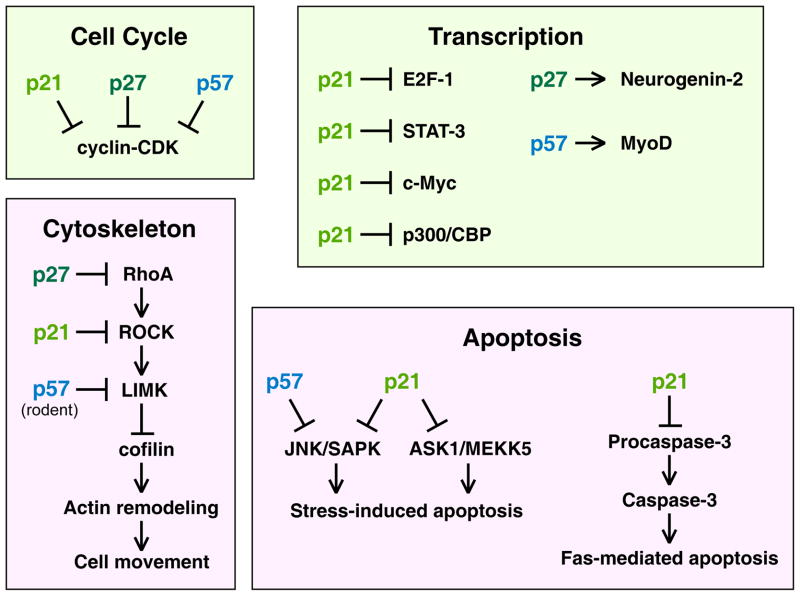
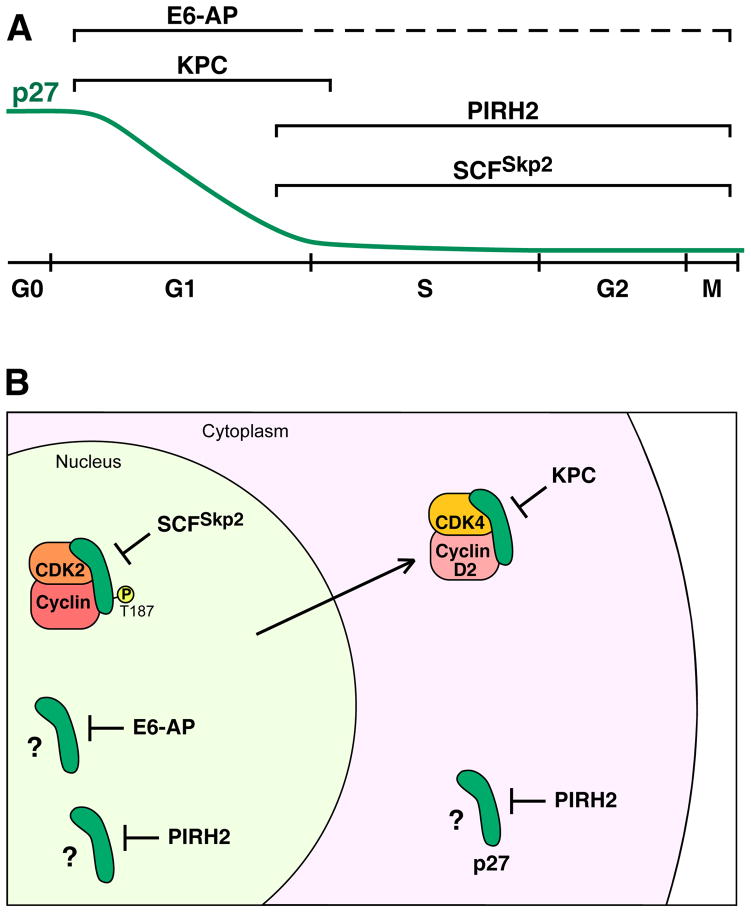
 is an inhibitory symbol, and an arrow is an activating symbol. See text for details.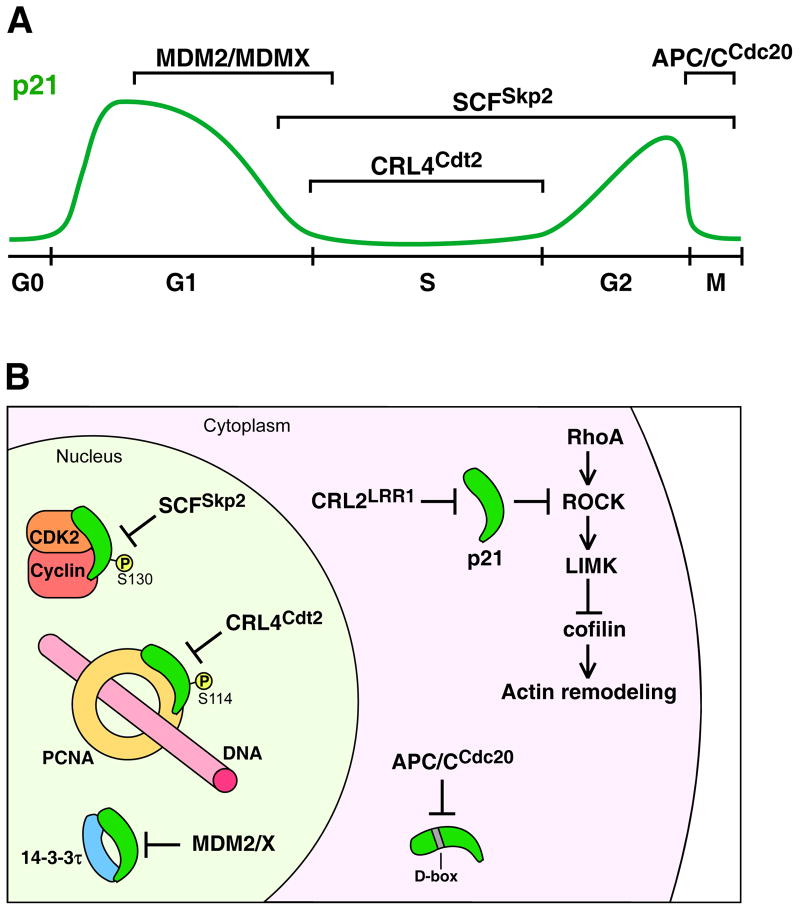
References
-
- Murray AW. Recycling the cell cycle: cyclins revisited. Cell. 2004;116:221–234. - PubMed
-
- Besson A, et al. CDK inhibitors: cell cycle regulators and beyond. Dev Cell. 2008;14:159–169. - PubMed
-
- Glickman MH, Ciechanover A. The ubiquitin-proteasome proteolytic pathway: destruction for the sake of construction. Physiol Rev. 2002;82:373–428. - PubMed
-
- Sherr CJ, Roberts JM. CDK inhibitors: positive and negative regulators of G1-phase progression. Genes Dev. 1999;13:1501–1512. - PubMed
Publication types
MeSH terms
Substances
Grants and funding
LinkOut - more resources
Full Text Sources
Miscellaneous
