Review
. 2012 Feb;37(2):49-57.
doi: 10.1016/j.tibs.2011.10.005. Epub 2011 Dec 7.

MultiBac: expanding the research toolbox for multiprotein complexes

Affiliations
Review

MultiBac: expanding the research toolbox for multiprotein complexes

Christoph Bieniossek et al. Trends Biochem Sci. 2012 Feb.

Abstract

Protein complexes composed of many subunits carry out most essential processes in cells and, therefore, have become the focus of intense research. However, deciphering the structure and function of these multiprotein assemblies imposes the challenging task of producing them in sufficient quality and quantity. To overcome this bottleneck, powerful recombinant expression technologies are being developed. In this review, we describe the use of one of these technologies, MultiBac, a baculovirus expression vector system that is particularly tailored for the production of eukaryotic multiprotein complexes. Among other applications, MultiBac has been used to produce many important proteins and their complexes for their structural characterization, revealing fundamental cellular mechanisms.


Figures

Figure I
Figure I
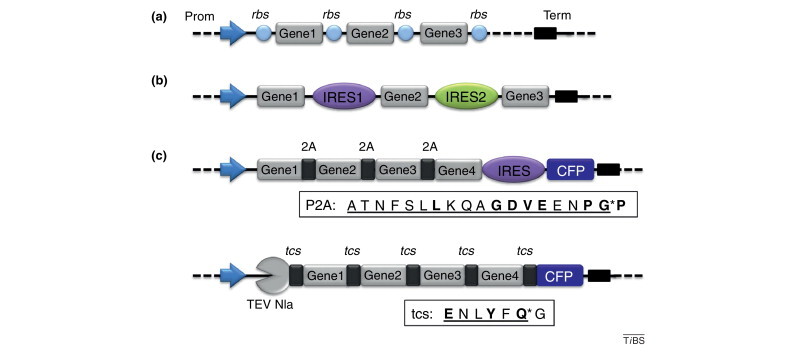
Tools for expression of protein complexes. (a) Protein complexes can be produced efficiently in E. coli by using polycistrons. In polycistrons, genes of interest are spaced apart by ribosome binding sites (rbs) and placed under control of a single promoter (Prom). A sequence (Term) ensures termination of mRNA transcription. One or several polycistrons can be provided on one or more plasmids simultaneously in one cell. (b) The equivalent construction for eukaryotic expression provides IRESs instead of rbs, resulting also in polycistronic mRNAs. (c) Polyproteins are particularly useful to balance the stoichiometry of expressed proteins. Polyprotein constructions can provide self-cleaving peptides derived from picornavirus (2A) in between the individual proteins (top). A fluorescent protein (here CFP) can be included to facilitate tracking of heterologous expression from the respective promoter by fluorescence measurement. As an alternative, polyproteins can be used that contain a highly specific protease [here tobacco etch virus (TEV) Nla], which processes the polyprotein by cleaving corresponding cleavage sites (tcs), thus liberating the individual proteins including itself (bottom). Both polyprotein strategies have the drawback of decorating the C terminus of the preceding protein with overhanging residues that are part of the cleavage sequence (boxed). Asterisks denote sites of cleavage. Conserved residues defining the site are in bold. C-terminal overhangs are underlined.
Figure 1
Figure 1
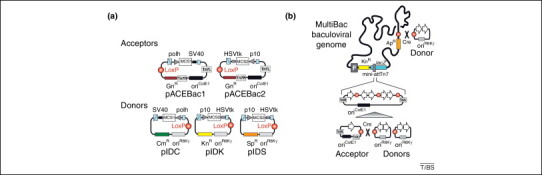
The MultiBac system. MultiBac is a baculovirus expression vector system particularly tailored for high-quality multiprotein complex production in insect cells. (a) MultiBac consists of an array of small (3 kb), synthetic DNA plasmids called acceptors and donors. Acceptors have a regular origin of replication (oriColE1), whereas donors have a conditional origin derived from R6Kγ phage (oriR6kγ) that requires special bacterial strains for their propagation. Donors and acceptors contain expression cassettes controlled by late baculoviral promoters (polh or p10) as well as strong eukaryotic polyadenylation signals (from SV40 or HSVtk). All plasmids contain the LoxP sequence (circles filled in red) for fusing donors to an acceptor by the Cre recombinase. Each plasmid has a different resistant marker: gentamycin resistance (GnR) for acceptors, and either chloramphenicol (CmR), kanamycin (KnR) or spectinomycin (SpR) resistance for donors. In addition, a ‘multiplication’ module is present to facilitate the assembly of several expression cassettes on a donor or acceptor based on specifically designed restriction sites (e.g. homing endonucleases and BstXI restriction endonuclease, shown as blue boxes flanking promoter and terminator, respectively) , , . Acceptors contain the DNA sequences (Tn7L and Tn7R) required for transposition by the Tn7 transposase. (b) The assembly of a composite MultiBac baculoviral genome for multigene expression. Genes are inserted into donors and acceptors by using either restriction endonucleases and ligase, or sequence-independent and ligation-independent cloning methods (bottom). Cre-mediated fusion produces a multigene construction that is inserted into the baculoviral genome by Tn7 transposition in specifically tailored E. coli cells that contain the viral DNA (also known as a bacmid). The DNA located between the Tn7R and Tn7L sequences in the multigene fusion construct is inserted by the transposase enzyme into the Tn7 attachment site (mini-attTn7). The MultiBac baculovirus was engineered for improved protein production and delayed host cell lysis by deleting specific genes . The combination of sequence and ligation independent cloning (SLIC) for gene insertion and Cre–LoxP fusion for multigene construct generation is called tandem recombineering and can be performed in a parallelized mode on microtiter plates, optionally on a robot . Further heterologous genes can be inserted into an additional LoxP site present on the bacmid. Composite baculoviral DNA is then purified from the bacteria and used to transfect insect cells. Virus is expanded by infecting small-volume (50–100 ml) insect cell cultures and harvesting the budded virus particles released into the culture media. This virus is then used for protein complex expression in larger (typically one to several liters) insect cell cultures , .
Figure 2
Figure 2
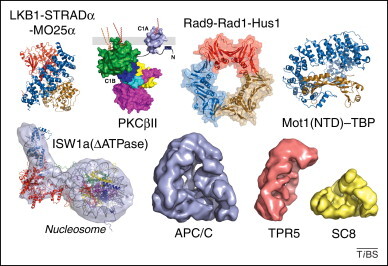
MultiBac expression for structural biology. The MultiBac system has been successfully used to produce many proteins and their complexes in high-quality for structural analysis. The structures of LKB1–STRADα–MO25α (PDB 2WTK) , a tumor suppressor kinase complex, the PKCβII kinase (PDB 3PFQ) , and the Rad9–Rad1–Hus1 complex, a DNA damage checkpoint complex (PDB 3G65) , were determined by X-ray crystallography providing crucial insight into the function of these important proteins. The crystal structure of the N-terminal domain (NTD) of the chromatin remodeler Mot1 bound to the TATA-box binding protein (TBP) showed a molecular bottle-opener for TBP (PDB 3G65) , . In a hybrid approach involving EM and X-ray crystallography, a structure of a different chromatin remodeling enzyme, ISW1 (lacking the ATPase domain), bound to a nucleosomal template was elucidated (PDB 2Y9Z and EMD-1877) . Strikingly, the entire 13 subunit yeast APC/C, an E3 ubiquitin ligase essential for the cell cycle, was assembled by MultiBac (Box 3) as well as two multisubunit APC/C subcomplexes (TPR5 and SC8), leading to structures revealing many details of APC/C assembly by EM (EMD-1844, 1841 and 1845) . Molecular illustrations were prepared with PyMOL (http://www.pymol.org/).
Figure I
Figure I
Architecture of Mediator head. The seven-subunit, 223-kDa complex was produced by MultiBac, crystallized and the X-ray structure determined . (a) A representative gel section from SDS-PAGE showing the quality of sample prepared. (b) The crystal structure in a schematic view (top) and in an identically color-coded ribbon representation superimposed on the experimental electron density (bottom). Density is displayed at 4 Å resolution (contoured at 1.5 σ).
Figure 3
Figure 3
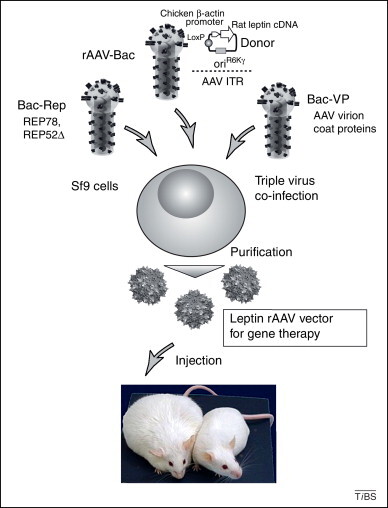
Application of the MultiBac system in gene therapy. rAAV particles are produced by co-infection with three different baculoviruses , . Bac-Rep harbors two expression cassettes that contain genes for the major AAV replication enzyme, Rep78, and an N-terminal truncation of Rep78, Rep52Δ. rAAV-Bac contains AAV inverted terminal repeat (ITR) elements that are required for rescue, replication and packaging of transgene sequences, together with rat leptin cDNA under the control of a chicken β-actin promoter, which is inserted into the rAAV-Bac baculoviral genome by Cre–LoxP-mediated fusion of a specifically tailored donor plasmid . Leptin is a hormone that acts in the brain to reduce food intake and stimulate energy expenditure. Bac-VP produces the AAV virion coat proteins. Complete rAAV virions containing the leptin gene are produced in triply co-infected insect cells and purified , , and then administered to diet-induced obese rats. An obese rat is shown compared to a normal rat for illustration (bottom). Diet-induced obesity renders laboratory rats (and presumably other species) resistant to leptin treatment. Therefore, it is close to impossible to curtail diet-induced weight gain. This could be overcome by circumventing leptin resistance or restoring leptin actions in obese animals. The surprising outcome of the study involving baculovirus-produced leptin rAAV as a gene therapy vector was that exercise, in this study wheel-running, was required to prevent completely weight gain when combined with the leptin gene therapy intervention, leading to the conclusion that work-out, in tandem with leptin gene delivery, may actually develop into a potential antiobesity treatment . The baculovirus schematic drawing is adapted from an image kindly supplied by K. J. Airenne (University of Kuopio, Finland). The rAAV particles shown are based on PDB entry 1LP3 .

References

    1. Nie Y., et al. Getting a grip on complexes. Curr. Genomics. 2009;10:558–572. - PMC - PubMed
    1. Puig O., et al. The tandem affinity purification (TAP) method: a general procedure of protein complex purification. Methods. 2001;24:218–229. - PubMed
    1. Gavin A.C., et al. Functional organization of the yeast proteome by systematic analysis of protein complexes. Nature. 2002;415:141–147. - PubMed
    1. Gavin A.C., et al. Proteome survey reveals modularity of the yeast cell machinery. Nature. 2006;440:631–636. - PubMed
    1. Robinson C.V., et al. The molecular sociology of the cell. Nature. 2007;450:973–982. - PubMed

Publication types

Substances

LinkOut - more resources