


Periprosthetic infections after shoulder hemiarthroplasty
- PMID: 22154310
- PMCID: PMC3310339
- DOI: 10.1016/j.jse.2011.08.067
Periprosthetic infections after shoulder hemiarthroplasty
Abstract
Background: To examine the rates and predictors of deep periprosthetic infections after shoulder hemiarthroplasty.
Methods: We used prospectively collected institutional registry data on all primary shoulder hemiarthroplasty patients from 1976-2008. We estimated survival free of deep periprosthetic infections using Kaplan-Meier survival curves. Using univariate Cox regression analyses, we examined the association of patient-related factors (age, sex, body mass index), comorbidity (Deyo-Charlson index), American Society of Anesthesiologists grade, underlying diagnosis, and implant fixation with the risk of infection.
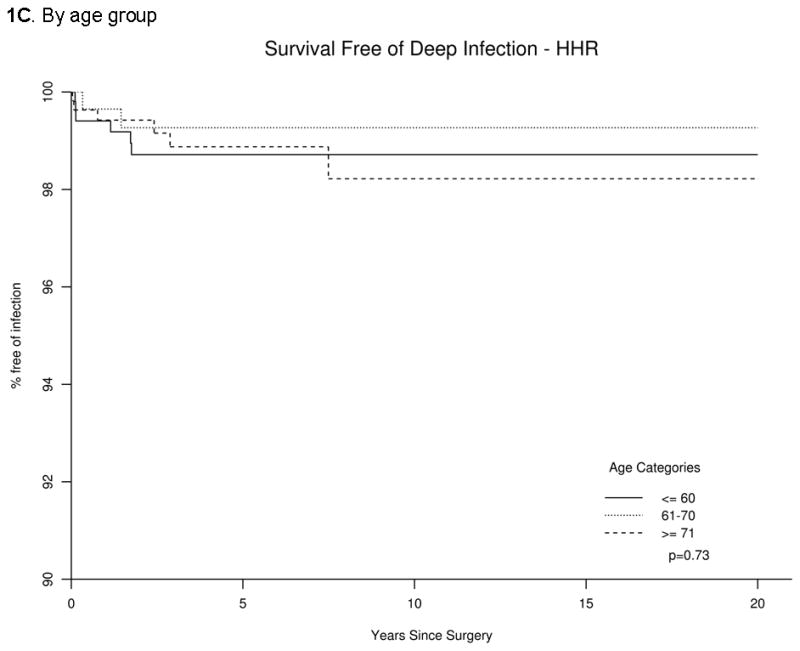
Results: A total of 1,349 patients, with a mean age of 63 years (SD, 16 years), 63% of whom were women, underwent 1,431 primary shoulder hemiarthroplasties. Mean follow-up was 8 years (SD, 7 years). Fourteen deep periprosthetic infections occurred during the follow-up, confirmed by medical record review. The most common organisms were Staphylococcus aureus, coagulase-negative Staphylococcus, and Propionibacterium acnes, each accounting for 3 cases (21% each). The 5-, 10-, and 20-year prosthetic infection-free rates were 98.9% (95% confidence interval [CI], 98.3%-99.5%), 98.7% (95% CI, 98.1%-99.4%), and 98.7% (95% CI, 98.1%-99.4%), respectively. None of the factors evaluated were significantly associated with risk of prosthetic infection after primary shoulder hemiarthroplasty, except that an underlying diagnosis of trauma was associated with a significantly higher hazard ratio of 3.18 (95% CI, 1.06-9.56) for infection compared with all other diagnoses (P = .04). A higher body mass index showed a non-statistically significant trend toward an association with higher hazard (P = .13).
Conclusion: The periprosthetic infection rate after shoulder hemiarthroplasty was low, estimated at 1.3% at 20-year follow-up. An underlying diagnosis of trauma was associated with a higher risk of periprosthetic infection. These patients should be observed closely for development of infection.
Published by Mosby, Inc.
Conflict of interest statement
J.A.S. has received speaker honoraria from Abbott; research and travel grants from Allergan, Takeda, Savient, Wyeth and Amgen; and consultant fees from Savient, URL pharmaceuticals and Novartis.
J.W.S. has received royalties from Aircast and Biomet, consultant fees from Tornier and owns stock in Tornier.
R.H.C. has received royalties from Smith and Nephew.
Figures



References
-
- Cofield RH, Edgerton BC. Total shoulder arthroplasty: complications and revision surgery. Instr Course Lect. 1990;39:449–62. - PubMed
Publication types
MeSH terms
Grants and funding
LinkOut - more resources
Full Text Sources
Medical
