Review
. 2012 Feb;24(1):3-8.
doi: 10.1016/j.smim.2011.11.006. Epub 2011 Dec 7.

The secret languages of coevolved symbioses: insights from the Euprymna scolopes-Vibrio fischeri symbiosis

Affiliations
Review

The secret languages of coevolved symbioses: insights from the Euprymna scolopes-Vibrio fischeri symbiosis

Margaret McFall-Ngai et al. Semin Immunol. 2012 Feb.

Abstract

Recent research on a wide variety of systems has demonstrated that animals generally coevolve with their microbial symbionts. Although such relationships are most often established anew each generation, the partners associate with fidelity, i.e., they form exclusive alliances within the context of rich communities of non-symbiotic environmental microbes. The mechanisms by which this exclusivity is achieved and maintained remain largely unknown. Studies of the model symbiosis between the Hawaiian squid Euprymna scolopes and the marine luminous bacterium Vibrio fischeri provide evidence that the interplay between evolutionarily conserved features of the innate immune system, most notably MAMP/PRR interactions, and a specific feature of this association, i.e., luminescence, are critical for development and maintenance of this association. As such, in this partnership and perhaps others, symbiotic exclusivity is mediated by the synergism between a general animal-microbe 'language' and a 'secret language' that is decipherable only by the specific partners involved.


Figures

Fig. 1
Fig. 1
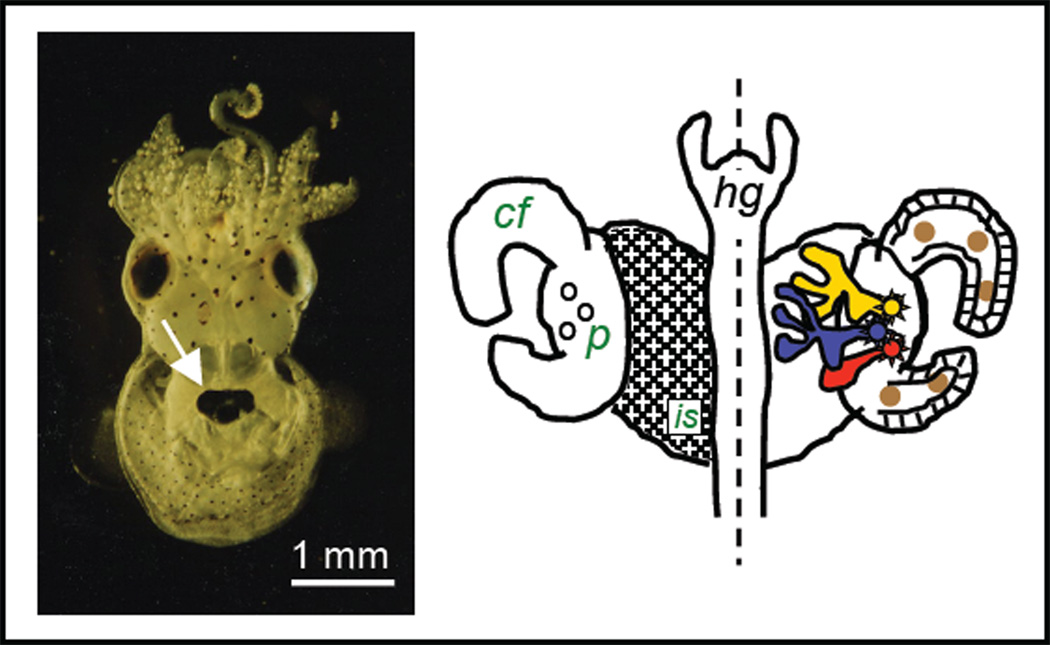
The light organ system of Euprymna scolopes. Left, a ventral view of a juvenile animal showing the location of the light organ in the mantle cavity (white arrow). Symbiont-containing tissue is surrounded by the ink sac, diverticula of which serve to modulate symbiont light emission from the animal. Right, the external (left half) and internal (right half) features of the juvenile light organ. The surface of the organ is covered by a ciliated field (cf), which overlies the ink sac (is), at the base of which are three pores (p), the sites of symbiont entry into host tissues during initial inoculation of the organ. Right, small numbers of symbiont cells enter the three pores and travel into three independent blind-ended crypt spaces (red, blue, yellow), where they grow out and begin to luminesce. Association of the symbiont cells with host tissues induces hemocyte (brown spheres) trafficking into the blood sinus of the ciliated field. hg, hindgut.
Fig. 2
Fig. 2
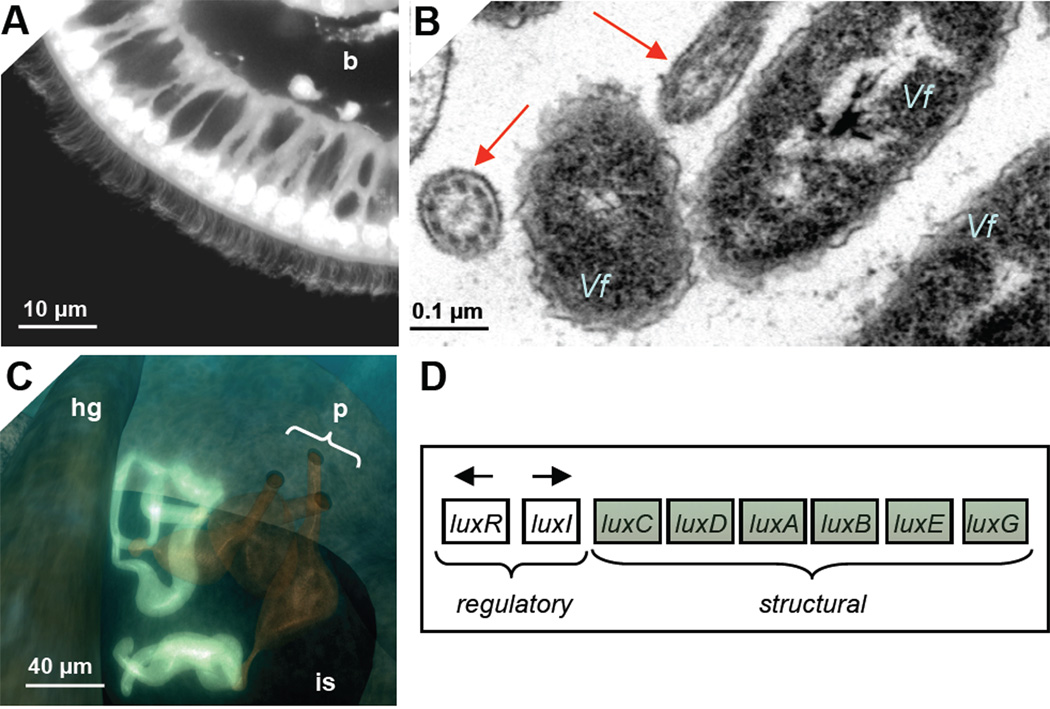
Host tissues and bacterial light production. Light is produced at and perceived by two regions of the organ, the ciliated field and the crypt spaces. A. The ciliated epithelial field where symbiont cells first associate with host tissues. The epithelium is a single layer overlying a blood sinus (b). B. Symbiont cells (Vf) closely associate with host cilia (red arrows). C. Following migration from the cilia into the pores (p), the bacterial population grows out and luminesces in the crypts (bright blue). D. The lux operon. The regulatory genes operate to sense symbiont cell density in the phenomenon called quorum sensing. When the population grows to high enough density, the transcription of the structural genes, which encode substrates and enzymes of the light reaction, is induced. is, ink sac; hg, hindgut.
Fig. 3
Fig. 3
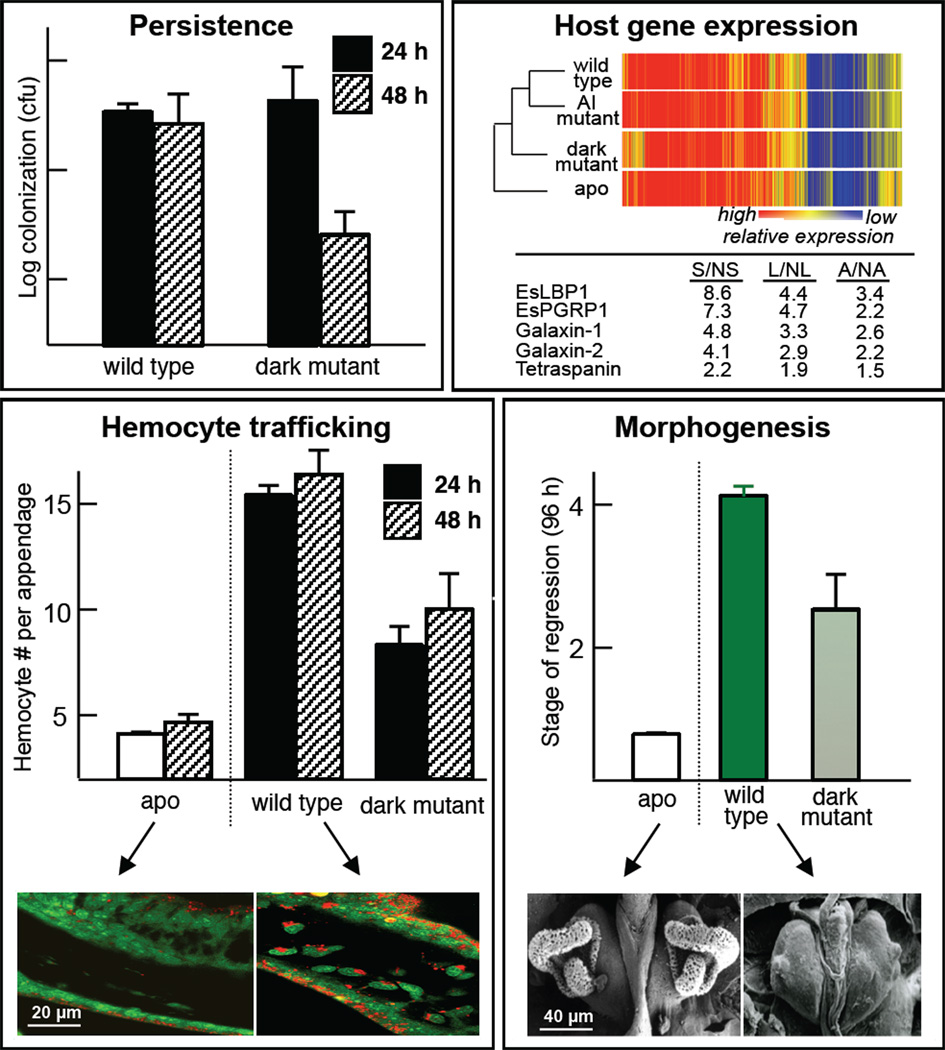
The importance of light production to normal symbiosis. Upper left, mutants defective in light production (Δlux, ‘dark mutant’) fail to persist in the host organ. No defect occurs with colonization, as these mutants colonize to wild-type levels at 24 h, but by 48 h, the population has diminished several fold and the colonization of these mutants is entirely lost within days. Upper right, dark mutants are defective in inducing normal symbiosis-induced changes in the expression of several genes. A heat map (upper) analysis shows that the absence of symbiont luminescence dramatically affects the overall patterns of the transcriptome. Most notable is the defect in changes in expression of genes encoding the MAMPs-interacting proteins, EsLBP1 and EsPGRP1. Lower left, dark mutants are defective in inducing normal activities of host cells, including hemocyte trafficking into the blood sinus. Lower right, dark mutants are also defective in normal development, i.e., in the symbiosis-induced loss of the ciliated field.
Fig. 4
Fig. 4
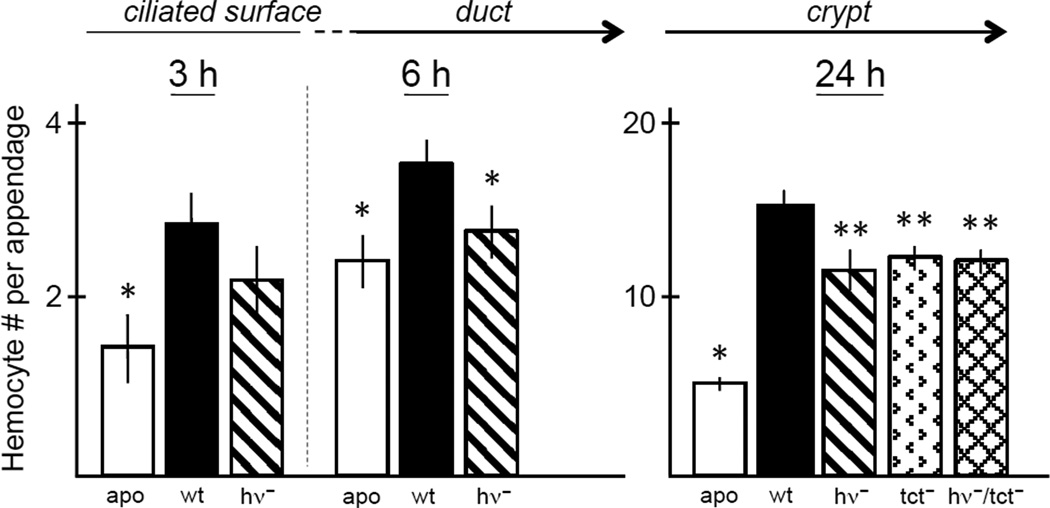
Host responses to V. fischeri cells uninduced and induced for light production, and the interplay with MAMPs. Animals are exposed to bacteria-rich seawater in the absence (apo) or presence of V. fischeri, either wild-type (wt) or mutant. Left graphs, perception of the small amount of light produced by uninduced V. fischeri cells. As early as 3 h, when bacteria are attaching to the cilia (left graph), a statistically significant (*) increase in hemocyte trafficking into the appendages of the ciliated fields can be observed in animals exposed to wild-type symbionts. Mutants defective in light production (hv-) show less, although not statistically significant, induced trafficking than wild-type (wt). By 6 h, when symbionts are moving through the ducts and into the crypts, both apo and mutants defective in light production are statistically significantly different (*) from wild-type. Right graph, responses at 24 h to V. fischeri cells in the crypts, which are induced for luminescence. Mutants defective in light continue to be defective in hemocyte trafficking. Mutants defective in transport of TCT (tct-), the principal inducer of this host phenotype, also show a defect, but the double mutant (hv-/tct-) does not show synergy of these two signals. N = 25–36 animals for each condition. Significance was determined by calculated Poissonian p-values for the comparisons examined.
Fig. 5
Fig. 5
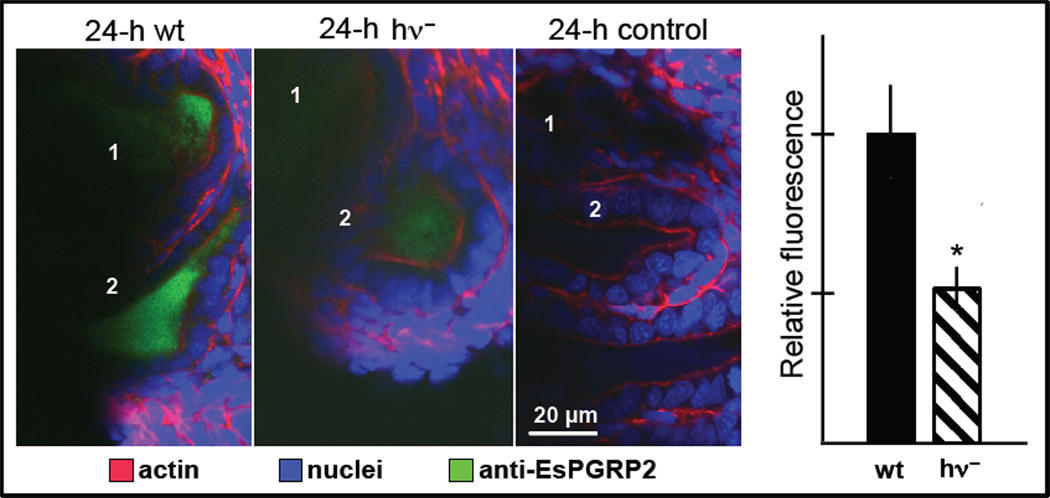
The effect of normal light production on EsPGRP2 into the crypts. Confocal images of immunocytochemistry of the host light organ at 24 h: antiEsPGRP2 (rabbit polyclonal), green; nuclei (TOTO3; Invitrogen), blue; actin cytoskeleton (rhodamine phalloidin), red. Left, colonization by wild-type (wt) V. fischeri induces strong transport of EsPGRP2 into the crypt spaces, which is attenuated in colonization by mutants defective in light production (hν-); control, preimmune serum alone. Graph right, quantification of fluorescence (n = 11–14 crypts for each treatment) * = p < 0.05 by a Student’s t-test for unequal variance.

References

    1. Eberl G. A new vision of immunity: homeostasis of the superorganism. Mucosal Immunol. 2010;3:450–460. - PubMed
    1. Round JL, Mazmanian SK. The gut microbiota shapes intestinal immune responses during health and disease. Nat Rev Immunol. 2009;9:313–323. - PMC - PubMed
    1. Ruby EG. Symbiotic conversations are revealed under genetic interrogation. Nat Rev Microbiol. 2008;6:752–762. - PMC - PubMed
    1. MacDonald SJ, Thomas GH, Douglas AE. Genetic and metabolic determinants of nutritional phenotype in an insect-bacterial symbiosis. Mol Ecol. 2011;20:2073–2084. - PubMed
    1. Koropatnick TA, Engle JT, Apicella MA, Stabb EV, Goldman WE, McFall-Ngai MJ. Microbial factor-mediated development in a host-bacterial mutualism. Science. 2004;306:1186–1188. - PubMed

Publication types

Substances