. 2012 May;9(5):760-9.
doi: 10.1016/j.hrthm.2011.12.006. Epub 2011 Dec 7.

A novel rare variant in SCN1Bb linked to Brugada syndrome and SIDS by combined modulation of Na(v)1.5 and K(v)4.3 channel currents

Affiliations

A novel rare variant in SCN1Bb linked to Brugada syndrome and SIDS by combined modulation of Na(v)1.5 and K(v)4.3 channel currents

Dan Hu et al. Heart Rhythm. 2012 May.

Abstract

Background: Cardiac sodium channel β-subunit mutations have been associated with several inherited cardiac arrhythmia syndromes.

Objective: To identify and characterize variations in SCN1Bb associated with Brugada syndrome (BrS) and sudden infant death syndrome (SIDS).

Methods: All known exons and intron borders of the BrS-susceptibility genes were amplified and sequenced in both directions. Wild type (WT) and mutant genes were expressed in TSA201 cells and studied using co-immunoprecipitation and whole-cell patch-clamp techniques.

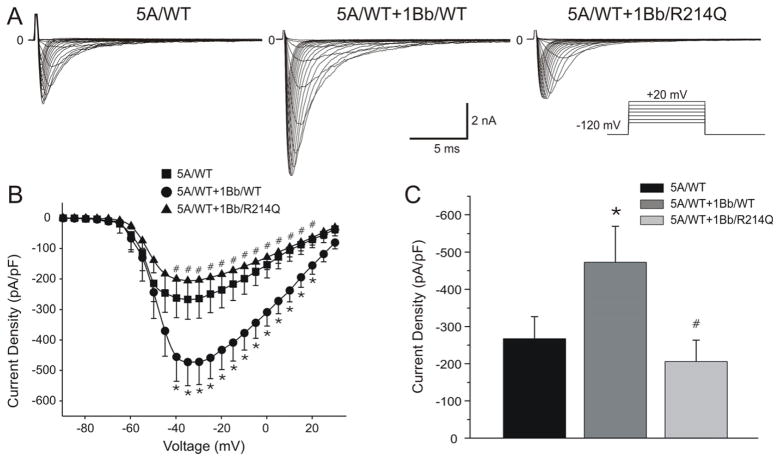
Results: Patient 1 was a 44-year-old man with an ajmaline-induced type 1 ST-segment elevation in V1 and V2 supporting the diagnosis of BrS. Patient 2 was a 62-year-old woman displaying a coved-type BrS electrocardiogram who developed cardiac arrest during fever. Patient 3 was a 4-month-old female SIDS case. A R214Q variant was detected in exon 3A of SCN1Bb (Na(v)1B) in all three probands, but not in any other gene previously associated with BrS or SIDS. R214Q was identified in 4 of 807 ethnically-matched healthy controls (0.50%). Co-expression of SCN5A/WT + SCN1Bb/R214Q resulted in peak sodium channel current (I(Na)) 56.5% smaller compared to SCN5A/WT + SCN1Bb/WT (n = 11-12, P<0.05). Co-expression of KCND3/WT + SCN1Bb/R214Q induced a Kv4.3 current (transient outward potassium current, I(to)) 70.6% greater compared with KCND3/WT + SCN1Bb/WT (n = 10-11, P<0.01). Co-immunoprecipitation indicated structural association between Na(v)β1B and Na(v)1.5 and K(v)4.3.

Conclusion: Our results suggest that R214Q variation in SCN1Bb is a functional polymorphism that may serve as a modifier of the substrate responsible for BrS or SIDS phenotypes via a combined loss of function of sodium channel current and gain of function of transient outward potassium current.


Conflict of interest statement

CONFLICT OF INTEREST STATEMENT

Michael J. Ackerman is a consultant for Transgenomic and their FAMILION™ genetic test for cardiac ion channel abnormalities. In addition, “cardiac channel gene screen” and “know-how relating to long QT genetic testing” license agreements, resulting in consideration and royalty payments, were established between Genaissance Pharmaceuticals (then PGxHealth and now Transgenomic, Omaha, Neb) and Mayo Medical Ventures (now Mayo Clinic Health Solutions, Rochester, Minn) in 2004. However, Transgenomic did not provide financial support for this study. The other authors have no financial or other considerations to disclose.

Figures
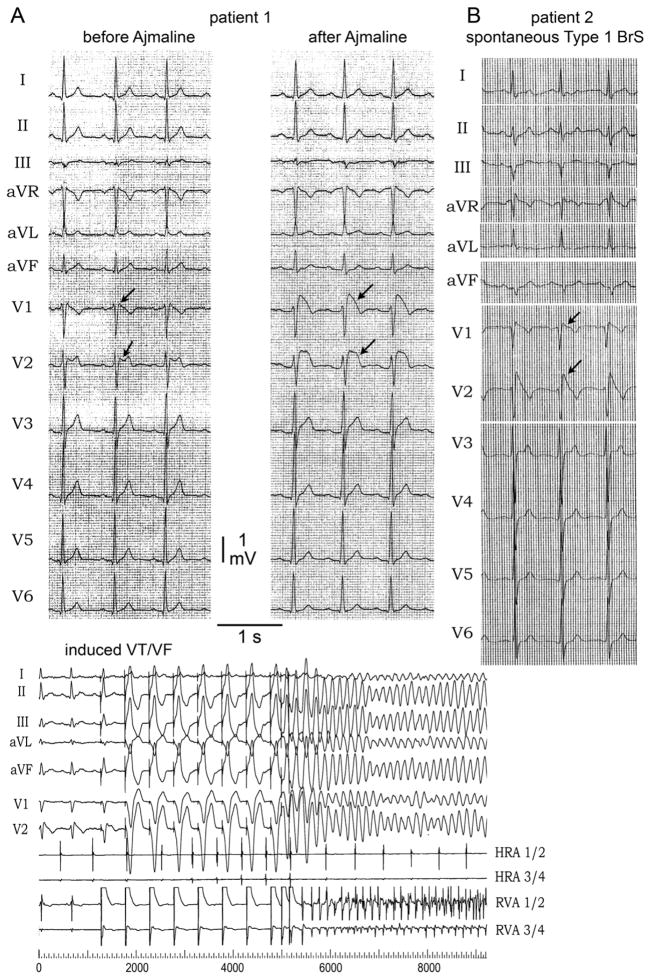
Figure 1
Figure 1. ECG of the patient 1 and patient 2 with Brugada syndrome (BrS) sign
A: (Upper panel) ECG at rest and 10 minutes after 40 mg of Ajmaline in patient 1. After sodium channel block challenge, ECG shows accentuation of R′ and development of a type 1 ST segment elevation in V1 and V2 (arrows). (Lower panel) Clinical electrophysiology study on patient 1. Ventricular tachycardia/ventricular fibrillation (VT/VF) was inducible with two extrastimulis. B: ECG of patient 2. It shows spontaneous huge accentuation of R′ and type 1 ST segment elevation in V1, and V2 (arrows).
Figure 2
Figure 2. Genetic analysis of SCB1Bb/R214Q
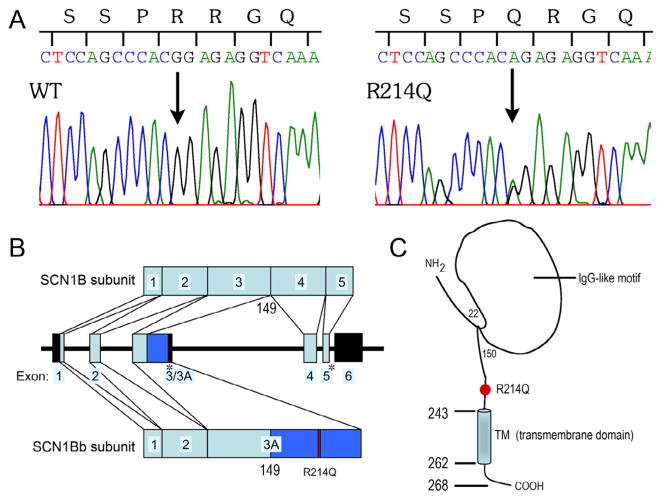
A: polymerase chain reaction -based sequence of SCN1Bb exon 3A showing wild-type (WT) and heterozygous G to A transversion at nucleotide 641 (arrow). It predicts a substitution of glutamine (CAG) for arginine (CGG) at position 214 (R214Q). B: Genomic structure of human Navβ1 gene. On chromosome 19, the SCN1B spans around 9 kb across six exons. SCN1Bb shares an identical N-terminal half (residues 1–149) with SCN1B, but contains a novel C-terminal half of less than 17% sequence identity with SCN1B. Exon 3A is an extended exon 3 (retention of part of intron 3) via alternative splicing. The dark blue region indicates the unique sequence of exon 3A compared with exon 3. Exons 1–5 (light blue boxes) encode the Navβ1 subunit, while exons 1, 2 and 3A (light and dark blue boxes) encode the Navβ1B subunit. The stop codon is indicated by an asterisk, the mutation is indicated as red box, and the untranslated regions are indicated using the black boxes. C: Predicted topology of Navβ1B. Red circle indicates the location of the mutant.
Figure 3
Figure 3. Effect of SCN1Bb/R214Q on INa expressed in TSA201 cells
A: Representative INa traces in cells expressing SCN5A/wild-type (WT) alone or co-transfected with SCN1Bb/WT or SCN1Bb/R214Q. Co-expression of SCN1Bb/R214Q produced loss of function. The inset shows the voltage-clamp protocol employed. B: Current-Voltage relationship for SCN5A/WT (n=9), SCN5A/WT + SCN1Bb/WT (n=11) and SCN5A/WT + SCN1Bb/R214Q (n=12). C: Bar graph of peak current density indicated significantly reduced for SCN5A/WT and SCN5A/WT + SCN1Bb/R214Q when compared to SCN5A/WT + SCN1Bb/WT (*P<0.05, compared with SCN5A/WT; #P <0.05, compared with SCN5A/WT+SCN1Bb/WT).
Figure 4
Figure 4. The effect of SCN1Bb subunit on current decay of INa
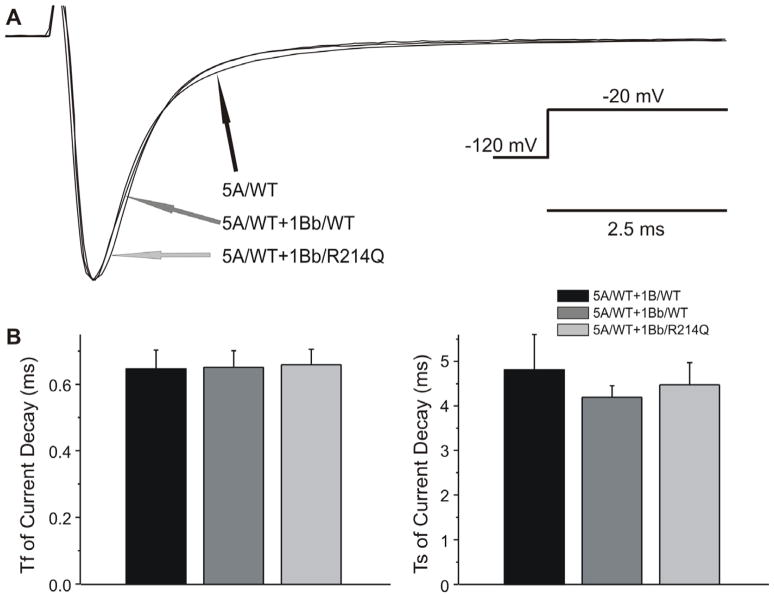
A: Overlapping sodium channel current (INa) traces from cells expressing NaV1.5, in the absence and presence of SCN1Bb wild-type (WT) and variant. INa was evoked by +20mV depolarizing pulses from a holding potential of −120m V. Traces are shown normalized to their individual peak value. B and C: Current decay (τ fand τs) for all 3 groups fitted with double exponential function.
Figure 5
Figure 5. Functional characterization of SCN1Bb/R214Q on INa
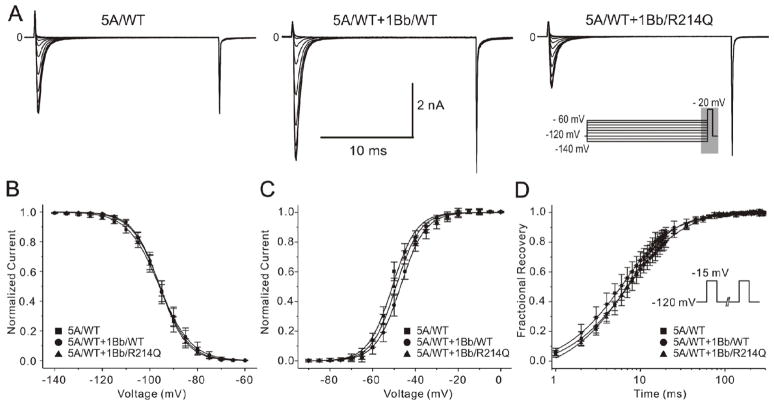
A: Representative traces recorded from wild-type (WT) and mutant channels in response to the voltage clamp protocol depicted on right middle inset designed to assess steady-state inactivation. B and C: Voltage dependence of inactivation and activation of SCN5A/WT and co-transfection of either SCN1Bb/WT or SCN1Bb/R214Q. Averaged values and the number of cells used are represented in Online Table 3. D: Recovery from fast inactivation of 3 groups determined using the two-pulse protocol shown in the inset. Fitting to a double-exponential function yielded the time constants demonstrated in Online Table 3. τf and τs in SCN5A/WT + SCN1Bb/R214Q were significantly slower as compared with SCN5A/WT + SCN1Bb/WT.
Figure 6
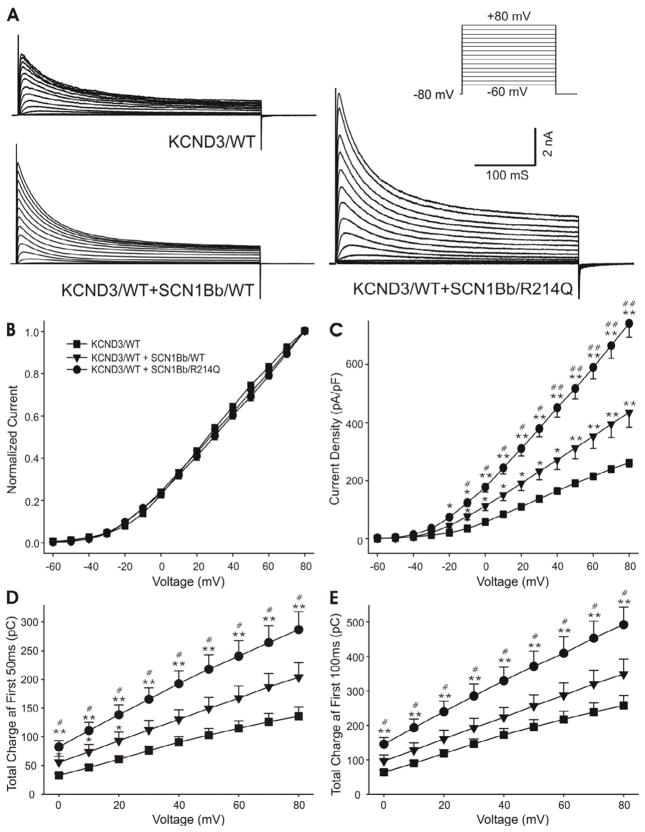
Figure 6. Effect of SCN1Bb/R214Q on Ito
A: Representative Ito traces recorded from cells expressing KCND3/wild-type (WT) alone or co-transfected with SCN1Bb/WT or SCN1Bb/R214Q. Co-expression of SCN1Bb/R214Q produced gain of function. The inset shows the voltage-clamp protocol employed. B: Normalized current-voltage relationship for KCND3/WT, KCND3/WT + SCN1Bb/WT and KCND3/WT + SCN1Bb/R214Q. There is no significant change in the presence of SCB1Bb (WT/R214Q) compared with both WT groups. C: Raw current-voltage relationship for peak Ito current density. D and E: Total charge of Ito current during the first 50 ms and 100 ms as a function of voltage. For panel B–E: n=31, 10, 11 for KCND3/WT, KCND3/WT + SCN1Bb/WT, KCND3/WT + SCN1Bb/R214Q; *P<0.05, **P<0.01 compared with KCND3/WT; #P <0.05, # #P <0.01 compared with KCND3/WT+SCN1Bb/WT.
Figure 7
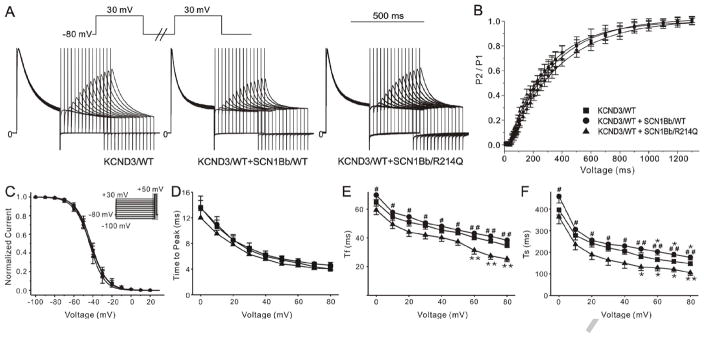
Figure 7. Functional characterization of SCN1Bb/R214Q on Ito
A: Representative traces recorded from wild-type (WT) and mutant channels in response to the voltage clamp protocol depicted on the top left inset designed to assess recovery. P1 was normalized to the same amplitude. B: Recovery from inactivation of 3 groups. C: Voltage dependence of inactivation of KCND3/WT and co-transfection of either SCN1Bb/WT or SCN1Bb/R214Q. The protocol was displayed in the top inset of Figure 7C. Averaged values and the number of cells used are represented in Online Table 4. D: Time to peak current as a function of voltage. E and F: Kinetics of current decay (τf and τs) for all 3 groups fitted with double exponential function. *P<0.05, **P<0.01 compared with KCND3/WT; #P <0.05, # #P <0.01 compared with KCND3/WT+SCN1Bb/WT.
Figure 8
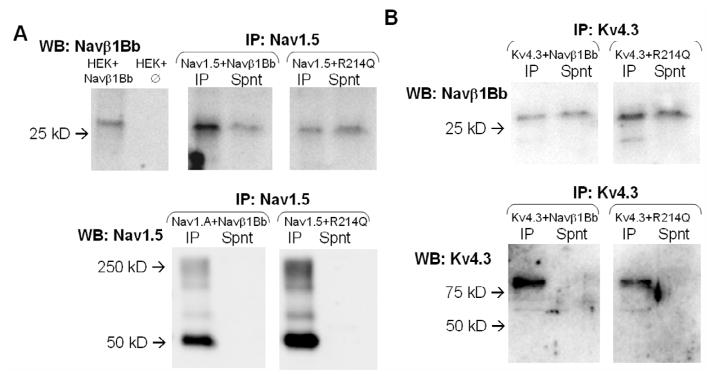
Figure 8. Coimmunoprecipitation of Nav1.5/Kv4.3 and Navβ1b subunit
Proteins were immunoprecipitated with (A) anti-Nav1.5 or (B) anti-Kv4.3 and immunoblotted with anti-Navβ1b (WT or R214Q variant) as indicated. Parallel western blot analysis of transfected and untransfected TSA201 cells was performed to confirm identity of labelled bands. Lower panels show that Nav1.5 and Kv4.3 are indeed fully precipitated. In both cases, the Navβ1b subunit appears in the pellet (IP) and in the supernatant (Spnt) of the immunoprecipitate. Each blot is representative of 4 experiments conducted under the same conditions.

Comment in

References

    1. Antzelevitch C. Brugada syndrome. PACE. 2006;29:1130–59. - PMC - PubMed
    1. Antzelevitch C, Yan GX. J wave syndromes. Heart Rhythm. 2010;7:549–58. - PMC - PubMed
    1. Burashnikov E, Pfeiffer R, Barajas-Martinez H, et al. Mutations in the cardiac L-type calcium channel associated J wave sydnrome and sudden cardiac death. Heart Rhythm. 2010;7:1872–82. - PMC - PubMed
    1. Giudicessi JR, Ye D, Tester DJ, et al. Transient outward current (Ito) gain-of-function mutations in the KCND3-encoded Kv4.3 potassium channel and Brugada syndrome. Heart Rhythm. 2011;8:1024–32. - PMC - PubMed
    1. Kattygnarath D, Maugenre S, Neyroud N, et al. MOG1: a new susceptibility gene for Brugada syndrome. Circ Cardiovasc Genet. 2011;4:261–8. - PubMed

Publication types

MeSH terms

Substances