


Antibacterial activity of sphingoid bases and fatty acids against Gram-positive and Gram-negative bacteria
- PMID: 22155833
- PMCID: PMC3294957
- DOI: 10.1128/AAC.05151-11
Antibacterial activity of sphingoid bases and fatty acids against Gram-positive and Gram-negative bacteria
Abstract
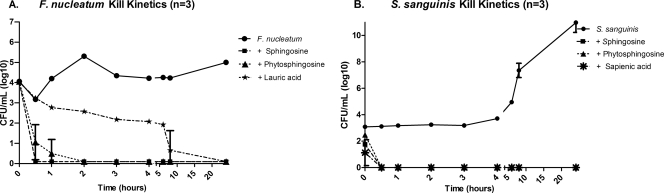
There is growing evidence that the role of lipids in innate immunity is more important than previously realized. How lipids interact with bacteria to achieve a level of protection, however, is still poorly understood. To begin to address the mechanisms of antibacterial activity, we determined MICs and minimum bactericidal concentrations (MBCs) of lipids common to the skin and oral cavity--the sphingoid bases D-sphingosine, phytosphingosine, and dihydrosphingosine and the fatty acids sapienic acid and lauric acid--against four Gram-negative bacteria and seven Gram-positive bacteria. Exact Kruskal-Wallis tests of these values showed differences among lipid treatments (P < 0.0001) for each bacterial species except Serratia marcescens and Pseudomonas aeruginosa. D-sphingosine (MBC range, 0.3 to 19.6 μg/ml), dihydrosphingosine (MBC range, 0.6 to 39.1 μg/ml), and phytosphingosine (MBC range, 3.3 to 62.5 μg/ml) were active against all bacteria except S. marcescens and P. aeruginosa (MBC > 500 μg/ml). Sapienic acid (MBC range, 31.3 to 375.0 μg/ml) was active against Streptococcus sanguinis, Streptococcus mitis, and Fusobacterium nucleatum but not active against Escherichia coli, Staphylococcus aureus, S. marcescens, P. aeruginosa, Corynebacterium bovis, Corynebacterium striatum, and Corynebacterium jeikeium (MBC > 500 μg/ml). Lauric acid (MBC range, 6.8 to 375.0 μg/ml) was active against all bacteria except E. coli, S. marcescens, and P. aeruginosa (MBC > 500 μg/ml). Complete killing was achieved as early as 0.5 h for some lipids but took as long as 24 h for others. Hence, sphingoid bases and fatty acids have different antibacterial activities and may have potential for prophylactic or therapeutic intervention in infection.
Figures
References
-
- Arikawa J, et al. 2002. Decreased levels of sphingosine, a natural antimicrobial agent, may be associated with vulnerability of the stratum corneum from patients with atopic dermatitis to colonization by Staphylococcus aureus. J. Investig. Dermatol. 119:433–439 - PubMed
-
- Bergsson G, Arnfinnsson J, Steingrimsson O, Thormar H. 2001. Killing of Gram-positive cocci by fatty acids and monoglycerides. APMIS 109:670–678 - PubMed
-
- Bibel DJ, Aly R, Shah S, Shinefield HR. 1993. Sphingosines: antimicrobial barriers of the skin. Acta Derm. Venereol. 73:407–411 - PubMed
-
- Brasser A, et al. 2011. Free sphingosine in human saliva. J. Dent. Res. 90(Special issue A):3465 (Abstract.) http://www.dentalresearch.org
Publication types
MeSH terms
Substances
Grants and funding
LinkOut - more resources
Full Text Sources
Other Literature Sources
Medical
Molecular Biology Databases
