


Swallowing screens after acute stroke: a systematic review
- PMID: 22156697
- PMCID: PMC3288702
- DOI: 10.1161/STROKEAHA.111.638254
Swallowing screens after acute stroke: a systematic review
Abstract
Background and purpose: Swallowing screens after acute stroke identify those patients who do not need a formal swallowing evaluation and who can safely take food and medications by mouth. We conducted a systematic review to identify swallowing screening protocols that met basic requirements for reliability, validity, and feasibility.
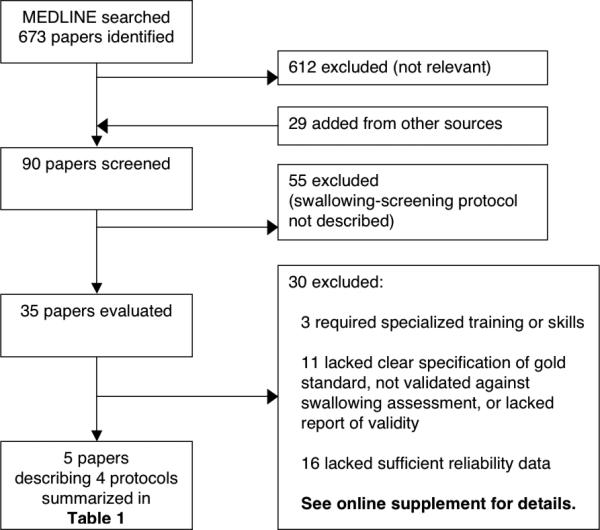
Methods: We searched MEDLINE and supplemented results with references identified through other databases, journal tables of contents, and bibliographies. All relevant references were reviewed and evaluated with specific criteria.
Results: Of 35 protocols identified, 4 met basic quality criteria. These 4 had high sensitivities of ≥87% and high negative predictive values of ≥91% when a formal swallowing evaluation was used as the gold standard. Two protocols had greater sample sizes and more extensive reliability testing than the others.
Conclusions: We identified only 4 swallowing screening protocols for patients with acute stroke that met basic criteria. Cost-effectiveness of screening, including costs associated with false-positive results and impact of screening on morbidity, mortality, and length of hospital stay, requires elucidation.
Figures
References
-
- Martino R, Foley N, Bhogal S, Diamant N, Speechley M, Teasell R. Dysphagia after stroke: incidence, diagnosis, and pulmonary complications. Stroke. 2005;36:2756–2763. - PubMed
-
- Edmiaston J, Connor LT, Ford AL. SWALLOW-3D, a simple 2-minute bedside screening test, detects dysphagia in acute stroke patients with high sensitivity when validated against video-fluoroscopy (abstract). Stroke. 2011;42:e352.
-
- Antonios N, Carnaby-Mann G, Crary M, Miller L, Hubbard H, Hood K, et al. Analysis of a physician tool for evaluating dysphagia on an inpatient stroke unit: the Modified Mann Assessment of Swallowing Ability. J Stroke Cerebrovasc Dis. 2010;19:49–57. - PubMed
-
- Turner-Lawrence DE, Peebles M, Price MF, Singh SJ, Asimos AW. A feasibility study of the sensitivity of emergency physician dysphagia screening in acute stroke patients. Ann Emerg Med. 2009;54:344–348. - PubMed
Publication types
MeSH terms
Grants and funding
LinkOut - more resources
Full Text Sources
Medical
Miscellaneous
