Comparative Study
. 2012 Jan;71(1):73-82.
doi: 10.1097/NEN.0b013e318240fa65.

The importance of 10q status in an outcomes-based comparison between 1p/19q fluorescence in situ hybridization and polymerase chain reaction-based microsatellite loss of heterozygosity analysis of oligodendrogliomas

Affiliations
Comparative Study

The importance of 10q status in an outcomes-based comparison between 1p/19q fluorescence in situ hybridization and polymerase chain reaction-based microsatellite loss of heterozygosity analysis of oligodendrogliomas

Craig Horbinski et al. J Neuropathol Exp Neurol. 2012 Jan.

Abstract

1p/19q codeletion is a favorable prognostic marker of oligodendrogliomas. Although fluorescence in situ hybridization (FISH) and microsatellite-based polymerase chain reaction (PCR) for loss of heterozygosity (LOH) are common methods to test for 1p/19q codeletion, it is unclear which test is better at prognostic stratification. This study analyzed outcomes of 111 oligodendrogliomas with both 1p/19q FISH and LOH done at the time of diagnosis. Overall concordance between the 2 assays was 81.1%. In grade III oligodendrogliomas, LOH was better than FISH at survival stratification (p < 0.0001 for LOH vs p = 0.02 for FISH), although increasing the stringency of FISH interpretation criteria improved concordance and prognostic power. Oligodendrogliomas that were 1p/19q-codeleted by FISH but also had 10q LOH were negative for 1p/19q codeletion by PCR analysis in more than 70% of cases, with very poor survival in the grade III subset. Thus, although PCR-based LOH is a better stratifier of 1p/19q status, FISH still has clinical and prognostic utility, especially if 10q data can be incorporated.


Figures
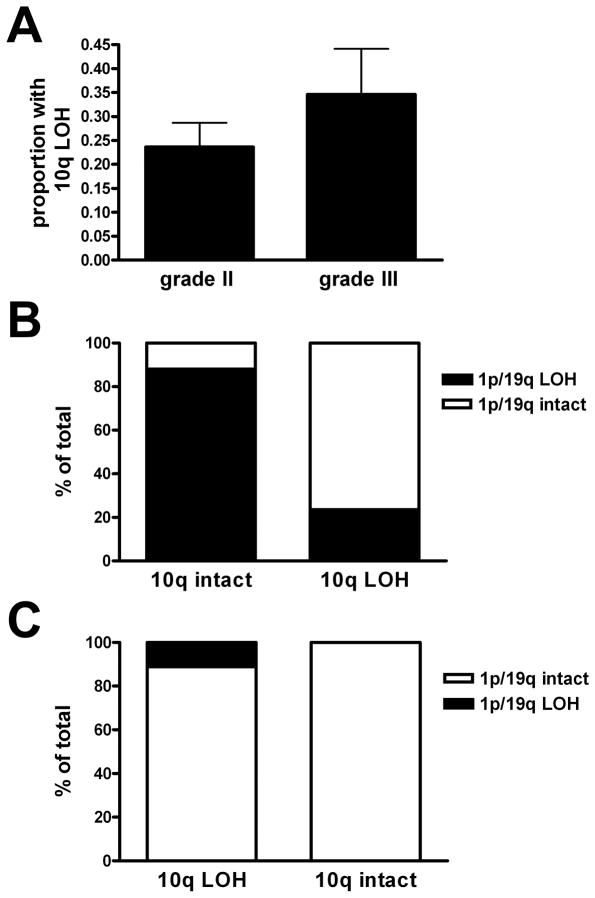
Figure 1
Figure 1
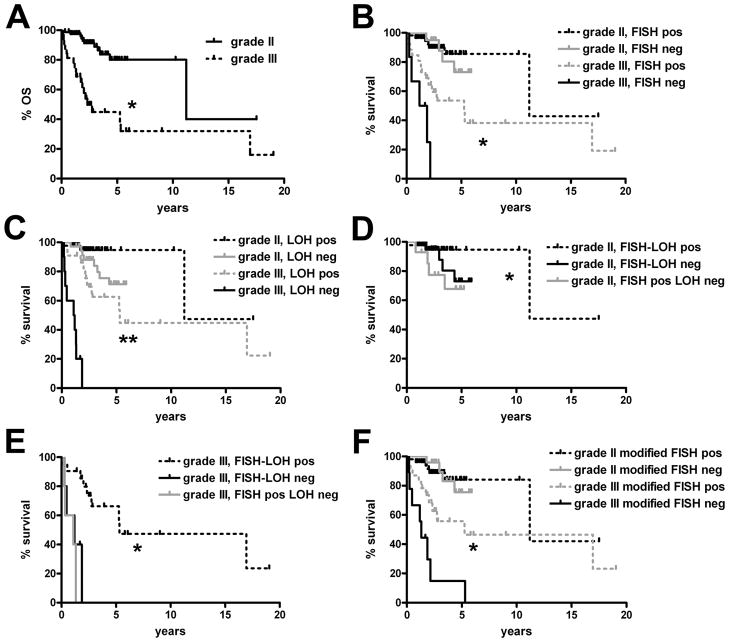
Survival according to 1p/19q fluorescence in situ hybridization (FISH) and loss of heterozygosity (LOH) analyses. (A) Grade III oligodendrogliomas had worse survival than grade II tumors (*p < 0.0001). (B, C) 1p/19q FISH (B) was weaker than PCR-based LOH (C) in differentiating longer-term from shorter-term survivors. This difference was most prominent in grade III anaplastic oligodendroglial tumors, in which prognostic stratification was better by LOH (**p < 0.0001) than by FISH (*p = 0.02). FISH could not stratify grade II oligodendrogliomas (p = 0.64), survival differences trended toward significance by LOH (p = 0.09). (D) Grade II oligodendrogliomas with 1p/19q codeletion by both modalities had longer survival than those that were positive by FISH but not by LOH (*p = 0.04; p = 0.26 vs. tumors that were negative by both tests). (E) Grade III anaplastic oligodendrogliomas that were codeleted by FISH and LOH showed longer survival compared to tumors that were negative by both tests (*p = 0.0006), or positive only by FISH but not LOH (*p < 0.0001). (F) Increasing the stringency of FISH codeletion criteria to a cutoff 1p36/1q25 and 19q13/19p13 ratio of 0.75 for each probe pair (from the original cutoff of 0.87) improved statistical power in stratifying grade III anaplastic oligodendrogliomas (*p = 0.007).
Figure 2
Figure 2
10q loss of heterozygosity (LOH) in gliomas. (A) 23.6% of grade II oligodendrogliomas had 10q LOH vs. 34.6% of grade III oligodendrogliomas (p = 0.40 by Mann-Whitney test). (B) When either a grade II or grade III oligodendroglioma was called 1p/19q-codeleted by fluorescence in situ hybridization (FISH), concordance with PCR-based 1p/19q microsatellite LOH analysis was much less likely if 10q was also deleted (p < 0.0001, n = 76). (C) If an oligodendroglioma was 1p/19q-intact by FISH, 10q status had no bearing on whether the FISH result would be concordant with PCR-based 1p/19q microsatellite analysis (p = 0.41, n = 22).
Figure 3
Figure 3
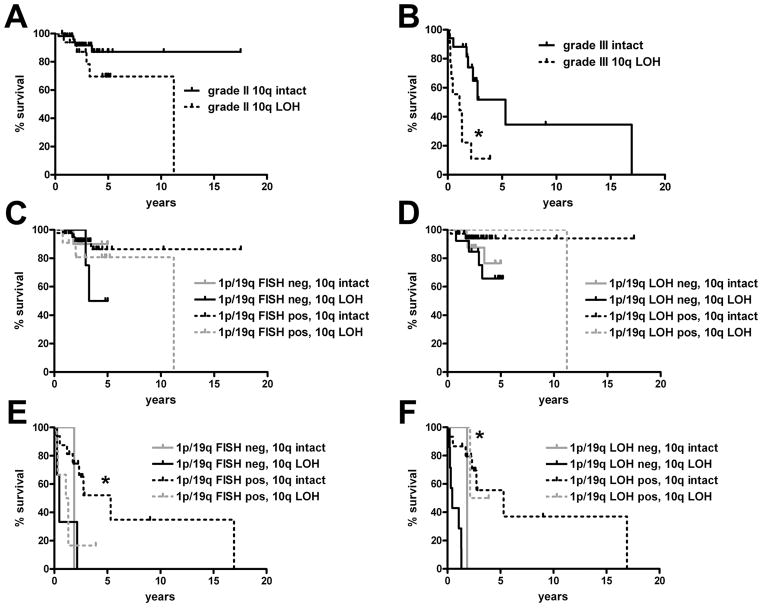
Impact of 10q loss of heterozygosity (LOH) on survival in oligodendrogliomas. (A, B) 10q LOH did not significantly change overall survival in grade II gliomas (A, p = 0.12) though it did in grade III gliomas (B, *p = 0.002). (C, D) Factoring in 1p/19q status, 10q LOH still did not significantly alter survival in grade II oligodendrogliomas as assessed by 1p/19q FISH (C, p = 0.39) or PCR-based LOH (D, p = 0.27), although the number of cases with 1p/19q codeletion and 10q LOH was very small (n = 3). (E) In grade III oligodendrogliomas, 1p/19q-codeleted cases by fluorescence in situ hybridization (FISH) had better survival only if 10q was also intact (*p = 0.03 vs. all other groups). (F) 10q status did not significantly refine survival when grade III oligodendrogliomas were 1p/19q-codeleted via PCR-based LOH (p = 0.86). Survival of 1p/19q-intact grade III oligodendrogliomas was slightly but significantly longer when 10q was also intact (*p = 0.03 for 1p/19q LOH-negative (neg.) 10q-intact vs. 1p/19q LOH-neg 10q LOH).

References

    1. Reifenberger J, Reifenberger G, Liu L, et al. Molecular genetic analysis of oligodendroglial tumors shows preferential allelic deletions on 19q and 1p. Am J Pathol. 1994;145:1175–90. - PMC - PubMed
    1. Kraus JA, Koopmann J, Kaskel P, et al. Shared allelic losses on chromosomes 1p and 19q suggest a common origin of oligodendroglioma and oligoastrocytoma. J Neuropathol Exp Neurol. 1995;54:91–5. - PubMed
    1. Cairncross JG, Ueki K, Zlatescu MC, et al. Specific genetic predictors of chemotherapeutic response and survival in patients with anaplastic oligodendrogliomas. J Natl Cancer Inst. 1998;90:1473–9. - PubMed
    1. Smith JS, Perry A, Borell TJ, et al. Alterations of chromosome arms 1p and 19q as predictors of survival in oligodendrogliomas, astrocytomas, and mixed oligoastrocytomas. J Clin Oncol. 2000;18:636–45. - PubMed
    1. Perry A, Fuller CE, Banerjee R, et al. Ancillary FISH analysis for 1p and 19q status: preliminary observations in 287 gliomas and oligodendroglioma mimics. Front Biosci. 2003;8:1–9. - PubMed

Publication types