Low-molecular-weight proteins as prognostic markers in idiopathic membranous nephropathy
- PMID: 22157712
- PMCID: PMC3255374
- DOI: 10.2215/CJN.04020411
Low-molecular-weight proteins as prognostic markers in idiopathic membranous nephropathy
Abstract
Background: Accurate prediction of prognosis in idiopathic membranous nephropathy (iMN) allows restriction of immunosuppressive therapy to patients at high risk for ESRD. Here we re-evaluate urinary low-molecular-weight proteins as prognostic markers and explore causes of misclassification.
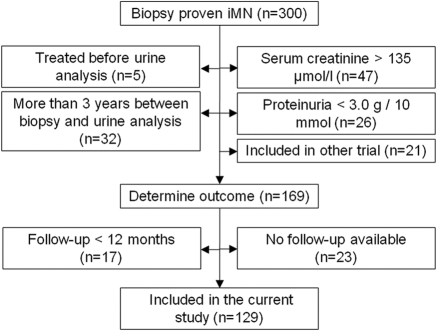
Design, setting, participants, & measurements: In a cohort of 129 patients with serum creatinine concentration <135 μmol/L and proteinuria ≥3.0 g/10 mmol, urinary α1- (uα1m) and β2-microglobulin (uβ2m) excretion rate was determined. Urinary α1m and uβ2m-creatinine ratio was also obtained. We defined progression as a rise in serum creatinine ≥50% or ≥25% and an absolute level ≥135 μmol/L.
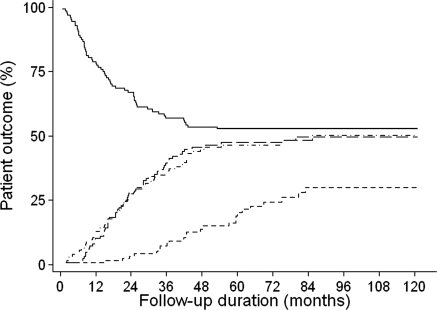
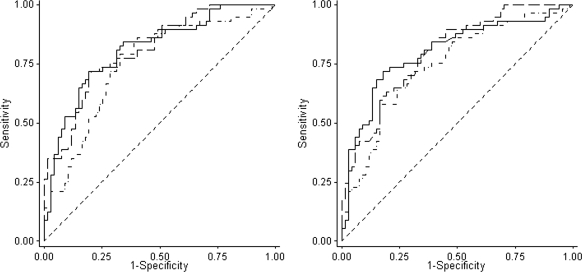
Results: Median survival time was 25 months, and 47% of patients showed progression. The area under the receiver operating characteristic curve for uβ2m was 0.81 (95% CI: 0.73 to 0.89). Using a threshold value of 1.0 μg/min, sensitivity and specificity were 73% and 75%, respectively. Similar accuracy was observed for the uβ2m-creatinine ratio with sensitivity and specificity of 75% and 73%, respectively, at a threshold of 1.0 μg/10 mmol creatinine. Similar accuracy was found for uα1m and uα1m-creatinine ratio. Blood Pressure and cholesterol contributed to misclassification. Repeated measurements improved accuracy in patients with persistent proteinuria: the positive predictive value of uβ2m increased from 72% to 89% and the negative predictive value from 76% to 100%.
Conclusions: Urinary excretion of uα2m and uβ2m predict prognosis in iMN. A spot urine sample can be used instead of a timed sample. A repeated measurement after 6 to 12 months increases prognostic accuracy.
Figures
References
-
- Cattran DC. Membranous nephropathy. In: Primer on Kidney Diseases, 5th ed., edited by Greenberg A, Cheung AK, Coffman TM, Falk RJ, Jennette JC, Philadelphia, Saunders Elsevier, 2009, pp 170–178
-
- Troyanov S, Wall CA, Miller JA, Scholey JW, Cattran DC: Idiopathic membranous nephropathy: Definition and relevance of a partial remission. Kidney Int 66: 1199–1205, 2004 - PubMed
-
- Polanco N, Gutierrez E, Covarsi A, Ariza F, Carreno A, Vigil A, Baltar J, Fernández-Fresnedo G, Martín C, Pons S, Lorenzo D, Bernis C, Arrizabalaga P, Fernández-Juárez G, Barrio V, Sierra M, Castellanos I, Espinosa M, Rivera F, Oliet A, Fernández-Vega F, Praga M: Grupo de Estudio de las Enfermedades Glomerulares de la Sociedad Española de Nefrología.: Spontaneous remission of nephrotic syndrome in idiopathic membranous nephropathy. J Am Soc Nephrol 21: 697–704, 2010 - PMC - PubMed
-
- Cattran DC, Pei Y, Greenwood CM, Ponticelli C, Passerini P, Honkanen E: Validation of a predictive model of idiopathic membranous nephropathy: Its clinical and research implications. Kidney Int 51: 901–907, 1997 - PubMed
-
- du Buf-Vereijken PW, Branten AJ, Wetzels JF: Idiopathic membranous nephropathy: Outline and rationale of a treatment strategy. Am J Kidney Dis 46: 1012–1029, 2005 - PubMed
Publication types
MeSH terms
Substances
LinkOut - more resources
Full Text Sources