. 2011 Dec;23(12):4185-207.
doi: 10.1105/tpc.111.089045. Epub 2011 Dec 9.

Massive analysis of rice small RNAs: mechanistic implications of regulated microRNAs and variants for differential target RNA cleavage

Affiliations

Massive analysis of rice small RNAs: mechanistic implications of regulated microRNAs and variants for differential target RNA cleavage

Dong-Hoon Jeong et al. Plant Cell. 2011 Dec.

Abstract

Small RNAs have a variety of important roles in plant development, stress responses, and other processes. They exert their influence by guiding mRNA cleavage, translational repression, and chromatin modification. To identify previously unknown rice (Oryza sativa) microRNAs (miRNAs) and those regulated by environmental stress, 62 small RNA libraries were constructed from rice plants and used for deep sequencing with Illumina technology. The libraries represent several tissues from control plants and plants subjected to different environmental stress treatments. More than 94 million genome-matched reads were obtained, resulting in more than 16 million distinct small RNA sequences. This allowed an evaluation of ~400 annotated miRNAs with current criteria and the finding that among these, ~150 had small interfering RNA-like characteristics. Seventy-six new miRNAs were found, and miRNAs regulated in response to water stress, nutrient stress, or temperature stress were identified. Among the new examples of miRNA regulation were members of the same miRNA family that were differentially regulated in different organs and had distinct sequences Some of these distinct family members result in differential target cleavage and provide new insight about how an agriculturally important rice phenotype could be regulated in the panicle. This high-resolution analysis of rice miRNAs should be relevant to plant miRNAs in general, particularly in the Poaceae.


Figures
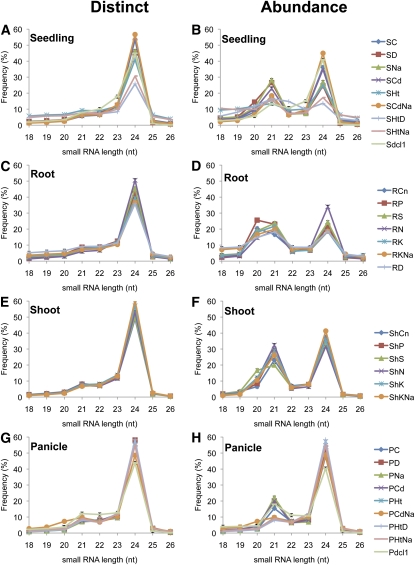
Figure 1.
Figure 1.
Small RNA Size Distributions from the Libraries of Different Tissues. Small RNA size profiles are grouped by tissue as indicated. The size of small RNAs was plotted versus frequency (percentage) among distinct sequences ([A], [C], [E], and [G]) or total sequences ([B], [D], [F], and [H]). Seedling, root, and shoot tissues were harvested at the 2-week-old stage. Panicle was harvested at a mature stage when the panicles were ~15 cm in length. Library codes and detailed information about each library are indicated in Supplemental Table 1 online.
Figure 2.
Figure 2.
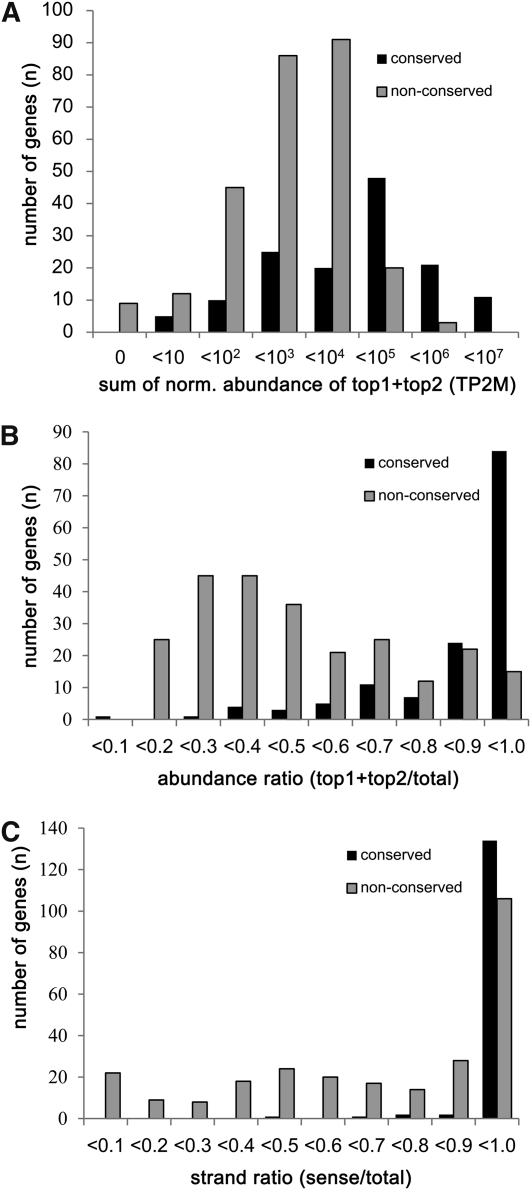
Evaluation of 414 of Known miRNA Genes from Rice. Known rice miRNA genes were grouped based on the conservation between rice and Arabidopsis. Sum of normalized abundance is from all the libraries. Histograms represent number of genes in each abundance range. (A) The sum of normalized abundance is represented for the two most abundant small RNAs from each miRNA gene. (B) The ratio of sum of the normalized abundance of the two most abundant small RNAs and all the small RNAs matching each miRNA gene was calculated. (C) The sum of the abundance of small RNAs matching sense strands was divided by that matching both strands to calculate strand ratio for each miRNA gene.
Figure 3.
Figure 3.
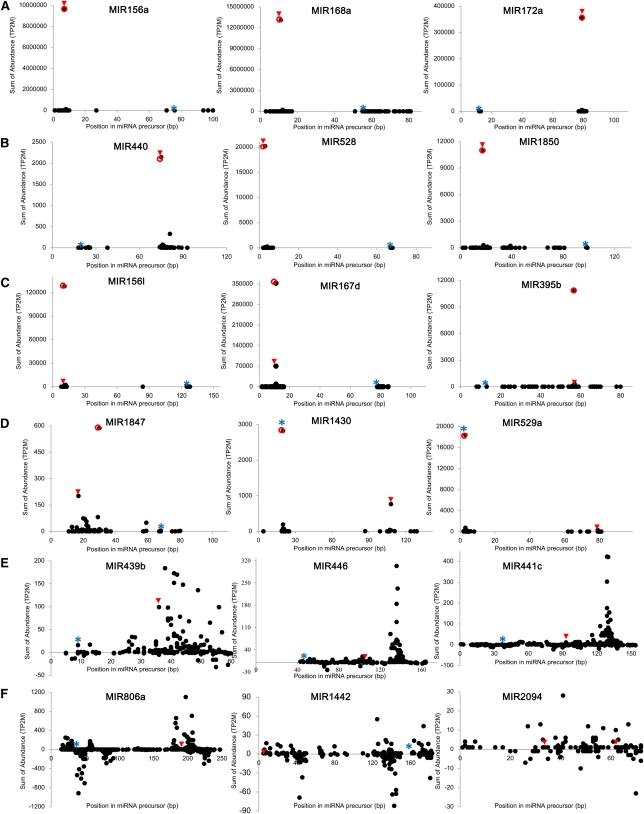
Small RNA Plots of miRNA Precursors. Small RNAs matching the indicated miRNA precursors were plotted versus the sum of their normalized abundance from all the libraries. Red arrowhead, miRNA reported in miRBase; blue asterisk, reported miRNA*; red circle, most abundant small RNA. (A) The known and conserved miRNA is the most abundant small RNA. (B) The known and nonconserved miRNA is the most abundant small RNA. (C) An overlapping sequence variant is more abundant than the known miRNA. (D) Another small RNA, unrelated to the known miRNA or same as miRNA*, is more abundant than the known miRNA. (E) The known miRNA is poorly expressed and small RNAs matching the miRNA precursors are highly clustered. (F) Known miRNAs are poorly expressed and small RNAs are found on the both sides of the miRNA precursor.
Figure 4.
Figure 4.
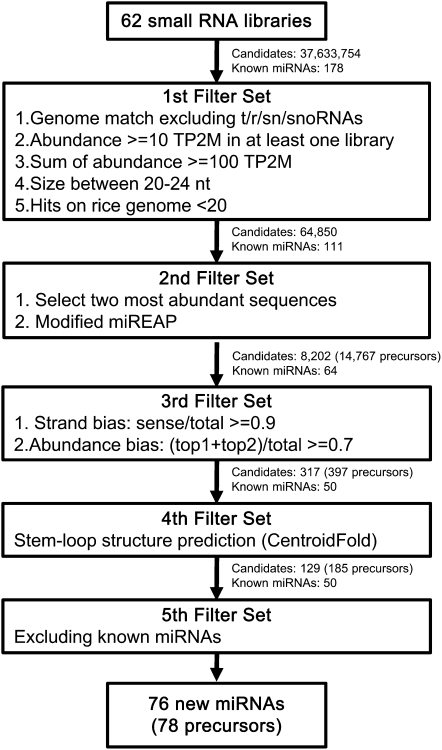
Pipeline for the Identification of New miRNAs from Small RNA Libraries. New miRNAs were identified by a series of filters shown in the diagram and described in the text. Numbers of candidate small RNAs and known miRNAs after each filter are indicated.
Figure 5.
Figure 5.
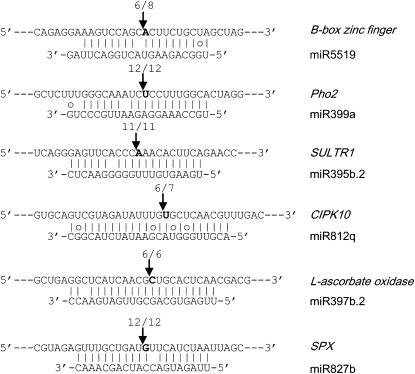
Validation of Predicted Target Genes. The arrows indicate sites verified by modified RLM 5′-RACE. Predicted cleavage sites are indicated by a bold nucleotide at position 10 relative to the 5′ end of the miRNA. The number of cloned RACE products sequenced is shown above each sequence.
Figure 6.
Figure 6.
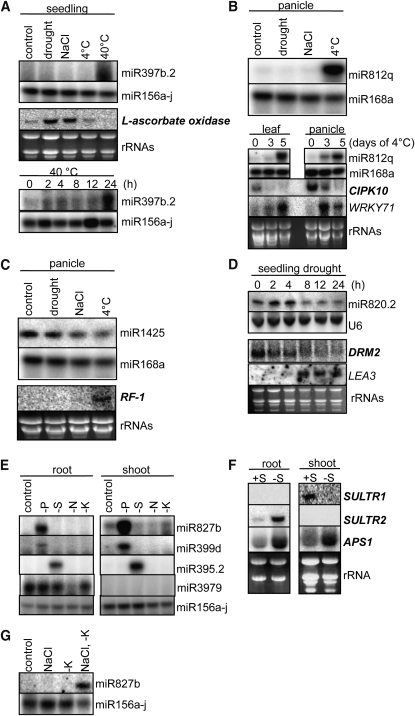
Expression Patterns of Environmental Stress–Responsive miRNAs and Their Target Genes. Splinted-ligation-based miRNA detection ([A] to [C] and [E] to [G]) or RNA gel blots (D) were used for miRNA expression analysis. U6, miR156a-j, and miR168a were used for loading controls. RNA gel blots were used for mRNA expression analysis. Genes in bold are targets of miRNAs. The other genes were used for controls of stress treatments. rRNAs served as loading controls. Seedling, root, and shoot tissues were harvested at the 2-week-old stage. Panicle was harvested at a mature stage when the panicles were ~15 cm in length.
Figure 7.
Figure 7.
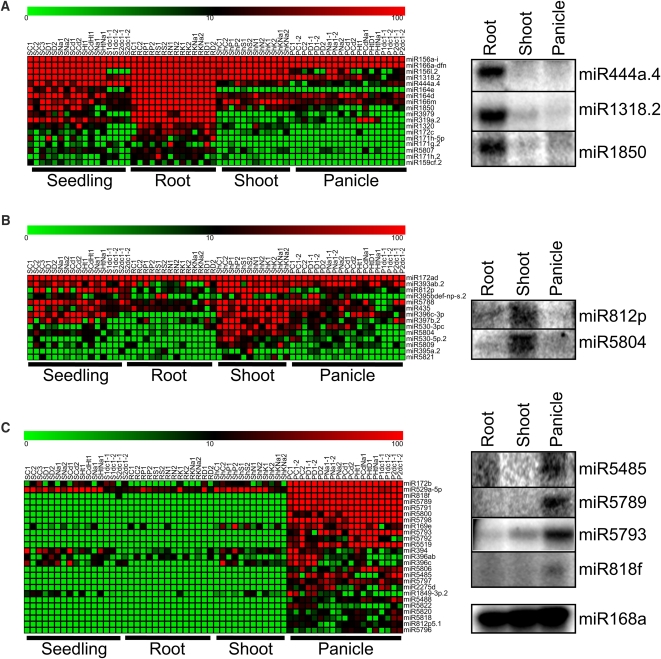
Expression Profiling Analysis and Validation of Tissue-Preferential Expression. miRNAs that are expressed at least 5 times higher in one tissue than the other tissues were identified, clustered by average linkage hierarchical clustering, and depicted in a heat map representation. Red represents high expression and green represents low expression. Seedling, root, and shoot tissues were harvested at the 2-week-old stage. Panicle was harvested at a mature stage when the panicles were ~15 cm in length. Detailed information about each library is indicated in Supplemental Table 1 online. Expression of selected miRNA was validated with splinted-ligation-based miRNA detection. Root-preferential miRNAs (A), shoot-preferential miRNAs (B), and panicle-preferential miRNAs (C).
Figure 8.
Figure 8.
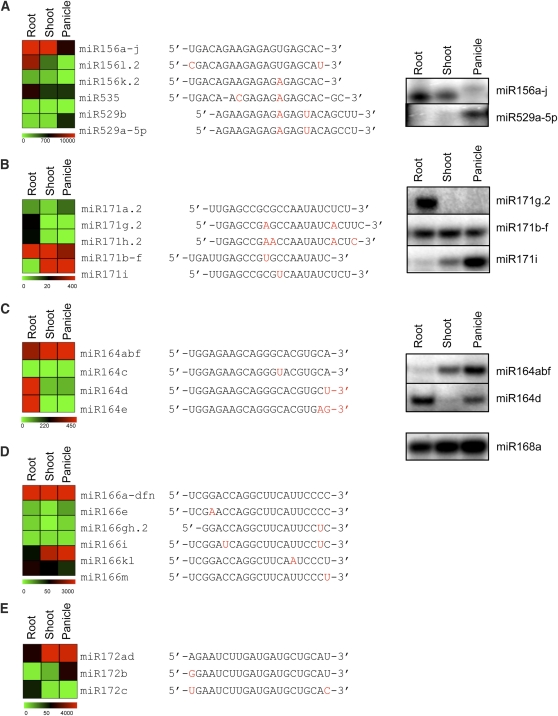
Differential Expression of Sequence Variants in the Same miRNA Family. miRNA expression data from 2-week-old root, shoot, and 15-cm panicle were mean centered and represented by a heat map. The sequences of miRNA family members were aligned, and nucleotides that differ are shown in red. Validation of the expression patterns was accomplished by splinted-ligation-based miRNA detection. miR168a was used as constitutive expression control. miR156 family (A), miR171 family (B), miR164 family (C), miR166 family (D), and miR172 family (E).
Figure 9.
Figure 9.
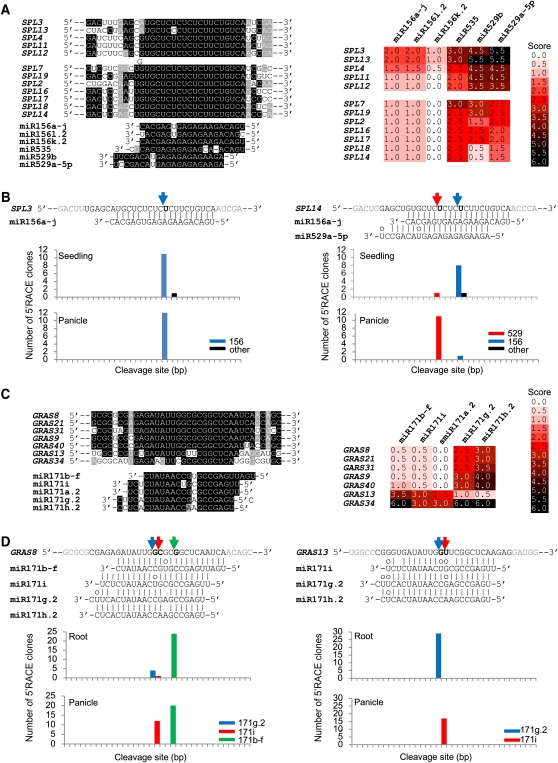
Differential Selection of Target Genes by Differentially Expressed miRNAs. (A) Sequence alignment of miR156 family members and their target genes. The table next to the target genes represents target score for each member of the miR156 family. (B) Validation of target cleavage by RLM 5′-RACE. Predicted cleavage sites are indicated by a bold nucleotide at position 10 relative to the 5′ end of the miRNA. The number of cloned RACE products sequenced is shown in the histogram. (C) Sequence alignment of the miR171 family and their target genes. (D) Validation of target cleavage by the miR171 family. The cleavage of GRAS13 shown formiR171g.2 could be equally the result of miR171 h.2. Names of target genes were from a previous publication (Tian et al., 2004), and their Michigan State University Rice Genome Annotation Project locus names are shown in Supplemental Table 8 online.
Figure 10.
Figure 10.
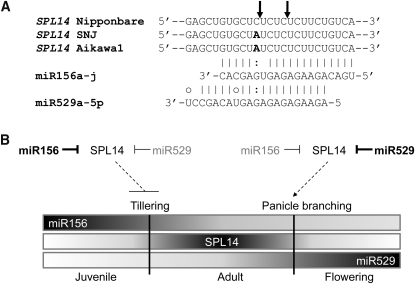
miR529 May Be Critical for Regulation of SPL14 in Panicle. (A) The SNJ and Akiawa1 sequence difference is adjacent to the miR529 cleavage site of Os-SPL14. (B) Model for regulation of tillering and panicle branching by miR156 and miR529.

References

    1. Addo-Quaye C., Snyder J.A., Park Y.B., Li Y.F., Sunkar R., Axtell M.J. (2009). Sliced microRNA targets and precise loop-first processing of MIR319 hairpins revealed by analysis of the Physcomitrella patens degradome. RNA 15: 2112–2121 - PMC - PubMed
    1. Arazi T., Talmor-Neiman M., Stav R., Riese M., Huijser P., Baulcombe D.C. (2005). Cloning and characterization of micro-RNAs from moss. Plant J. 43: 837–848 - PubMed
    1. Aung K., Lin S.I., Wu C.C., Huang Y.T., Su C.L., Chiou T.J. (2006). pho2, a phosphate overaccumulator, is caused by a nonsense mutation in a microRNA399 target gene. Plant Physiol. 141: 1000–1011 - PMC - PubMed
    1. Bari R., Datt Pant B., Stitt M., Scheible W.R. (2006). PHO2, microRNA399, and PHR1 define a phosphate-signaling pathway in plants. Plant Physiol. 141: 988–999 - PMC - PubMed
    1. Batistic O., Kudla J. (2009). Plant calcineurin B-like proteins and their interacting protein kinases. Biochim. Biophys. Acta 1793: 985–992 - PubMed

Publication types

MeSH terms

Associated data