


Connexin gene transfer preserves conduction velocity and prevents atrial fibrillation
- PMID: 22158756
- PMCID: PMC3260348
- DOI: 10.1161/CIRCULATIONAHA.111.053272
Connexin gene transfer preserves conduction velocity and prevents atrial fibrillation
Abstract
Background: Several lines of evidence have suggested that maintenance of atrial fibrillation (AF) depends on reentrant mechanisms. Maintenance of reentry necessitates a sufficiently short refractory period and/or delayed conduction, and AF has been associated with both alterations. Fibrosis, cellular dysfunction, and gap junction protein alterations occur in AF and cause conduction delay. We performed this study to test the hypothesis that gap junction protein overexpression would improve conduction and prevent AF.
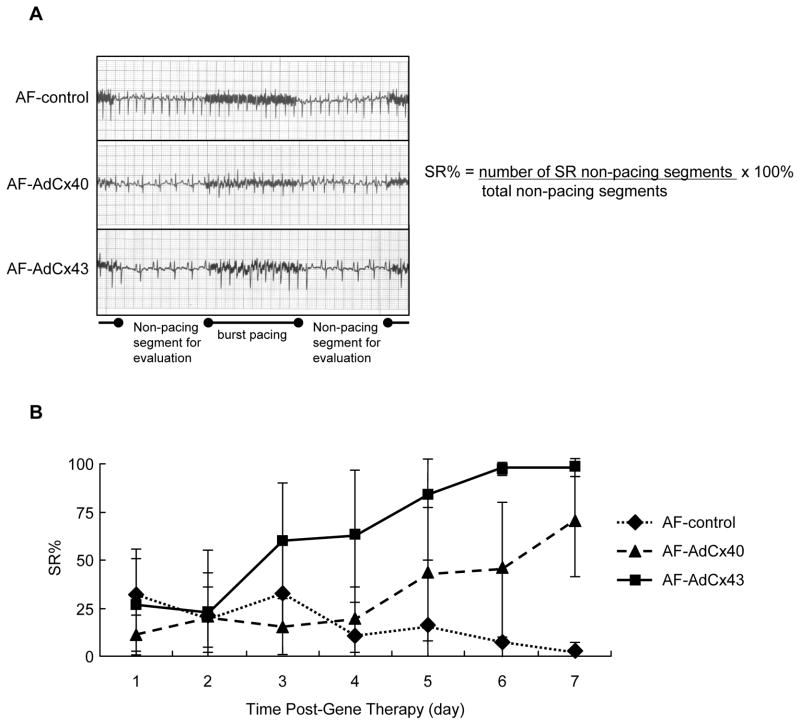
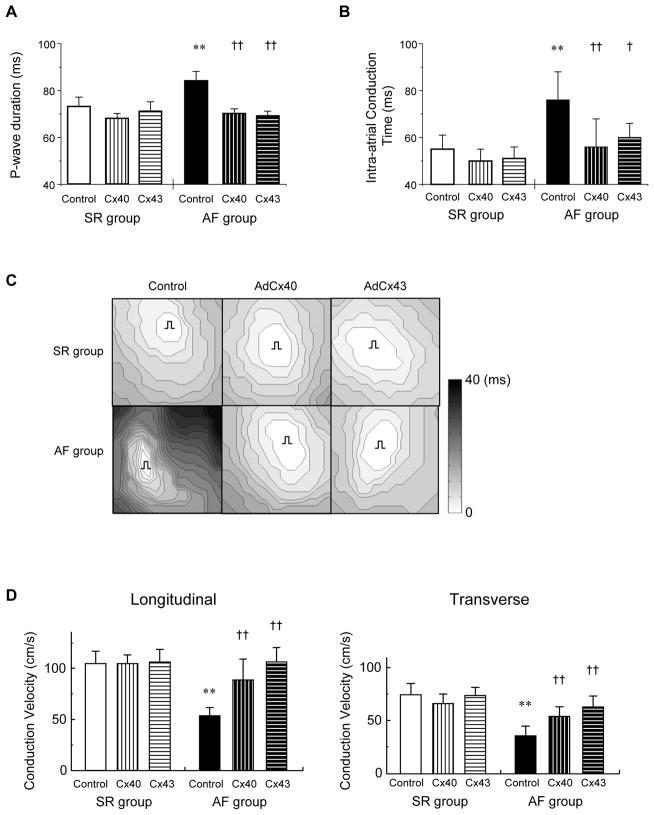
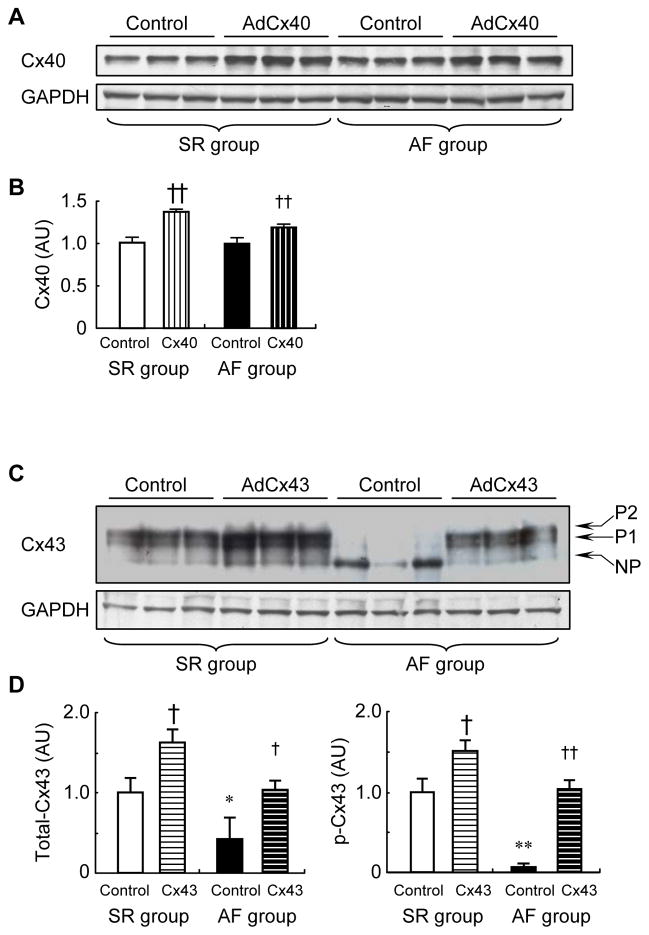
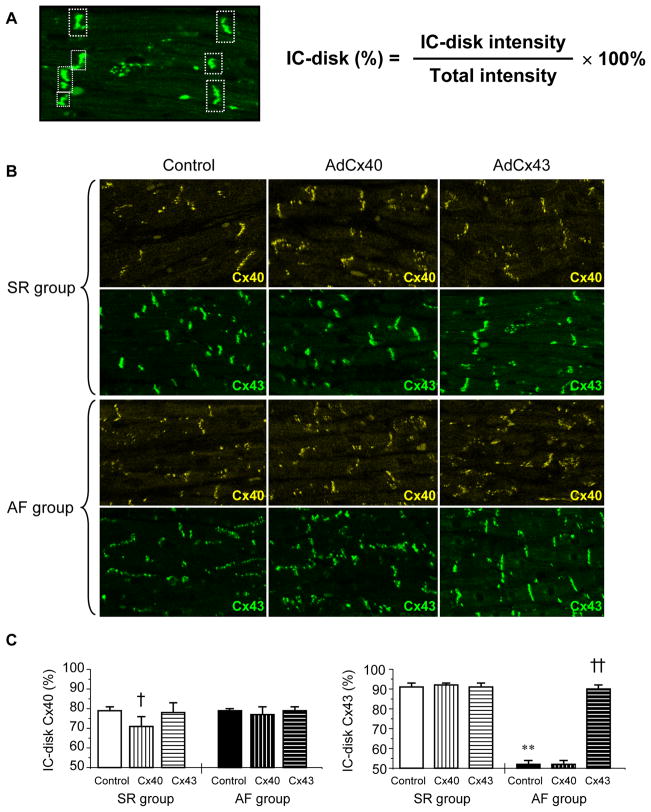
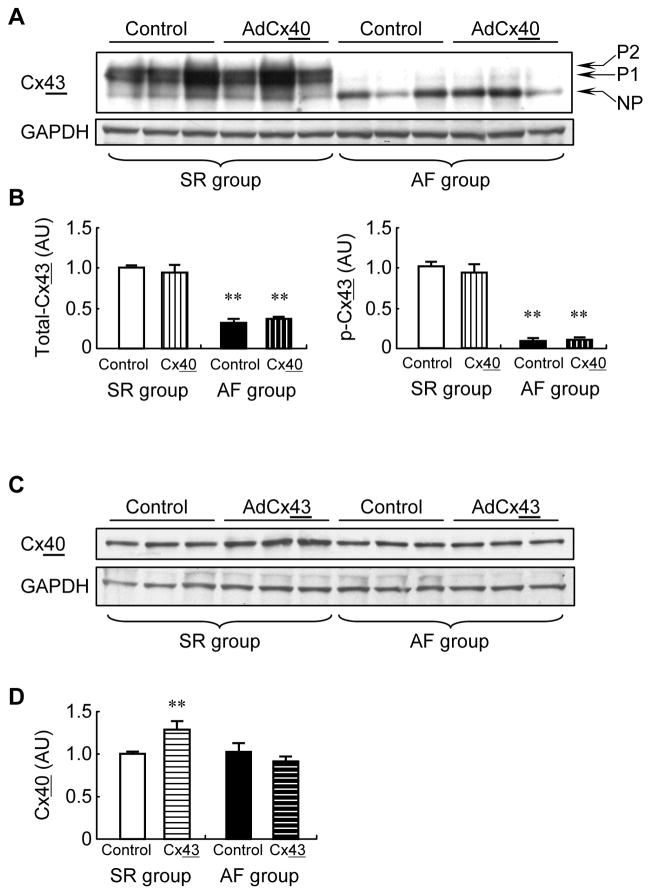
Methods and results: Thirty Yorkshire swine were randomized into 2 groups (sinus rhythm and AF), and each group into 3 subgroups: sham-operated control, gene therapy with adenovirus expressing connexin (Cx) 40, and gene therapy with adenovirus expressing Cx43 (n=5 per subgroup). All animals had epicardial gene painting; the AF group had burst atrial pacing. All animals underwent terminal study 7 days after gene transfer. Sinus rhythm animals had strong transgene expression but no atrial conduction changes. In AF animals, controls had reduced and lateralized Cx43 expression, and Cx43 gene transfer restored expression and cellular location to sinus rhythm control levels. In the AF group, both Cx40 and Cx43 gene transfer improved conduction and reduced AF relative to controls.
Conclusions: Connexin gene therapy preserved atrial conduction and prevented AF.
© 2011 American Heart Association, Inc.
Conflict of interest statement
Dr Donahue has an ownership interest in Excigen Inc. The remaining authors report no conflicts.
Figures
Comment in
-
Connexins and atrial fibrillation: filling in the gaps.Circulation. 2012 Jan 17;125(2):203-6. doi: 10.1161/CIRCULATIONAHA.111.075432. Epub 2011 Dec 8. Circulation. 2012. PMID: 22158757 No abstract available.
References
-
- Miyasaka Y, Barnes ME, Gersh BJ, Cha SS, Bailey KR, Abhayaratna WP, Seward JB, Tsang TS. Secular trends in incidence of atrial fibrillation in Olmsted County, Minnesota, 1980 to 2000, and implications on the projections for future prevalence. Circulation. 2006;114:119–25. - PubMed
-
- Corley S, Epstein A, DiMarco J, Domanski M, Geller N, Greene H, Josephson M, Kellen J, Klein R, Krahn A, Mickel M, Mitchell L, Nelson J, Rosenberg Y, Schron E, Shemanski L, Waldo A, Wyse D AFFIRM Investigators. Relationships between sinus rhythm, treatment, and survival in the Atrial Fibrillation Follow-Up Investigation of Rhythm Management (AFFIRM) Study. Circulation. 2004;109:1509–13. - PubMed
-
- Camm AJ. Safety considerations in the pharmacological management of atrial fibrillation. Int J Cardiol. 2008;127:299–306. - PubMed
-
- Cappato R, Calkins H, Chen SA, Davies W, Iesaka Y, Kalman J, Kim YH, Klein G, Natale A, Packer D, Skanes A, Ambrogi F, Biganzoli E. Updated Worldwide Survey on the Methods, Efficacy, and Safety of Catheter Ablation for Human Atrial Fibrillation. Circ Arrhythm Electrophysiol. 2010;3:32–8. - PubMed
-
- Nattel S. Therapeutic implications of atrial fibrillation mechanisms: can mechanistic insights be used to improve AF management? Cardiovasc Res. 2002;54:347–60. - PubMed
Publication types
MeSH terms
Substances
Grants and funding
LinkOut - more resources
Full Text Sources
Other Literature Sources
Medical
Miscellaneous
