. 2012 Feb 3;287(6):3704-9.
doi: 10.1074/jbc.C111.328559. Epub 2011 Dec 12.

Phospholipase Cγ-2 and intracellular calcium are required for lipopolysaccharide-induced Toll-like receptor 4 (TLR4) endocytosis and interferon regulatory factor 3 (IRF3) activation

Affiliations

Phospholipase Cγ-2 and intracellular calcium are required for lipopolysaccharide-induced Toll-like receptor 4 (TLR4) endocytosis and interferon regulatory factor 3 (IRF3) activation

Chih-Yuan Chiang et al. J Biol Chem. .

Abstract

Toll-like receptor 4 (TLR4) is unique among the TLRs in its use of multiple adaptor proteins leading to activation of both the interferon regulatory factor 3 (IRF3) and nuclear factor κB (NF-κB) pathways. Previous work has demonstrated that TLR4 initiates NF-κB activation from the plasma membrane, but that subsequent TLR4 translocation to the endosomes is required for IRF3 activation. Here we have characterized several components of the signaling pathway that governs TLR4 translocation and subsequent IRF3 activation. We find that phospholipase C γ2 (PLCγ2) accounts for LPS-induced inositol 1,4,5-trisphosphate (IP(3)) production and subsequent calcium (Ca(2+)) release. Blockage of PLCγ2 function by inhibitors or knockdown of PLCγ2 expression by siRNAs in RAW 264.7 macrophages lead to reduced IRF3, but enhanced NF-κB activation. In addition, bone marrow-derived macrophages from PLCγ2-deficient mice showed impaired IRF3 phosphorylation and expression of IRF3-regulated genes after LPS stimulation. Using cell fractionation, we show that PLCγ2-IP(3)-Ca(2+) signaling cascade is required for TLR4 endocytosis following LPS stimulation. In conclusion, our results describe a novel role of the PLCγ2-IP(3)-Ca(2+) cascade in the LPS-induced innate immune response pathway where release of intracellular Ca(2+) mediates TLR4 trafficking and subsequent activation of IRF3.


Figures
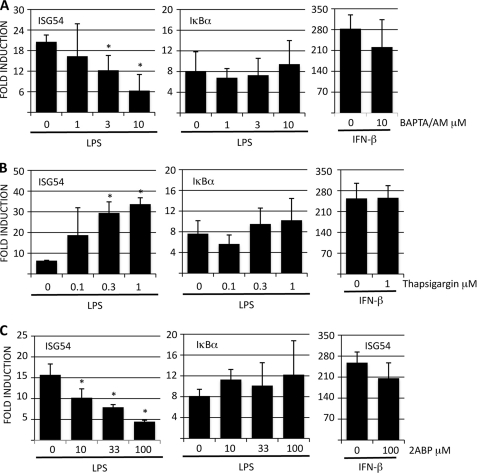
FIGURE 1.
FIGURE 1.
Calcium signaling modulates LPS-induced expression of IRF3-regulated genes. RAW264.7 cells were pretreated with A, BAPTA/AM; B, thapsigargin; or C, 2-ABP for 30 min and then stimulated with LPS (100 ng/ml) or IFN-β (100 IU/ml) for 4 h. ISG54 and IκBα expressions were analyzed by RT-QPCR and normalized to GAPDH. Results are presented as fold induction compared with unstimulated controls and are the means of three independent experiments. Error bars indicate S.D. and statistical significance was determined by paired Student's t test.
FIGURE 2.
FIGURE 2.
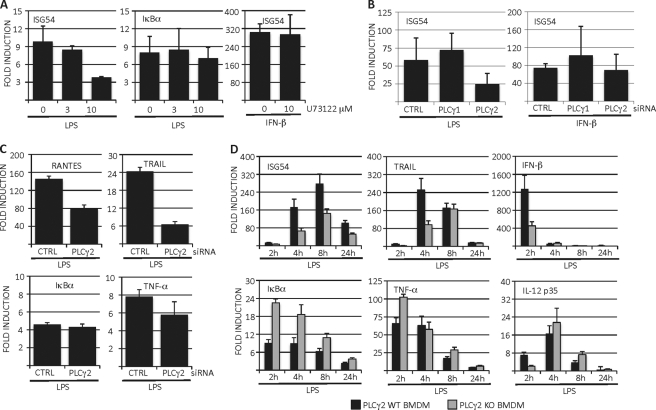
PLCγ is required for expression of IRF3-regulated genes in LPS-stimulated macrophages. A, RAW 264.7 cells were pretreated for 30 min with PLCγ inhibitor U73122 followed by LPS or IFN-β stimulation. ISG54 and IκBα expression was analyzed by RT-QPCR. B, RAW 264.7 cells were transiently transfected with control siRNAs or siRNAs targeting PLCγ1 or PLCγ2. After 48 h, cells were stimulated with LPS or IFN-β and ISG54 expression was analyzed by RT-QPCR. An aliquot of the cell lysates was analyzed for knock-down efficiency. C, RAW 264.7 cells were transfected with control or PLCγ2 siRNAs and stimulated with LPS. Expression of RANTES, TRAIL, IκBα, and TNF-α was analyzed by RT-QPCR. D, bone marrow-derived macrophages from wild type or PLCγ2 knock-out mice were stimulated with LPS (100 ng/ml) for the times indicated and expression of inflammatory cytokines was analyzed by RT-QPCR. Results are mean of three independent experiments and error bars represent standard deviations of means, and statistical significance was determined by paired Student's t test.
FIGURE 3.
FIGURE 3.
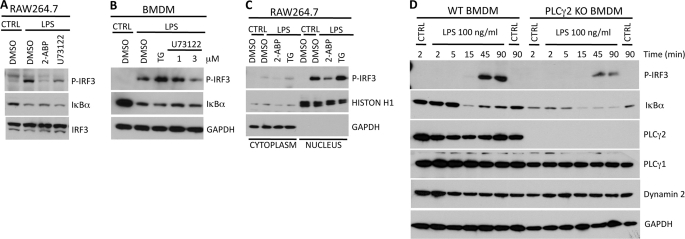
Calcium is required for efficient phosphorylation and nuclear import of IRF3. A, RAW 264.7 cells or B, bone marrow-derived macrophages were pretreated with the indicated inhibitors for 30 min and subsequently stimulated with LPS (100 ng/ml) for 45 min. Whole cell lysates were analyzed for phosphorylated IRF3 and IκBα. C, RAW 264.7 cells were pretreated with inhibitors for 30 min and stimulated with LPS for 45 min. Cells were lysed and cytoplasmic and nuclear fractions were analyzed for phosphorylated IRF3. D, bone marrow-derived macrophages from wild type or PLCγ2 knock-out mice were stimulated with LPS and levels of phosphorylated IRF3 and IκBα were analyzed by Western blotting from whole cell lysates.
FIGURE 4.
FIGURE 4.
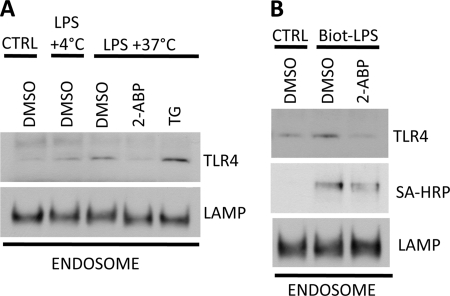
Calcium signaling regulates TLR4 endocytosis. A, RAW 264.7 cells were pretreated with inhibitors for 30 min prior to stimulation with LPS. Cells were lysed and endosomes were enriched by sucrose gradient centrifugation. TLR4 and LAMP-1 levels were analyzed by Western blotting. B, RAW 264.7 cells were treated similarly to A but stimulated with biotin-conjugated LPS (Biot-LPS). Levels of TLR4 and biotin-LPS in the endosome enriched fraction were determined by using TLR4-specific antibody and streptavidin-HRP (SA-HRP), respectively. Results from one out of three experiments are shown.

References

    1. Akira S., Takeda K., Kaisho T. (2001) Toll-like receptors: critical proteins linking innate and acquired immunity. Nat. Immunol. 2, 675–680 - PubMed
    1. Akira S., Uematsu S., Takeuchi O. (2006) Pathogen recognition and innate immunity. Cell 124, 783–801 - PubMed
    1. Poltorak A., He X., Smirnova I., Liu M. Y., Van Huffel C., Du X., Birdwell D., Alejos E., Silva M., Galanos C., Freudenberg M., Ricciardi-Castagnoli P., Layton B., Beutler B. (1998) Defective LPS signaling in C3H/HeJ and C57BL/10ScCr mice: mutations in Tlr4 gene. Science 282, 2085–2088 - PubMed
    1. Qureshi S. T., Larivière L., Leveque G., Clermont S., Moore K. J., Gros P., Malo D. (1999) Endotoxin-tolerant mice have mutations in Toll-like receptor 4 (TLR4) J. Exp. Med. 189, 615–625 - PMC - PubMed
    1. Kawai T., Adachi O., Ogawa T., Takeda K., Akira S. (1999) Unresponsiveness of MyD88-deficient mice to endotoxin. Immunity 11, 115–122 - PubMed

Publication types

MeSH terms