. 2011 Dec 27;108(52):21212-7.
doi: 10.1073/pnas.1114023109. Epub 2011 Dec 7.

Legionella pneumophila regulates the small GTPase Rab1 activity by reversible phosphorylcholination

Affiliations

Legionella pneumophila regulates the small GTPase Rab1 activity by reversible phosphorylcholination

Yunhao Tan et al. Proc Natl Acad Sci U S A. .

Abstract

Effectors delivered into host cells by the Legionella pneumophila Dot/Icm type IV transporter are essential for the biogenesis of the specialized vacuole that permits its intracellular growth. The biochemical function of most of these effectors is unknown, making it difficult to assign their roles in the establishment of successful infection. We found that several yeast genes involved in membrane trafficking, including the small GTPase Ypt1, strongly suppress the cytotoxicity of Lpg0695(AnkX), a protein known to interfere severely with host vesicle trafficking when overexpressed. Mass spectrometry analysis of Rab1 purified from a yeast strain inducibly expressing AnkX revealed that this small GTPase is modified posttranslationally at Ser(76) by a phosphorylcholine moiety. Using cytidine diphosphate-choline as the donor for phosphorylcholine, AnkX catalyzes the transfer of phosphorylcholine to Rab1 in a filamentation-induced by cAMP(Fic) domain-dependent manner. Further, we found that the activity of AnkX is regulated by the Dot/Icm substrate Lpg0696(Lem3), which functions as a dephosphorylcholinase to reverse AnkX-mediated modification on Rab1. Phosphorylcholination interfered with Rab1 activity by making it less accessible to the bacterial GTPase activation protein LepB; this interference can be alleviated fully by Lem3. Our results reveal reversible phosphorylcholination as a mechanism for balanced modulation of host cellular processes by a bacterial pathogen.


Conflict of interest statement

The authors declare no conflict of interest.

Figures
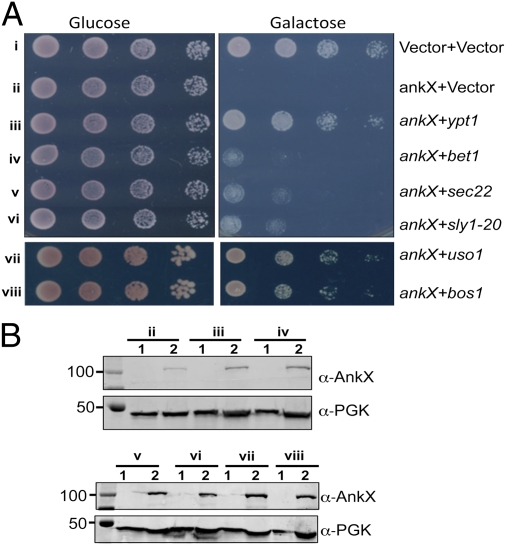
Fig. 1.
Fig. 1.
Suppression of AnkX yeast toxicity by yeast genes involved in membrane trafficking. (A) Yeast expressing chromosomally encoded (obtained by integration) AnkX from the galactose-inducible promoter was transformed with plasmids expressing the indicated genes from the alcohol dehydrogenase promoter. Yeast cells diluted with water were spotted onto glucose or galactose medium. The growth of yeast cells was documented 3 d after inoculation. Strains harboring only the vectors (Top row) or only ankX and vector (Second row) were used as controls. (B) Expression of ankX in yeast strains harboring the suppressor genes. Yeast strains grown in medium supplemented with raffinose (1) were induced with galactose (2) for 7 h, and total proteins resolved by SDS/PAGE were probed by immunoblotting with an AnkX-specific antibody. The 3-phosphoglycerate kinase (PGK) was probed as a loading control. Note that AnkX is expressed in all strains in a galactose-dependent manner.
Fig. 2.
Fig. 2.
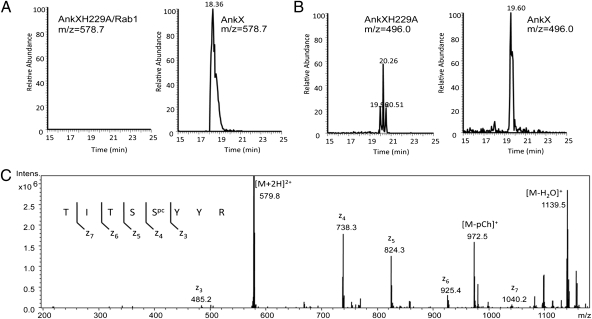
Rab1 coexpressed with AnkX in yeast was modified on Ser76 by phosphorylcholination. (A) Extracted ion chromatograms for the -T72ITSSYYR79- peptide (m/z = 578.7) in GST-Rab1 coexpressed with the AnkXH229A mutant (1.6% relative to all forms of the peptide; Left) or with AnkX (92.5% relative abundance; Right). (B) Extracted ion chromatograms for the -T72ITSSYYR79- peptide (m/z = 496.0) of GST-Rab1 coexpressed with the AnkXH229A mutant (96.3% relative abundance) or AnkX (6.8% relative abundance). (C) Electron-transfer dissociation MS/MS spectrum of modified -TITSSYYR- peptide. The mass shift for fragment ions z4 through z7 and lack of shift for z3 shows that the phosphorylcholination occurred at Ser76. Labeled sequence-specific z-ions indicate the site of modification.
Fig. 3.
Fig. 3.
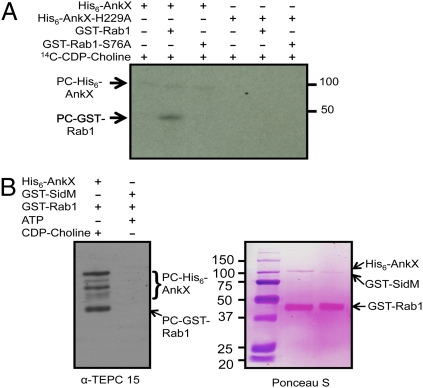
AnkX is a PC transferase that modifies Rab1. (A) PCylation of Rab1 by AnkX requires the Fic domain and Ser76 of the small GTPase. A series of reactions with the indicated components and 14C-CDP-choline was allowed to proceed for 30 min at 35 °C. After separation by SDS/PAGE, the incorporation of 14C-PC into the proteins was detected by autoradiography. The sizes of relevant protein markers (in kDa) are indicated. (B) The PC-specific antibody TEPC 15 can detect PCylated Rab1 and PCylated AnkX but not AMPylated Rab1. GST-Rab1 was incubated with His6-AnkX and CDP-choline or with GST-SidM and ATP. After SDS/PAGE, proteins on the same membrane were detected by Ponceau S staining (Right) or by Western blot with the TEPC 15 antibody (Left).
Fig. 4.
Fig. 4.
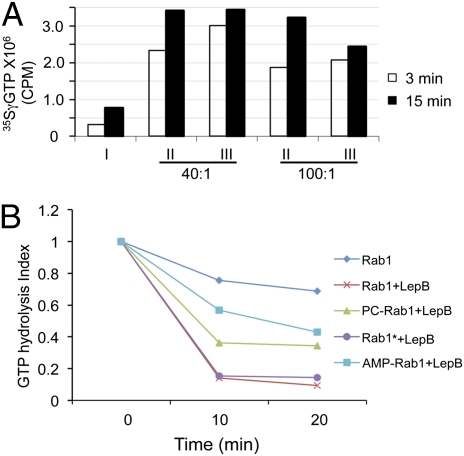
PCylation of Rab1 affects its activity in GTP loading stimulated by SidM and hydrolysis induced by LepB. (A) GDP-loaded GST-Rab1 or GST-PC-Rab1 was incubated with 35SγGTP for the indicated time in reactions with different molar ratios of Rab1 and SidM. Radioactivity associated with the protein was determined by a scintillation counter. Reactions: I, Rab1 without SidM; II, Rab1 with SidM; III, PCylated Rab1 with SidM. (B) Differently modified GST-Rab1 was loaded with 32PγGTP, and GTPase activity was induced by adding LepB. Rab1* denotes the protein incubated with AnkXH229A and CDP-choline. The GTP hydrolysis index is the ratio of the radioactivity at the endpoint of the experiments and the radioactivity associated with Rab1 before LepB was added.
Fig. 5.
Fig. 5.
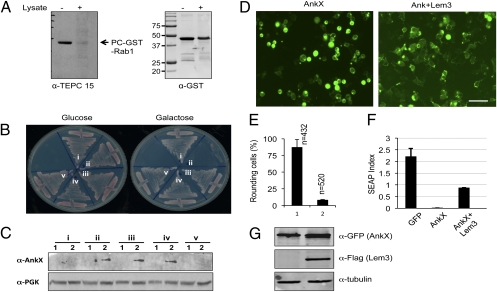
Identification of a L. pneumophila gene capable of suppressing AnkX toxicity to eukaryotic cells. (A) Removal of PCylation signals from Rab1 by total-cell lysate of L. pneumophila. Soluble bacterial cell lysate was incubated with PCylated GST-Rab1, and proteins resolved by SDS/PAGE were detected for the levels of PCylation with the TEPC 15 antibody (Left) or with a GST-specific antibody (for GST-Rab1). The sizes of relevant protein markers (in kDa) are indicated. (B) The yeast strain W303(pGal::AnkX was transformed with empty vector (ii), one of the original identified suppressor clones (iii), or plasmid harboring the lem3 gene (iv). Yeast cells were streaked onto selective medium containing glucose (Left) or galactose (Right). Strains carrying the vector (i) or the lem3 plasmid (v) were included as additional controls. Plates were incubated at 30 °C for 3 d before image acquisition. (C) Expression of ankX in yeast. SDS/PAGE-resolved lysates of indicated yeast cells uninduced (1) or induced (2) with galactose were detected with an AnkX specific antibody. PGK was probed as a loading control (Lower). (D and E) Lem3 rescued the cell-rounding phenotype caused by AnkX in mammalian cells. (D) 293T cells were transfected with pEGFP::AnkX/pFlag (Left) or with pEGFP::AnkX/pFlag::Lem3 (1:1 molar ratio) (Right) for 24 h before image acquisition. (Scale bar, 50 μm.) (E) The same samples were used to quantitate the percentage of cells exhibiting the rounding phenotype. (F and G). Lem3 rescued the AnkX-mediated inhibition of SEAP secretion by mammalian cells. The indicated combinations of plasmids were used to cotransfect 293T cells with a plasmid that directs SEAP biosynthesis. Twenty-four hours after transfection, extracellular and intracellular SEAP levels were measured. (F) The SEAP index is the ratio between extracellular and intracellular SEAP activity. (G) The same samples were used to evaluate the expression of GFP-AnkX and Flag-Lem3. For quantitative assays, each experiment was performed in triplicate, and data from the samples were used to calculate SD. Similar results were obtained in at least three independent experiments.
Fig. 6.
Fig. 6.
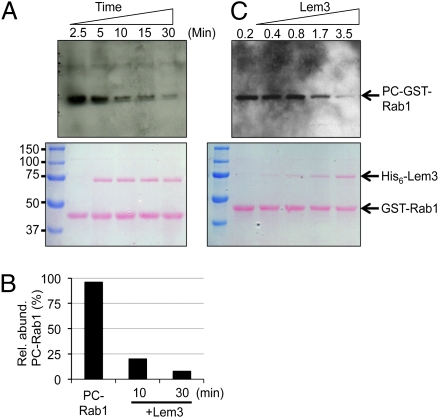
Lem3 is a dephosphorycholinase that removes the PC moiety from PCylated Rab1. (A and B) GST-Rab1 modified by AnkX and CDP-choline was incubated with His6-Lem3 at a 5:1 molar ratio for the indicated time. (A) After SDS/PAGE, the levels of PCylated GST-Rab1 were analyzed by immunoblotting with the TEPC 15 antibody (Upper). Protein levels were detected by Ponceau S staining (Lower). (B) After SDS/PAGE, the levels of PCylated GST-Rab1 were analyzed by mass spectrometry of the GST-Rab1 protein bands. (C) Dose-dependent activity of Lem3. Ten micrograms of PCylated GST-Rab1 were incubated with the indicated amounts of His6-Lem3 for 10 min. Proteins resolved by SDS/PAGE were detected first by Ponceau S staining (Lower), and the levels of PCylation were detected by Western blot (Upper). The sizes of relevant protein markers (in kDa) are indicated.

References

    1. Tilney LG, Harb OS, Connelly PS, Robinson CG, Roy CR. How the parasitic bacterium Legionella pneumophila modifies its phagosome and transforms it into rough ER: Implications for conversion of plasma membrane to the ER membrane. J Cell Sci. 2001;114:4637–4650. - PubMed
    1. Derré I, Isberg RR. Legionella pneumophila replication vacuole formation involves rapid recruitment of proteins of the early secretory system. Infect Immun. 2004;72:3048–3053. - PMC - PubMed
    1. Kagan JC, Stein MP, Pypaert M, Roy CR. Legionella subvert the functions of Rab1 and Sec22b to create a replicative organelle. J Exp Med. 2004;199:1201–1211. - PMC - PubMed
    1. Kagan JC, Roy CR. Legionella phagosomes intercept vesicular traffic from endoplasmic reticulum exit sites. Nat Cell Biol. 2002;4:945–954. - PubMed
    1. Dorer MS, Kirton D, Bader JS, Isberg RR. RNA interference analysis of Legionella in Drosophila cells: Exploitation of early secretory apparatus dynamics. PLoS Pathog. 2006;2:e34. - PMC - PubMed

Publication types

MeSH terms