


Altered brain activation during visuomotor integration in chronic active cannabis users: relationship to cortisol levels
- PMID: 22159107
- PMCID: PMC3273845
- DOI: 10.1523/JNEUROSCI.4148-11.2011
Altered brain activation during visuomotor integration in chronic active cannabis users: relationship to cortisol levels
Abstract
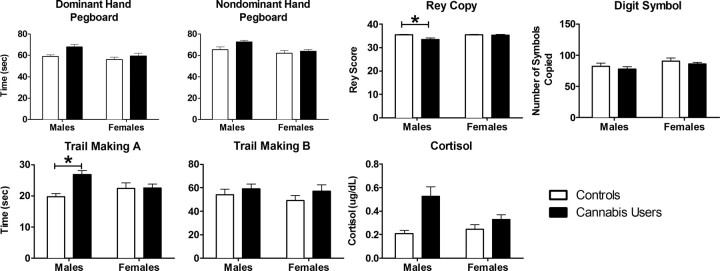
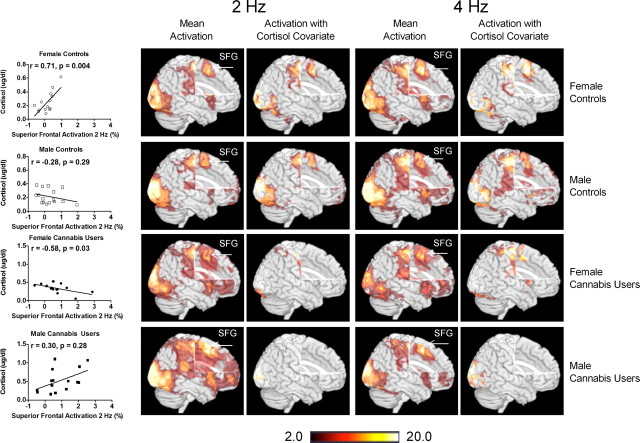
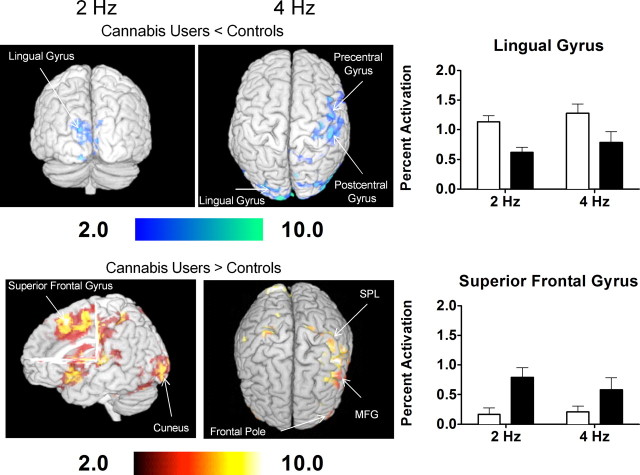
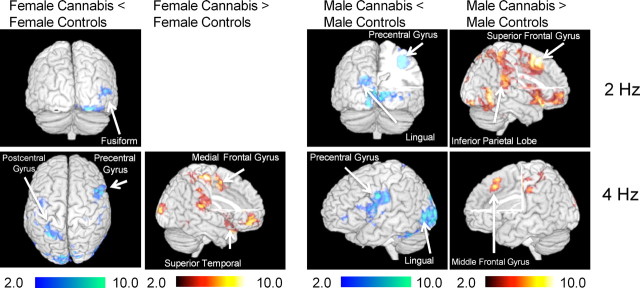
Cannabis is the most abused illegal substance in the United States. Alterations in brain function and motor behavior have been reported in chronic cannabis users, but the results have been variable. The current study aimed to determine whether chronic active cannabis use in humans may alter psychomotor function, brain activation, and hypothalamic-pituitary-axis (HPA) function in men and women. Thirty cannabis users (16 men, 14 women, 18-45 years old) and 30 nondrug user controls (16 men, 14 women, 19-44 years old) were evaluated with neuropsychological tests designed to assess motor behavior and with fMRI using a 3 Tesla scanner during a visually paced finger-sequencing task, cued by a flashing checkerboard (at 2 or 4 Hz). Salivary cortisol was measured to assess HPA function. Male, but not female, cannabis users had significantly slower performance on psychomotor speed tests. As a group, cannabis users had greater activation in BA 6 than controls, while controls had greater activation in the visual area BA 17 than cannabis users. Cannabis users also had higher salivary cortisol levels than controls (p = 0.002). Chronic active cannabis use is associated with slower and less efficient psychomotor function, especially in male users, as indicated by a shift from regions involved with automated visually guided responses to more executive or attentional control areas. The greater but altered brain activities may be mediated by the higher cortisol levels in the cannabis users, which in turn may lead to less efficient visual-motor function.
Conflict of interest statement
The authors declare no financial conflicts of interest.
Figures
References
-
- Bell EC, Willson MC, Wilman AH, Dave S, Silverstone PH. Males and females differ in brain activation during cognitive tasks. Neuroimage. 2006;30:529–538. - PubMed
-
- Bernal B, Altman N. Neural networks of motor and cognitive inhibition are dissociated between brain hemispheres: an fMRI study. Int J Neurosci. 2009;119:1848–1880. - PubMed
-
- Bischoff-Grethe A, Goedert KM, Willingham DT, Grafton ST. Neural substrates of response-based sequence learning using fMRI. J Cogn Neurosci. 2004;16:127–138. - PubMed
-
- Bolla KI, Brown K, Eldreth D, Tate K, Cadet JL. Dose-related neurocognitive effects of marijuana use. Neurology. 2002;59:1337–1343. - PubMed
-
- Börnert P, Aldefeld B, Eggers H. Reversed spiral MR imaging. Magn Reson Med. 2000;44:479–484. - PubMed
Publication types
MeSH terms
Substances
Grants and funding
LinkOut - more resources
Full Text Sources
Research Materials
