


Health-related quality of life and biomarkers in breast cancer survivors participating in tai chi chuan
- PMID: 22160628
- PMCID: PMC3664952
- DOI: 10.1007/s11764-011-0205-7
Health-related quality of life and biomarkers in breast cancer survivors participating in tai chi chuan
Abstract
Introduction: Breast cancer survivors experience diminished health-related quality of life (HRQOL). We report on the influence of tai chi chuan exercise (TCC) on HRQOL and explore associations between changes in HRQOL and biomarkers.
Methods: Breast cancer survivors (N = 21) were randomly assigned to TCC or standard support therapy (SST) for 12 weeks (three times/week; 60 min/session). Interleukin-6, interleukin-8 (IL-8), insulin-like growth factor-1 (IGF-1), insulin-like growth factor-binding protein (IBFBP)-1, IGFBP-3, glucose, insulin, and cortisol were measured pre- and postintervention. Overall HRQOL and subdomains were assessed at preintervention (T1), midintervention (T2) and postintervention (T3) and biomarkers at T1 and T3.
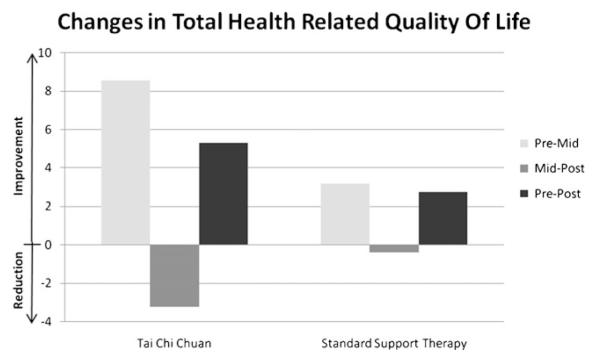
Results: The TCC group improved in total HRQOL (T1-T2:CS = 8.54, P = 0.045), physical functioning (T1-T2:CS = 1.89, P = 0.030), physical role limitations (T1-T2 CS = 1.55, P = 0.023), social functioning (T1-T3:CS = 1.50, P = 0.020), and general mental health (T1-T2:CS = 2.67, P = 0.014; T1-T3:CS = 2.44, P = 0.019). The SST improved in social functioning (T1-T2:CS = 0.64, P = 0.043) and vitality (T1-T2:CS = 0.90, P = 0.01). There were relationships between changes in IGF-1 and overall HRQOL (r = -0.56; P < 0.05), physical role limitation (r = -0.68; P < 0.05), and social functioning (r = -0.56; P < 0.05). IGFBP-1 changes were associated with physical role limitations changes (r = 0.60; P < 0.05). IGFBP-3 changes were associated with physical functioning changes (r = 0.46; P ≤ 0.05). Cortisol changes were associated with changes in physical role limitations (r = 0.74; P < 0.05) and health perceptions (r = 0.46; P < 0.05). Glucose changes were associated with emotional role limitation changes (r = -0.70; P < 0.001). IL-8 changes were associated with emotional role limitation changes (r = 0.59; P < 0.05).
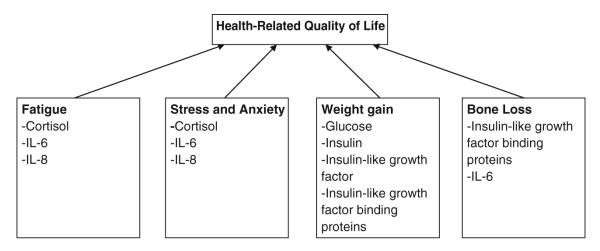
Discussion/conclusions: TCC may improve HRQOL by regulating inflammatory responses and other biomarkers associated with side effects from cancer and its treatments.
Implications for cancer survivors: TCC may be an intervention capable of improving HRQOL in breast cancer survivors.
Figures
References
-
- American Cancer Society Cancer facts and figures. 2009.
-
- Sadler IJ, Jacobsen PB. Progress in understanding fatigue associated with breast cancer treatment. Cancer Invest. 2001;19(7):723–31. - PubMed
-
- Hermelink K, et al. Cognitive function during neoadjuvant chemotherapy for breast cancer: results of a prospective, multicenter, longitudinal study. Cancer. 2007;109(9):1905–13. - PubMed
-
- Vardy J, Tannock I. Cognitive function after chemotherapy in adults with solid tumours. Crit Rev Oncol Hematol. 2007;63(3):183–202. - PubMed
Publication types
MeSH terms
Substances
Grants and funding
LinkOut - more resources
Full Text Sources
Medical
Miscellaneous
