


A randomized trial of exercise on well-being and function following breast cancer surgery: the RESTORE trial
- PMID: 22160629
- PMCID: PMC3900279
- DOI: 10.1007/s11764-011-0208-4
A randomized trial of exercise on well-being and function following breast cancer surgery: the RESTORE trial
Abstract
Objectives: This study aimed to determine the effect of a moderate, tailored exercise program on health-related quality of life, physical function, and arm volume in women receiving treatment for nonmetastatic breast cancer.
Methods: Women who were within 4-12 weeks of surgery for stage I-III breast cancer were randomized to center-based exercise and lymphedema education intervention or patient education. Functional assessment of cancer therapy-breast cancer (FACT-B), 6-min walk, and arm volume were performed at 3-month intervals through 18 months. Repeated measures analysis of covariance was used to model the total meters walked over time, FACT-B scores, and arm volume. Models were adjusted for baseline measurement, baseline affected arm volume, number of nodes removed, age, self-reported symptoms, baseline SF-12 mental and physical component scores, visit, and treatment group.
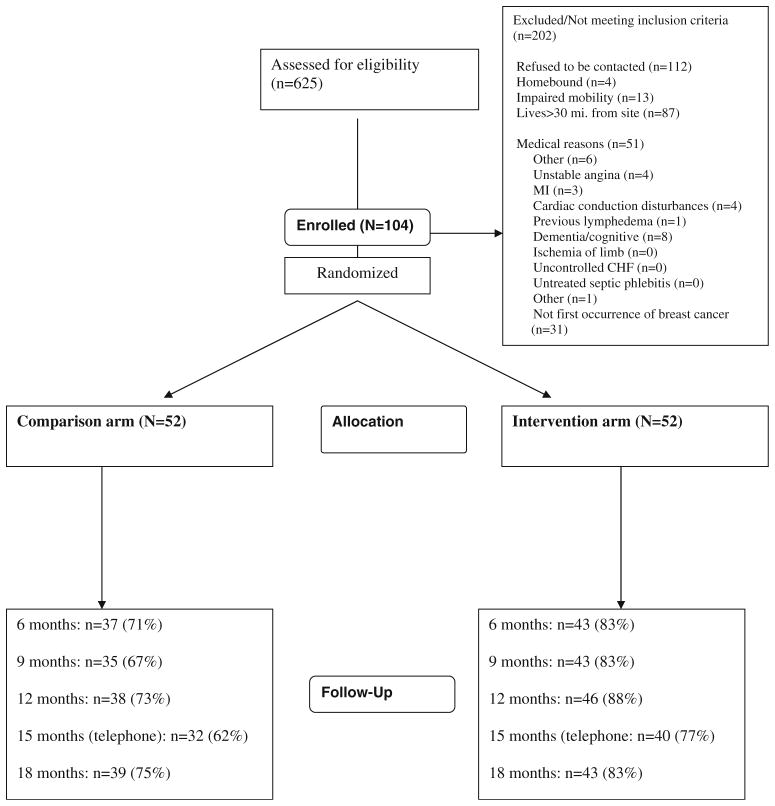
Results: Of the recruited 104 women, 82 completed all 18 months. Mean age (range) was 53.6 (32-82) years; 88% were Caucasian; 45% were employed full time; 44% were overweight; and 28% obese. Approximately, 46% had breast-conserving surgery; 79% had axillary node dissection; 59% received chemotherapy; and 64% received radiation. The intervention resulted in an average increase of 34.3 ml (SD = 12.8) versus patient education (p = 0.01). Changes in FACT-B scores and arm volumes were not significantly different.
Conclusions: With this early exercise intervention after breast cancer diagnosis, a significant improvement was achieved in physical function, with no decline in health-related quality of life or detrimental effect on arm volume.
Implications for cancer survivors: Starting a supervised exercise regimen that is tailored to an individual's strength and stamina within 3 months following breast cancer surgery appears safe and may hasten improvements in physical functioning.
References
-
- Burstein HJ, Winer EP. Primary care for survivors of breast cancer. N Engl J Med. 2000;343:1086–94. - PubMed
-
- Kim CJ, Kang DH, Smith BA, et al. Cardiopulmonary responses and adherence to exercise in women newly diagnosed with breast cancer undergoing adjuvant therapy. Cancer Nurs. 2006;29:156–65. - PubMed
-
- Hewitt ME, Greenfield S, Stovall E, et al. In: From cancer patient to cancer survivor—lost in transition: an American Society of Clinical Oncology and Institute of Medicine Symposium. Hewitt ME, Ganz PA, editors. Washington: The National Academies Press; 2006.
-
- Petruzzello SJ, Landers DM, Hatfield BD, et al. A meta-analysis on the anxiety-reducing effects of acute and chronic exercise. Outcomes and mechanisms. Sports Med. 1991;11:143–82. - PubMed
-
- North TC, McCullagh P, Tran ZV. Effect of exercise on depression. Exerc Sport Sci Rev. 1990;18:379–415. - PubMed
