. 2012 Jan 10;109(2):413-8.
doi: 10.1073/pnas.1111561108. Epub 2011 Dec 12.

Imaging protein synthesis in cells and tissues with an alkyne analog of puromycin

Affiliations

Imaging protein synthesis in cells and tissues with an alkyne analog of puromycin

Jing Liu et al. Proc Natl Acad Sci U S A. .

Abstract

Synthesis of many proteins is tightly controlled at the level of translation, and plays an essential role in fundamental processes such as cell growth and proliferation, signaling, differentiation, or death. Methods that allow imaging and identification of nascent proteins are critical for dissecting regulation of translation, both spatially and temporally, particularly in whole organisms. We introduce a simple and robust chemical method to image and affinity-purify nascent proteins in cells and in animals, based on an alkyne analog of puromycin, O-propargyl-puromycin (OP-puro). OP-puro forms covalent conjugates with nascent polypeptide chains, which are rapidly turned over by the proteasome and can be visualized or captured by copper(I)-catalyzed azide-alkyne cycloaddition. Unlike methionine analogs, OP-puro does not require methionine-free conditions and, uniquely, can be used to label and assay nascent proteins in whole organisms. This strategy should have broad applicability for imaging protein synthesis and for identifying proteins synthesized under various physiological and pathological conditions in vivo.


Conflict of interest statement

The authors declare no conflict of interest.

Figures
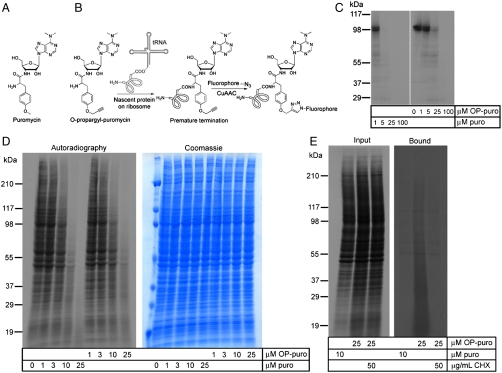
Fig. 1.
Fig. 1.
OP-puro, an alkyne puroanalog, is a potent protein synthesis inhibitor. (A) Structure of puro and the analog OP-puro, which bears a terminal alkyne group. (B) Schematic of OP-puro incorporation into nascent polypeptide chains on translating ribosomes. The prematurely terminated polypeptides are subsequently detected by CuAAC using a fluorescent azide. (C) Inhibition of protein translation in vitro by puro and OP-puro. A 35S-Met-labeled protein (a GFP fusion of mouse SuFu) was generated by translation in rabbit reticulocyte lysates, in the absence or presence of varying concentrations of puro and OP-puro. The translation reactions were separated by SDS-PAGE, and the translated protein was visualized by autoradiography. OP-puro inhibits protein synthesis in a dose-dependent manner. (D) Inhibition of protein translation in cultured cells by puro and OP-puro. Human embryonic kidney 293T cells were incubated in methionine-free media supplemented with 35S-Met, in the absence or presence of varying concentrations of puro and OP-puro. Total cell lysates were analyzed by SDS-PAGE, followed by autoradiography, to measure bulk protein translation. The gel was also stained with Coomassie blue, to demonstrate equal protein loading. (E) Formation of conjugates between OP-puro and nascent polypeptide chains. Cultured 293T cells were labeled with 35S-Met as in D), in the presence of OP-puro, puro, or OP-puro and the protein synthesis inhibitor CHX. Cellular lysates were reacted with biotin-azide under conditions for CuAAC, after which biotinylated molecules were purified on streptavidin beads. Bound proteins were eluted, separated by SDS-PAGE, and followed by autoradiography to detect nascent proteins.
Fig. 2.
Fig. 2.
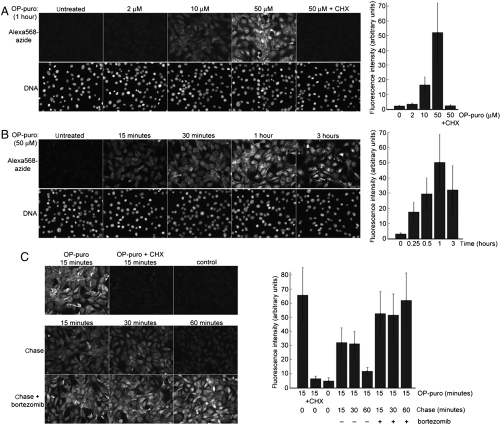
Imaging nascent proteins in cultured cells with OP-puro. (A) Cultured NIH 3T3 cells were incubated for 1 h in complete media supplemented with increasing concentrations of OP-puro, OP-puro, and CHX, or control vehicle. The cells were then fixed, stained by CuAAC with Alexa568-azide, and imaged by fluorescence microscopy. A specific signal is observed in cells treated with OP-puro, which is proportional to the concentration of added OP-puro. This signal is abolished if protein translation is blocked with CHX (50 μg/mL), which blocks translation elongation and thus prevents the formation of conjugates between nascent polypeptide chains and OP-puro. The graph on the right shows the quantification of Alexa568 fluorescence intensity in this experiment. (B) Time course of OP-puro incorporation into nascent proteins. NIH 3T3 cells were incubated with OP-puro (50 μM, which is sufficient to completely block protein synthesis) for varying amounts of time, after which OP-puro incorporation was imaged as in A. The intensity of the OP-puro signal reaches a maximum after about 1 h. The graph on the right shows the quantification of Alexa568 fluorescence intensity in this experiment. (C) The nascent protein-OP-puro conjugates are unstable and are cleared from cells in a proteasome-dependent manner. NIH 3T3 cells were treated with 50 μM OP-puro for 15 min, followed by incubation in media without OP-puro, in the absence or presence of 5 μM of the proteasome inhibitor bortezomib. Parallel cultures were fixed at the indicated times after removal of OP-puro, and nascent protein-OP-puro conjugates were imaged by CuAAC with Alexa568-azide. The OP-puro conjugates have largely disappeared after 1 h but are completely stabilized by proteasome inhibition. Untreated cells and cells incubated for 15 min with OP-puro (50 μM) and CHX (50 μg/mL) served as negative controls. The graph on the right shows the quantification of Alexa568 fluorescence intensity in this experiment.
Fig. 3.
Fig. 3.
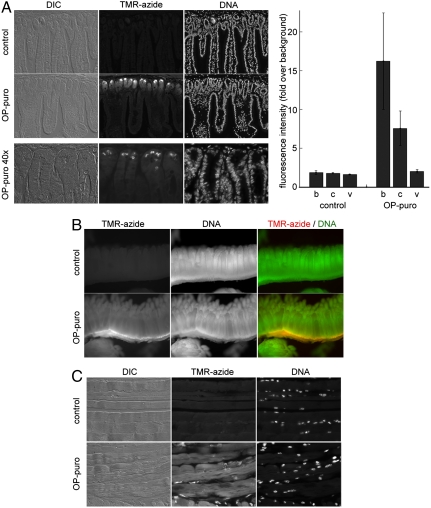
Using OP-puro to image protein synthesis in whole animals. One hundred microliters of a 20 mM OP-puro solution in PBS or PBS alone (negative control) were injected intraperitoneally into mice. Organs were harvested 1 h later, fixed in formalin, and stained by CuAAC with TMR-azide, either after paraffin sectioning or whole mount. (A) Section through mouse small intestine showing intestinal vili sectioned longitudinally. OP-puro stains strongly the cells in the crypts (particularly Paneth cells) and the cells at the base of the villi. Bottom panels show a higher magnification (40× objective) view of the intestinal crypts in an OP-puro-injected mouse. Note the intense staining of the secretory granules characteristic of Paneth cells. The graph on the right shows the quantification of TMR fluorescence in three different regions of the intestinal epithelium: the bottom of the crypts (b), the crypts proper (c), and the epithelium covering the vili (v). The rate of protein translation is significantly higher in crypts compared to vili. (B) Whole-mount staining of mouse small intestine, showing the localization of the OP-puro stain in the crypts. Protein-OP-puro conjugates were detected with TMR-azide (red), and nuclear DNA was stained with OliGreen (green). (C) OP-puro incorporation into striated muscle fibers. Paraffin sections of muscle were stained as in A. Sarcomeres are strongly stained with OP-puro, likely because some protein-OP-puro conjugates are functional and are properly assembled into sarcomeres. Images of OP-puro staining of other mouse tissues (spleen, kidney, liver) are shown in Fig. S1.

Comment in

  • Imaging of protein synthesis with puromycin.
    Goodman CA, Pierre P, Hornberger TA. Goodman CA, et al. Proc Natl Acad Sci U S A. 2012 Apr 24;109(17):E989; author reply E990. doi: 10.1073/pnas.1202000109. Epub 2012 Mar 23. Proc Natl Acad Sci U S A. 2012. PMID: 22447778 Free PMC article. No abstract available.

References

    1. Sonenberg N, Hinnebusch AG. Regulation of translation initiation in eukaryotes: Mechanisms and biological targets. Cell. 2009;136:731–745. - PMC - PubMed
    1. Selbach M, et al. Widespread changes in protein synthesis induced by microRNAs. Nature. 2008;455:58–63. - PubMed
    1. Baek D, et al. The impact of microRNAs on protein output. Nature. 2008;455:64–71. - PMC - PubMed
    1. Lecuyer E, et al. Global analysis of mRNA localization reveals a prominent role in organizing cellular architecture and function. Cell. 2007;131:174–187. - PubMed
    1. Dieterich DC, Link AJ, Graumann J, Tirrell DA, Schuman EM. Selective identification of newly synthesized proteins in mammalian cells using bioorthogonal noncanonical amino acid tagging (BONCAT) Proc Natl Acad Sci USA. 2006;103:9482–9487. - PMC - PubMed

Publication types