. 2011 Dec 27;108(52):20947-52.
doi: 10.1073/pnas.1108155108. Epub 2011 Dec 12.

The mirror game as a paradigm for studying the dynamics of two people improvising motion together

Affiliations

The mirror game as a paradigm for studying the dynamics of two people improvising motion together

Lior Noy et al. Proc Natl Acad Sci U S A. .

Abstract

Joint improvisation is the creative action of two or more people without a script or designated leader. Examples include improvisational theater and music, and day-to-day activities such as conversations. In joint improvisation, novel action is created, emerging from the interaction between people. Although central to creative processes and social interaction, joint improvisation remains largely unexplored due to the lack of experimental paradigms. Here we introduce a paradigm based on a theater practice called the mirror game. We measured the hand motions of two people mirroring each other at high temporal and spatial resolution. We focused on expert actors and musicians skilled in joint improvisation. We found that players can jointly create novel complex motion without a designated leader, synchronized to less than 40 ms. In contrast, we found that designating one player as leader deteriorated performance: The follower showed 2-3 Hz oscillation around the leader's smooth trajectory, decreasing synchrony and reducing the range of velocities reached. A mathematical model suggests a mechanism for these observations based on mutual agreement on future motion in mirrored reactive-predictive controllers. This is a step toward understanding the human ability to create novelty by improvising together.


Conflict of interest statement

The authors declare no conflict of interest.

Figures
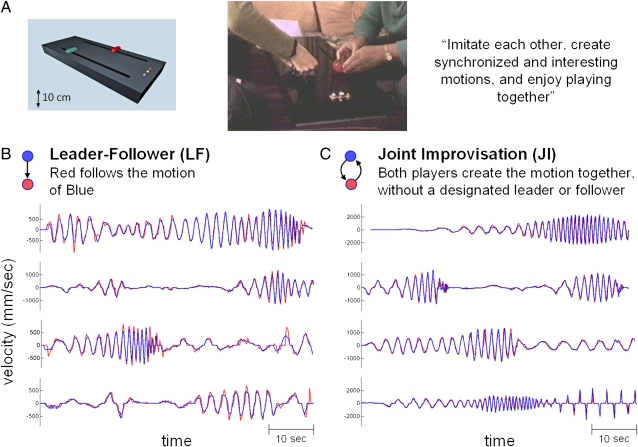
Fig. 1.
Fig. 1.
A one-dimensional mirror game shows complex, coordinated improvised motion. (A) In the mirror game, the motion of two players moving handles along tracks is sampled at 50 Hz and at a spatial resolution of 0.94 mm. (B) Examples of velocity traces in rounds where the leader and follower are designated (LF rounds). Here the leader is the blue player. (C) Examples of velocity traces in joint improvisation rounds, with no designated leader and follower (JI rounds). The data for all experimental rounds are provided in SI Appendix, Fig. 24.
Fig. 2.
Fig. 2.
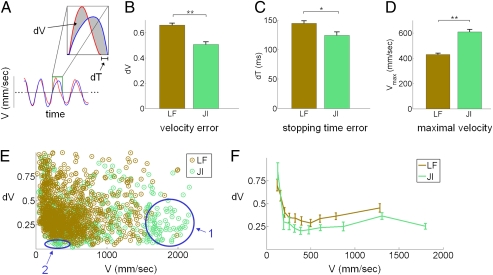
Joint improvised motion by experts is more synchronized and rapid than leader–follower motion. (A) Two measures of synchronicity of the motions of the two players. The velocity traces are segmented to periods between zero-velocity events. For each segment, the relative velocity error (dV) and the timing difference between zero-velocity events (dT) are computed. (B) Relative velocity error between players, dV, averaged over all segments. (C) Mean temporal differences between zero-velocity events of the two players, dT, averaged over all segments. (D) Maximal velocity averaged over all segments. (E) Relative velocity error in all segments, as a function of average segment velocity. Brown and green dots correspond to LF and JI rounds, respectively. Areas 1 and 2 are regions reached primarily in JI rounds and not in LF rounds. (F) Relative velocity error as a function of velocity. Shown is median dV in equal-sized velocity bins, with SEs computed by bootstrapping (*P < 0.01, **P < 0.001).
Fig. 3.
Fig. 3.
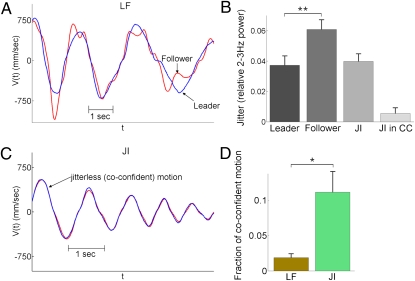
Followers demonstrate 2–3 Hz oscillation (jitter) around the leader's smooth trajectory, whereas joint improvisation shows periods of coconfident motion without such jitter. (A) In LF rounds, the follower shows jitter around the leader's smooth trajectory. (B) Mean jitter of the follower is higher than that of the leader. Jitter in JI motion is similar to that of the leader in LF motion. (C) JI rounds show periods of coconfident (CC) motion in which both players show almost no jitter (<0.01; B). (D) Percentage of time in coconfident motion is higher in JI than in LF rounds (*P < 0.05, **P < 0.01).
Fig. 4.
Fig. 4.
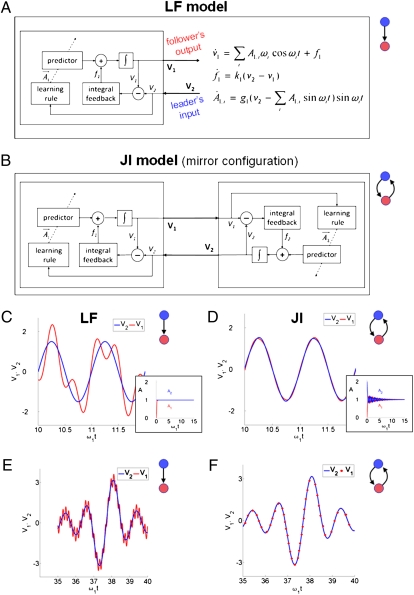
Control model for the mirror game. (A) A reactive–predictive controller produces output motion υ1 that tracks the input motion υ2. The controller has a reactive unit (integral feedback, f1) that compares υ1 with υ2, and a predictive unit that generates an expectation of the future motion. (B) Two reactive–predictive controllers in a mirror configuration, where the output of one is the input of the other. (C) A single controller tracks an input signal with jitter. Here the predictor has a single frequency, ω. (D) Mirrored controllers converge to precise jitterless motion. Initial conditions are A1(0) = 2, A2(0) = 0, υ1(0) = 0, υ2(0) = 0. (Insets) Predictor amplitudes A1 and A2 converge, so that controllers end up agreeing on future motion. Here k1 = k2 = 1, g1 = g2 = 10. (E and F) Same as C and D for a predictor with five frequencies (ω1,…,ω5 = 0.025, 0.05, 0.075, 0.1, 0.125). F shows the motion of mirrored controllers, after a transient time, in response to initial conditions Ai,1(0) = Ai,2(0) = 0,υ1(0) = 0,υ2(0) = 1. E is the motion of a single controller receiving the motion of F as input.

References

    1. Sebanz N, Bekkering H, Knoblich G. Joint action: Bodies and minds moving together. Trends Cogn Sci. 2006;10(2):70–76. - PubMed
    1. Schmidt R, Richardson M. Dynamics of interpersonal coordination. In: Fuchs A, Jirsa V, editors. Coordination: Neural, Behavioral and Social Dynamics. Heidelberg, Germany: Springer; 2008. pp. 281–308.
    1. Stephens GJ, Silbert LJ, Hasson U. Speaker-listener neural coupling underlies successful communication. Proc Natl Acad Sci USA. 2010;107:14425–14430. - PMC - PubMed
    1. Tognoli E, Lagarde J, DeGuzman GC, Kelso JA. The phi complex as a neuromarker of human social coordination. Proc Natl Acad Sci USA. 2007;104:8190–8195. - PMC - PubMed
    1. Konvalinka I, Vuust P, Roepstorff A, Frith CD. Follow you, follow me: Continuous mutual prediction and adaptation in joint tapping. Q J Exp Psychol. 2010;63:2220–2230. - PubMed

Publication types