. 2012 Jan;20(1):44-8.
doi: 10.1007/s12471-011-0226-x.

Monitoring cardiac fibrosis: a technical challenge

Affiliations

Monitoring cardiac fibrosis: a technical challenge

S de Jong et al. Neth Heart J. 2012 Jan.

Abstract

The heart contains a collagen network that contributes to the contractility of the heart and provides cardiac strength. In cardiac diseases, an increase in collagen deposition is often observed. This fibrosis formation causes systolic and diastolic dysfunction, and plays a major role in the arrythmogenic substrate. Therefore, accurate detection of cardiac fibrosis and its progression is of clinical importance with regard to diagnostics and therapy for patients with cardiac disease. To evaluate cardiac collagen deposition, both invasive and non-invasive techniques are used. In this review the different techniques that are currently used in clinical and experimental setting are summarised, and the advantages and disadvantages of these techniques are discussed.


Figures
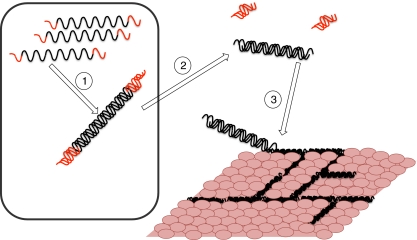
Fig. 1
Fig. 1
Schematic overview from the synthesis of procollagen to embedding of the collagen into the network 1. Three procollagen strands, synthesised by the fibroblast, form procollagen with its triple helical structure. 2. Procollagen is transported into the extracellular matrix and the propeptides are cleaved. 3. The mature collagen forms larger fibrils and cross-links and is embedded in the collagen network of the heart
Fig. 2
Fig. 2
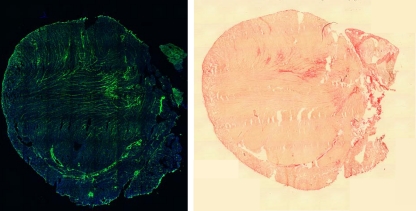
Collagen detection with CNA35. The left panel shows a coronal section of a mouse heart containing interstitial fibrosis that is detected by CNA35 labelled with the fluorescent probe FITC. Green = collagen, blue = nuclei. The right panel shows a serial section of the mouse heart stained with Picrosirius Red, yellow = viable myocardium, red = collagen. CNA35-stained picture kindly provided by Prof. Dr. Prinzen and Prof. Dr. van Zandvoort, Maastricht University

References

    1. Eghbali M, Weber KT. Collagen and the myocardium: fibrillar structure, biosynthesis and degradation in relation to hypertrophy and its regression. Mol Cell Biochem. 1990;96(1):1–14. doi: 10.1007/BF00228448. - DOI - PubMed
    1. Janicki JS, Brower GL. The role of myocardial fibrillar collagen in ventricular remodeling and function. J Card Fail. 2002;8(6 Suppl):S319–S325. doi: 10.1054/jcaf.2002.129260. - DOI - PubMed
    1. de Jong S, van Veen TA, van Rijen HV, et al. Fibrosis and cardiac arrhythmias. J Cardiovasc Pharmacol. 2011;57(6):630–638. doi: 10.1097/FJC.0b013e318207a35f. - DOI - PubMed
    1. van der Rest M, Garrone R. Collagen family of proteins. FASEB J. 1991;5(13):2814–2823. - PubMed
    1. Weber KT, Sun Y, Katwa LC, et al. Connective tissue and repair in the heart. Potential regulatory mechanisms. Ann N Y Acad Sci. 1995;752:286–299. doi: 10.1111/j.1749-6632.1995.tb17438.x. - DOI - PubMed

LinkOut - more resources