


Brief report: genotype, phenotype, and clinical course in five patients with PAPA syndrome (pyogenic sterile arthritis, pyoderma gangrenosum, and acne)
- PMID: 22161697
- PMCID: PMC3737487
- DOI: 10.1002/art.34332
Brief report: genotype, phenotype, and clinical course in five patients with PAPA syndrome (pyogenic sterile arthritis, pyoderma gangrenosum, and acne)
Abstract
Objective: To describe the genotypes, phenotypes, immunophenotypes, and treatments of PAPA syndrome (pyogenic sterile arthritis, pyoderma gangrenosum, and acne), a rare autoinflammatory disease, in 5 patients.
Methods: Clinical information was gathered from medical records and through interviews with 5 patients from 4 kindreds. PSTPIP1 (CD2BP1) exon 10 and exon 11 sequencing was performed in each patient. Neutrophil granule content and cytokine levels were determined in plasma and stimulated peripheral blood mononuclear cells (PBMCs) from patients and controls.
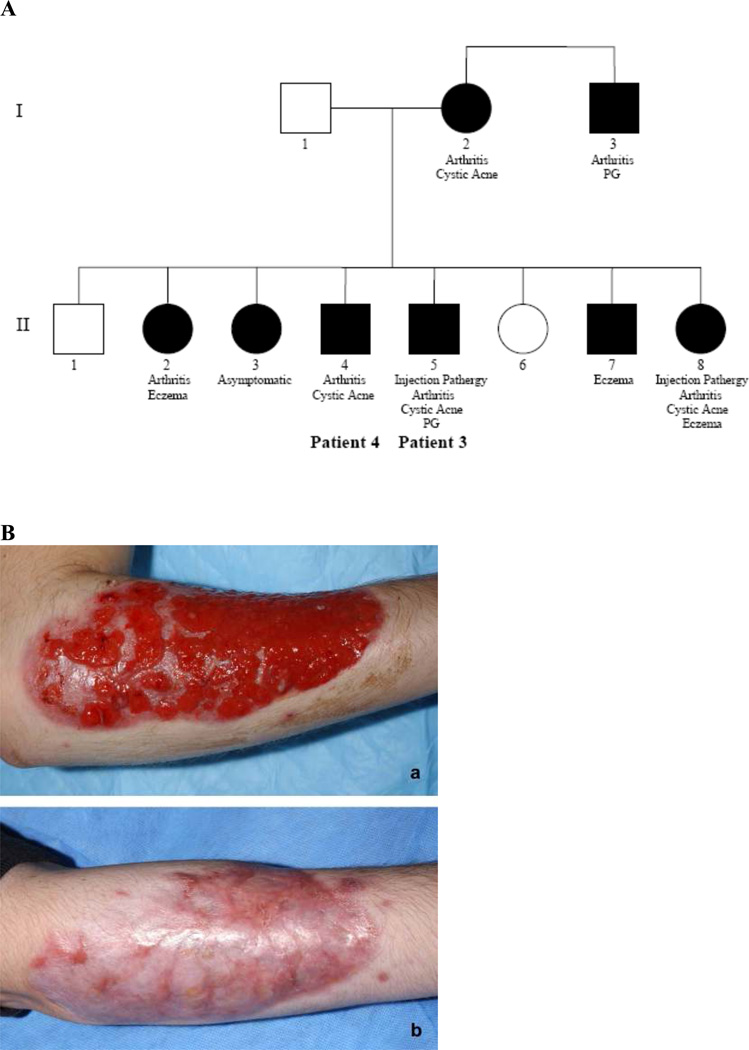
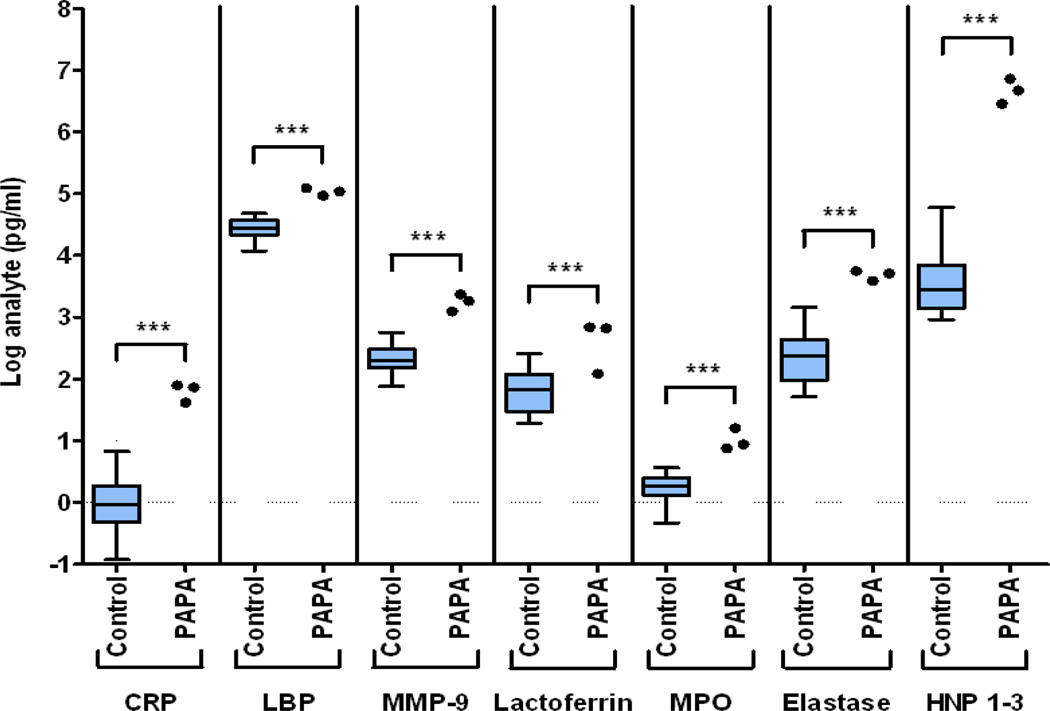
Results: We identified 2 previously described PAPA syndrome-associated PSTPIP1 mutations, A230T and E250Q, and a novel change, E250K. Disease penetrance was incomplete, with variable expressivity. The cutaneous manifestations included pathergy, cystic acne, and pyoderma gangrenosum. Interleukin-1β (IL-1β) and circulating neutrophil granule enzyme levels were markedly elevated in patients compared to those in controls. PBMC stimulation studies demonstrated impaired production of IL-10 and enhanced production of granulocyte-macrophage colony-stimulating factor. Good resolution of pyoderma gangrenosum was achieved in 3 patients with tumor necrosis factor α (TNFα) blockade treatment.
Conclusion: This analysis of 5 patients demonstrates that mutations in PSTPIP1 are incompletely penetrant and variably expressed in the PAPA syndrome. Neutrophil granule proteins are markedly elevated ex vivo and in the plasma, and elevated levels might be compatible with a diagnosis of PAPA syndrome. TNFα blockade appears to be effective in treating the cutaneous manifestations of PAPA syndrome.
Copyright © 2012 by the American College of Rheumatology.
Figures
References
-
- Yang H, Reinherz E. CD2BP1 modulates CD2-dependent T cell activation via linkage to protein tyrosine phosphatase (PTP)-PEST. J Immunol. 2006;176:5898–5907. - PubMed
-
- Lindor NM, Arsenault TM, Solomon H, Seidman CE, McEvoy MT. A new autosomal dominant disorder of pyogenic sterile arthritis, pyoderma gangrenosum and acne: PAPA syndrome. Mayo Clin Proc. 1997;72:611–615. - PubMed
-
- Cortis E, De Benedetti F, Insalaco A, Cioschi S, Muratori F, D’Urbano LE, et al. Abnormal production of the tumor necrosis factor α and clinical efficacy of the TNF inhibitor etanercept in a patient with PAPA syndrome. J Pediatr. 2004;145:851–855. - PubMed
-
- Dierselhuis MP, Frenkel J, Wulffraat NM, Boelens JJ. Anakinra for flares of pyogenic arthritis in PAPA syndrome. Rheumatology (Oxford) 2005;44:406–408. - PubMed
Publication types
MeSH terms
Substances
Supplementary concepts
Grants and funding
LinkOut - more resources
Full Text Sources
Other Literature Sources
Medical
Molecular Biology Databases
