


Most HIV type 1 non-B infections in the Spanish cohort of antiretroviral treatment-naïve HIV-infected patients (CoRIS) are due to recombinant viruses
- PMID: 22162552
- PMCID: PMC3264155
- DOI: 10.1128/JCM.05798-11
Most HIV type 1 non-B infections in the Spanish cohort of antiretroviral treatment-naïve HIV-infected patients (CoRIS) are due to recombinant viruses
Abstract
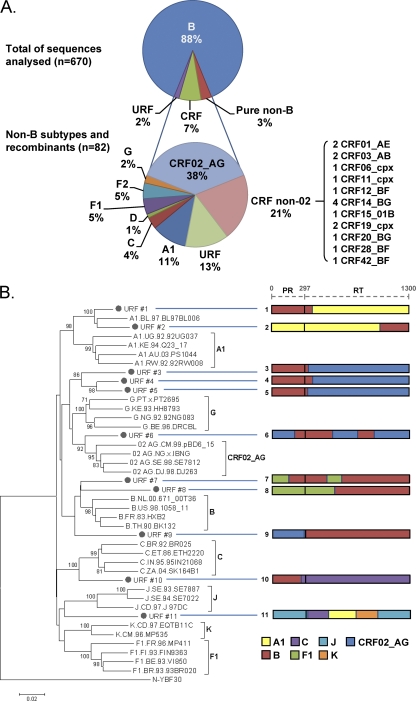
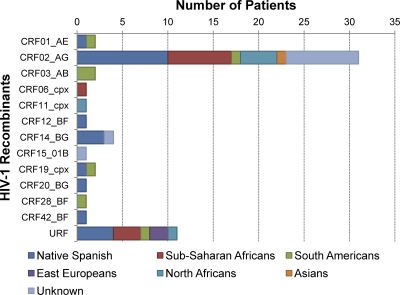
HIV-1 group M is classified into 9 subtypes, as well as recombinants favored by coinfection and superinfection events with different variants. Although HIV-1 subtype B is predominant in Europe, intersubtype recombinants are increasing in prevalence and complexity. In this study, phylogenetic analyses of pol sequences were performed to detect the HIV-1 circulating and unique recombinant forms (CRFs and URFs, respectively) in a Spanish cohort of antiretroviral treatment-naïve HIV-infected patients included in the Research Network on HIV/AIDS (CoRIS). Bootscanning and other methods were used to define complex recombinants not assigned to any subtype or CRF. A total of 670 available HIV-1 pol sequences from different patients were collected, of which 588 (87.8%) were assigned to HIV-1 subtype B and 82 (12.2%) to HIV-1 non-B variants. Recombinants caused the majority (71.9%) of HIV-1 non-B infections and were found in 8.8% of CoRIS patients. Eleven URFs (accounting for 13.4% of HIV-1 non-B infections), presenting complex mosaic patterns, were detected. Among them, 10 harbored subtype B fragments. Four of the 11 URFs were found in Spanish natives. A cluster of three B/CRF02_AG recombinants was detected. We conclude that complex variants, including unique recombinant forms, are being introduced into Spain through both immigrants and natives. An increase in the frequency of mosaic viruses, reflecting the increasing heterogeneity of the HIV epidemic in our country, is expected.
Figures
References
-
- Annaz HE, et al. 2011. Presence of drug resistance mutations among drug-naïve patients in Morocco. AIDS Res. Hum. Retroviruses 27: 917–920 - PubMed
-
- Baeten JM, et al. 2007. HIV-1 subtype D infection is associated with faster disease progression than subtype A in spite of similar plasma HIV-1 loads. J. Infect. Dis. 195: 1177–1180 - PubMed
-
- Brennan CA, Yamaguchi J, Devare SG, Foster GA, Stramer SL. 2010. Expanded evaluation of blood donors in the United States for human immunodeficiency virus type 1 non-B subtypes and antiretroviral drug-resistant strains: 2005 through 2007. Transfusion 50: 2707–2712 - PubMed
-
- Bruselles A, et al. 2009. Use of massive parallel pyrosequencing for near full-length characterization of a unique HIV type 1 BF recombinant associated with a fatal primary infection. AIDS Res. Hum. Retroviruses 25: 937–942 - PubMed
-
- Candotti D, et al. 2000. AIDS in an HIV-seronegative Ghanaian woman with intersubtype A/G recombinant HIV-1 infection. J. Med. Virol. 62: 1–8 - PubMed
Publication types
MeSH terms
Substances
LinkOut - more resources
Full Text Sources
Medical
