


Outcome of pulmonary rehabilitation in COPD patients with severely impaired health status
- PMID: 22162650
- PMCID: PMC3232171
- DOI: 10.2147/COPD.S24579
Outcome of pulmonary rehabilitation in COPD patients with severely impaired health status
Abstract
Introduction: Effects of pulmonary rehabilitation (PR) in chronic obstructive pulmonary disease (COPD) patients with severely impaired health status are poorly documented since these patients are usually excluded from clinical trials. This retrospective, observational study aims to study the impact of disease on health status and the effects of PR on COPD patients referred to a tertiary center for PR in The Netherlands.
Methods: Between June 2006 and June 2010, 437 patients with COPD were allocated to our intensive, comprehensive PR program. Patients participated in this interdisciplinary program for 12 weeks for a weekly average of 20-25 hours. Before and directly after, several measures of physical performance and health-related quality of life were determined.
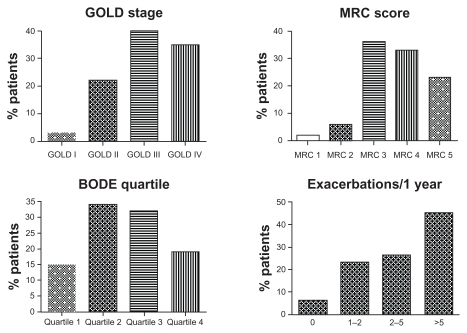
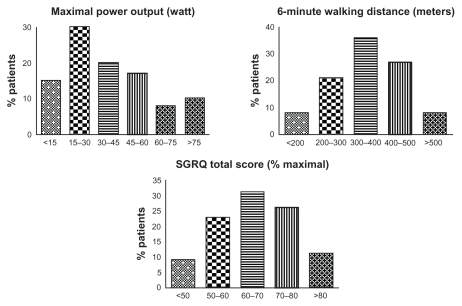
Results: At baseline, most patients (75%) had a Global Initiative for Chronic Obstructive Lung Disease (GOLD) stage of III-IV. Peak exercise performance on a cycle ergometer was on average reduced to 43 ± 29 Watt, and health-related quality of life was significantly impaired, with a total score on the St George's Respiratory Questionnaire (SGRQ) of 66. Health-care utilization in the year preceding PR was very high. After rehabilitation, all outcome measures improved statistically significantly (P < 0.001). Exercise performance measured with the 6 minute walking distance test improved clinically significantly in 68% of the patients, whereas 75% of the patients showed a clinically meaningful improvement in quality of life as measured with the SGRQ. Multiple regression analysis revealed that 19% of the variation in responses on the 6 minute walking distance test and the SGRQ could be explained on the basis of baseline characteristics.
Conclusion: The present study provides data to indicate that COPD patients may substantially benefit from rehabilitation in a tertiary pulmonary rehabilitation center, despite a severely impaired health status and high level of health-care utilization, in which prior treatment in primary and secondary care have failed to improve health status. Individual rehabilitation responses can only partially be predicted on the basis of baseline characteristics. Consequently, no firm conclusions can be drawn from this study with respect to the selection of candidates that could be deemed eligible for this rehabilitation program when entering the program.
Keywords: 6MWDT; BODE index; HRQL; SGRQ; pulmonary rehabilitation.
Figures
References
-
- Lahaije AJ, van Helvoort HA, Dekhuijzen PN, Heijdra YF. Physiologic limitations during daily life activities in COPD patients. Respir Med. 2010;104(8):1152–1159. - PubMed
-
- Reardon JZ, Lareau SC, Zuwallack R. Functional status and quality of life in chronic obstructive pulmonary disease. Am J Med. 2006;119(10 Suppl 1):32–37. - PubMed
-
- Man WD, Kemp P, Moxham J, Polkey MI. Exercise and muscle dysfunction in COPD: implications for pulmonary rehabilitation. Clin Sci (Lond) 2009;117(8):281–291. - PubMed
-
- Lacasse Y, Goldstein R, Lasserson TJ, Martin S. Pulmonary rehabilitation for chronic obstructive pulmonary disease. Cochrane Database Syst Rev. 2006;(4):CD003793. - PubMed
-
- Langer D, Hendriks E, Burtin C, et al. A clinical practice guideline for physiotherapists treating patients with chronic obstructive pulmonary disease based on a systematic review of available evidence. Clin Rehabil. 2009;23(5):445–462. - PubMed
MeSH terms
LinkOut - more resources
Full Text Sources
Medical
Research Materials
