


Exploiting the autofluorescent properties of photosynthetic pigments for analysis of pigmentation and morphology in live Fremyella diplosiphon cells
- PMID: 22163584
- PMCID: PMC3231140
- DOI: 10.3390/s100706969
Exploiting the autofluorescent properties of photosynthetic pigments for analysis of pigmentation and morphology in live Fremyella diplosiphon cells
Abstract
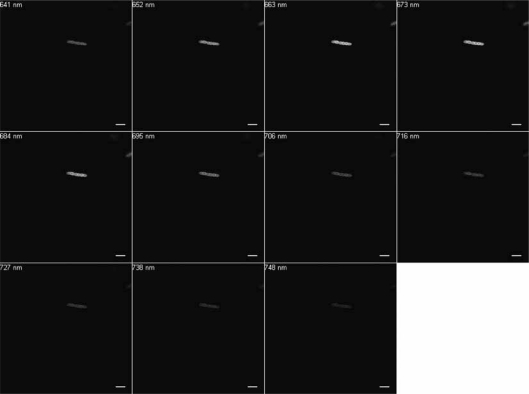
Fremyella diplosiphon is a freshwater, filamentous cyanobacterium that exhibits light-dependent regulation of photosynthetic pigment accumulation and cellular and filament morphologies in a well-known process known as complementary chromatic adaptation (CCA). One of the techniques used to investigate the molecular bases of distinct aspects of CCA is confocal laser scanning microscopy (CLSM). CLSM capitalizes on the autofluorescent properties of cyanobacterial phycobiliproteins and chlorophyll a. We employed CLSM to perform spectral scanning analyses of F. diplosiphon strains grown under distinct light conditions. We report optimized utilization of CLSM to elucidate the molecular basis of the photoregulation of pigment accumulation and morphological responses in F. diplosiphon.
Keywords: autofluorescence; confocal laser scanning microscopy; cyanobacteria; fluorescence imaging; light; microscopy; morphology; phycobiliproteins.
Figures




References
-
- Kehoe DM, Grossman AR. Similarity of a chromatic adaptation sensor to phytochrome and ethylene receptors. Science. 1996;273:1409–1412. - PubMed
-
- Terauchi K, Montgomery BL, Grossman AR, Lagarias JC, Kehoe DM. RcaE is a complementary chromatic adaptation photoreceptor required for green and red light responsiveness. Mol. Microbiol. 2004;51:567–577. - PubMed
-
- Grossman AR. A molecular understanding of complementary chromatic adaptation. Photosynth. Res. 2003;76:207–215. - PubMed
Publication types
MeSH terms
Substances
LinkOut - more resources
Full Text Sources
