


Experimental demonstration of masking phenomena between competing odorants via an air dilution sensory test
- PMID: 22163603
- PMCID: PMC3231180
- DOI: 10.3390/s100807287
Experimental demonstration of masking phenomena between competing odorants via an air dilution sensory test
Abstract
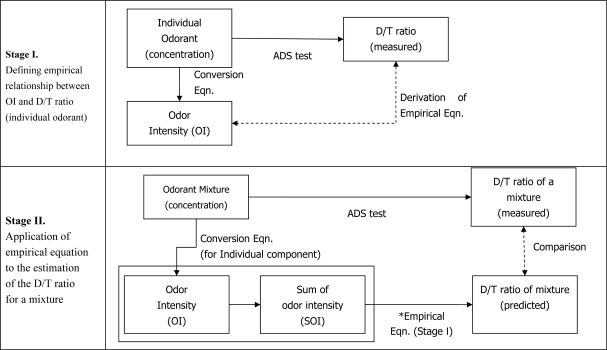
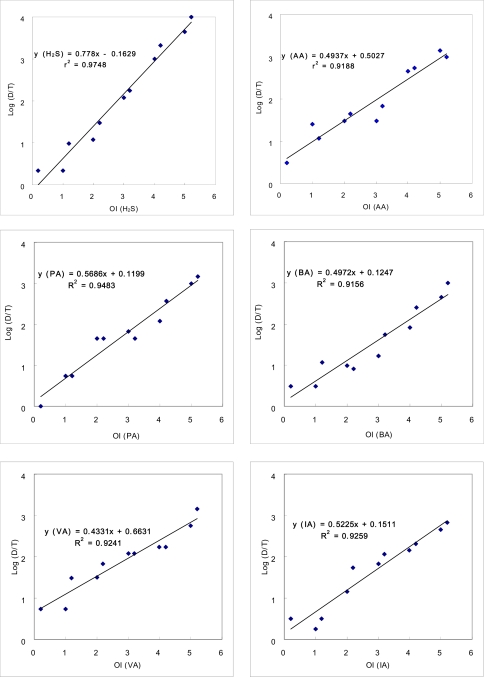
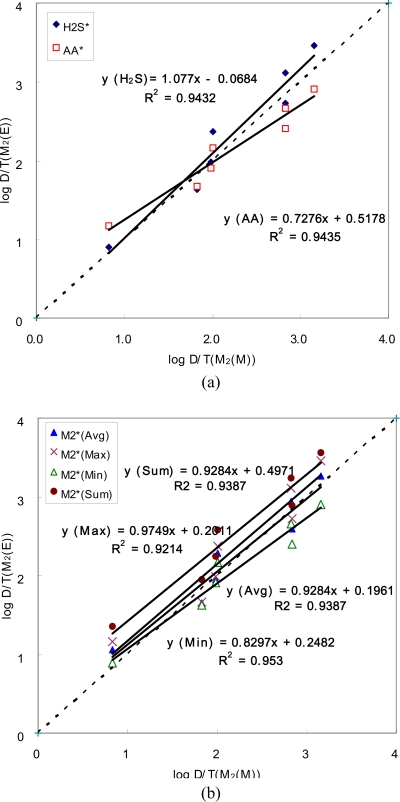
To simulate the occurrence of masking phenomena with the aid of an air dilution sensory (ads) test, two types of odorant mixtures were prepared: (1) M(2) with two individual odorants [H(2)S and acetaldehyde (AA)] and (2) M(6) with six individual odorants (H(2)S and five aldehydes). The test results derived for samples containing single individual odorants at a wide range of concentrations are initially used to define the empirical relationship between the dilution-to-threshold (D/T) ratio and odor intensity (OI) scaling. Based on these relationships, the D/T ratios were estimated for each odorant with the same intensity as the synthetic mixture. The relative contribution of each odorant to such mixture is then assessed by comparing the estimated and measured D/T values. This stepwise test confirmed the dominance of certain compounds at a given OI rating. In the case of M(2), H(2)S showed sensitive detection at high OI range, while AA did so at low end. The pattern of a competing relationship is also seen consistently from M(6) between AA (low) and iso-valeraldehyde (IA: high OI range). The overall results thus suggest that the masking phenomena between strong odorants should proceed under competing relationships, if released at the same time.
Keywords: acetaldehyde; dilution-to-threshold (D/T) ratio; human sensing; hydrogen sulfide; odor masking; threshold.
Figures

References
-
- Comett-Muniz JE, Cain WS, Abraham MH. Dose-addition of individual odorants in the odor detection of binary mixtures. Behav. Brain Res. 2003;138:95–105. - PubMed
-
- Smith BH. An analysis of interaction in binary odorant mixtures. Physiol. Behav. 1998;653:397–407. - PubMed
-
- Lawless HT. Descriptive analysis of complex odors: Reality, model or illusion? Food Qual. Preference. 1999;10:325–332.
-
- Chandra S, Smith BH. An analysis of synthetic processing of odor mixtures in the honeybee (Apis Mellifera) J. Exp. Biol. 1998;201:3113–3121. - PubMed
-
- Laing DG, Panhuber H, Slotnick BM. Odor masking in the rat. Physiol. Behav. 1989;45:689–694. - PubMed
Publication types
MeSH terms
Substances
LinkOut - more resources
Full Text Sources
